




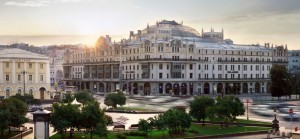
Prime Minister Alexis Tsipras woke up this morning to an exquisite view of Moscow’s Red Square as seen from the Metropol Hotel, where he and his wife are staying. The hotel, located in Moscow’s city center, opposite the Bolshoi Theater, is a 3-minute walk to the Kremlin.
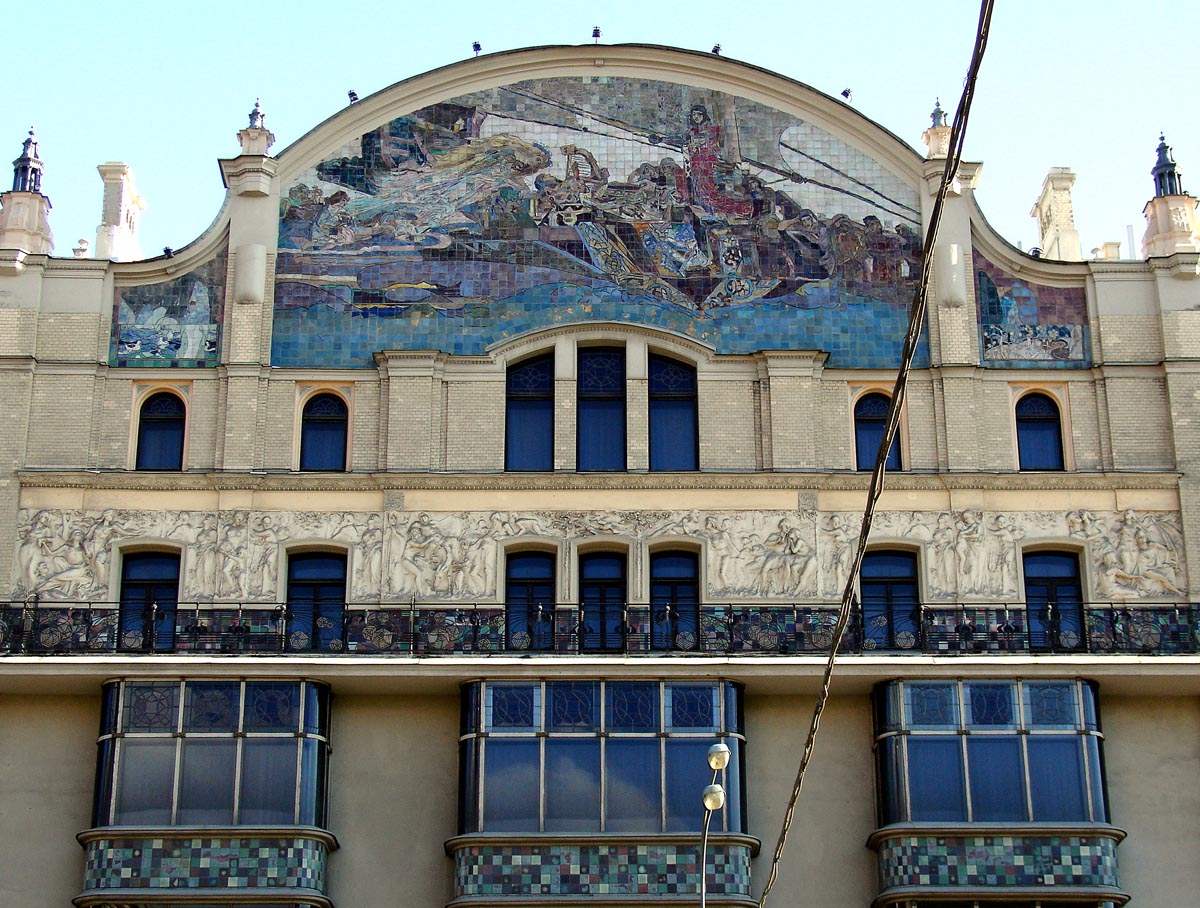
The 5-star luxury hotel was built in 1901 and has a rich history. Designed in 1901 by architect Savva Mamontov, the hotel is of the highest European standards. Mamontov gathered together young and talented artists and architects: Walcott, Vrubel, Kekushev and Chekhonin. The hotel building is an outstanding example of the modernist era, the Silver Age of Russian art (the end of the 19th – beginning of the 20th centuries).
Muscovites would come in crowds to see the “Tower of Babel of the 20th century”: that was how Hotel Metropol was called those days. None of the other hotels in Russia except the Metropol could boast of hot water, refrigerators, elevators and telephones. The rooms and restaurants were were the domain of Europe’s aristocracy and Moscow’s “best society”. The Metropol would often host famous industrialists (Morozov, Ryabushincky) and personalities of the arts and letters (Bryusov, Komissarzhevskaya, Shalyapin, Rakhmaninov).
In 1917, new masters came to Hotel Metropol carrying guns and swords. The Bolshevist government moved from Petrograd (former St. Petersburg) to Moscow, and Hotel Metropol was turned into the residence of the All-Russian Central Executive Committee (RCEC). It was then called the Second House of Soviets. Chicherin, Sverdlov, and Bukharin lived and worked at the Metropol.
In the 1930s the Metropol was reverted to its original status as a top-class hotel. If the Soviet government wished to win the favor of foreign guests, among them Bernard Shaw and Bertold Brecht, it would usually accommodate them in the Metropol. During the World War II correspondents of Western newspapers and magazines prevailed among the hotel’s guests, and a press center was organized at the hotel. In the mid-1950s “the Khrushchev Thaw” set in.
More and more foreign visitors would come to Moscow and stay at the Metropol. Ordinary Soviet citizens would not stay at the hotel as a rule, although there was a 70-bed hostel for those coming on business trips. The payments in some hotel bars and restaurants were made in hard currency only, i.e. those places were mostly frequented by foreigners. The years were passing by – and Hotel Metropol was growing old and ramshackle.
In 1986, it was closed for renovation. After the long debate on the renovation concept the architects found the golden mean: it was decided to reconstruct Metropol using the old drawings while at the same time equipping it with the latest technological standards. Metropol owes its second birth to concerted efforts of Russian and Finnish architects, engineers, and artists. The perestroika period in the USSR (1985-1991) coincided with the Metropol renovation period (1986-1991). The Hotel was closed for renovation back in the USSR, but opened in 1991 establishing itself as one of the best hotels in the new Russia. Foreign commissions were right in their high appraisal of the restored splendor of this historical hotel as well as of its highly-qualified staff. The Metropol received the highest hotel rank – a five-star distinction. In 2001, Hotel Metropol celebrates two significant dates: its centennial, and 10 years after it has been fully renovated. The prominent Russian stage director Konstantin Stanislavsky used to say that “a theater starts with a cloakroom”. To rephrase, it is possible to say that a city starts with a hotel.
Hotel Metropol has rightfully become a symbol of Moscow for many foreign tourists and businesspeople. Some of Moscow’s old buildings indeed possess a magnetism of the kind. They attract events; within their precincts human fates have been intertwined; they become a part of the history. The one of such buildings is Hotel Metropol. Besides fulfilling the responsibilities of a hotel at large, the Metropol carries out a mission of a “historic hotel”, a hotel-museum. Everyone who visits the Metropol will have a glimpse of Russian history and culture, and the staff of the hotel will do their best to make the guests feel at home. On October 22nd, 2001, in Geneva’s Hotel Intercontinental the Business Initiative Directions (BID) company held a ceremony where the International Star Awards were presented. The BID’S Selection Board presented an International Star Award to Hotel Metropol for quality in the category Gold. The Metropol’s prestige has been recognized worldwide by the diplomatic and business circles, economic experts, company quality and image specialists, cultural and artistic figures. The Metropol is the only Russian hotel presented with such a high award, setting it apart as one of the best hotels in Russia.
The cost of a simple room is at 250 euros per night and 1,200 euros for a suite.


Ask me anything
Explore related questions