

×
GreekEnglish

×
  • Politics
  • Diaspora
  • World
  • Lifestyle
  • Travel
  • Culture
  • Sports
  • Cooking
Monday
12
Jan 2026
weather symbol
Athens 6°C
  • Home
  • Politics
  • Economy
  • World
  • Diaspora
  • Lifestyle
  • Travel
  • Culture
  • Sports
  • Mediterranean Cooking
  • Weather
Contact follow Protothema:
Powered by Cloudevo
> technology

We’re closer to robots than you think

Intelligence could be the product of a basic algorithm

Newsroom May 17 12:29

THEORY OF CONNECTIVITY

The human brain is the most sophisticated organ in the human body. The things that the brain can do, and how it does them, have even inspired a model of artificial intelligence (AI). Now, a recent study published in the journal Frontiers in Systems Neuroscience shows how human intelligence may be a product of a basic algorithm.

This algorithm is found in the Theory of Connectivity, a “relatively simple mathematical logic underlies our complex brain computations,” according to researcher and author Joe Tsien, neuroscientist at the Medical College of Georgia at Augusta University, co-director of the Augusta University Brain and Behavior Discovery Institute and Georgia Research Alliance Eminent Scholar in Cognitive and Systems Neurobiology. He first proposed the theory in October 2015.

Basically, it’s a theory about how the acquisition of knowledge, as well as our ability to generalize and draw conclusions from them, is a function of billions of neurons assembling and aligning. “We present evidence that the brain may operate on an amazingly simple mathematical logic,” Tsien said.
b

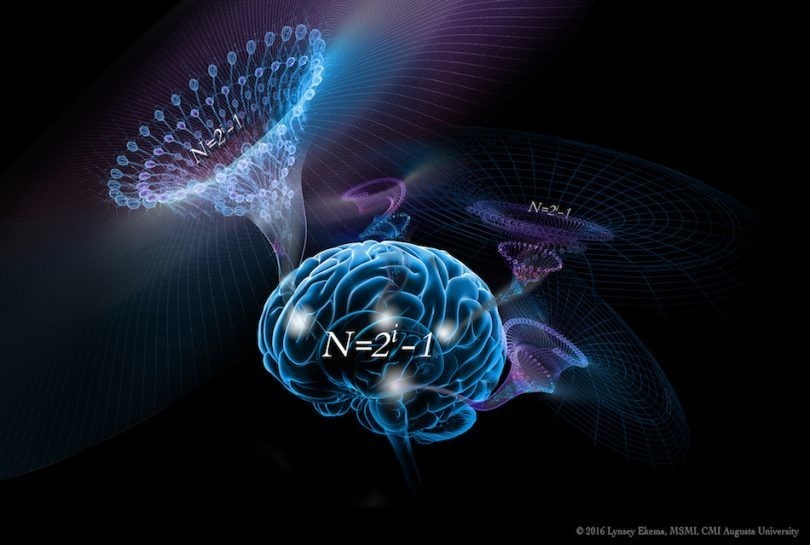
The theory describes how groups of similar neurons form a complexity of cliques to handle basic ideas or information. These groups cluster into functional connectivity motifs (FCM), which handles every possible combinations of ideas. More cliques are involved in more complex thoughts.

In order to test it, Tsien and his team monitored and documented how the algorithm works in seven different brain regions, each involved in handling basics like food and fear in mice and hamsters. The algorithm represented how many cliques are necessary for an FCM, a power-of-two-based permutation logic (N=2i–1), according to the study.

>Related articles

From Tesla to Disney, 4 companies are preparing humanoid robots for the market: What they can do, how much they will cost

AI Cameras begin recording traffic violations: where they are in Attica

25,000 public sector employees will receive bonuses of up to €2,000 this year, based on evaluation using Artificial Intelligence

They gave the animals various combinations of four different foods (rodent biscuits, pellets, rice, and milk). Using electrodes placed at specific areas of the brain, they were able to “listen” to the neurons’ response. The scientists were able to identify all 15 different combinations of neurons or cliques that responded to the assortment of food combinations, as the Theory of Connectivity would predict. Furthermore, these neural cliques seem prewired in the brain, as they appeared immediately as soon as the food choices did.

If the intelligence in the human brain, in all its complexity, can be summed up by a particular algorithm, imagine what it means for AI. It is possible, then, for the same algorithm to be applied to how AI neural networks work, as these already mimic the brain’s structural wiring.

Source

Ask me anything

Explore related questions

#algorithms#artificial intelligence#computers#logic#Neurobiology#robots#Theory of Connectivity
> More technology

Follow en.protothema.gr on Google News and be the first to know all the news

See all the latest News from Greece and the World, the moment they happen, at en.protothema.gr

> Latest Stories

Pierrakakis to Tasoula: Greece has increased authority in decision-making at the European level

January 12, 2026

The first snow fell on Parnitha, see impressive photos

January 12, 2026

Bloomberg: Britain and Germany discuss the presence of NATO forces in Greenland

January 12, 2026

JPMorgan: Greek bonds passed the convergence test, and investors are repositioning

January 12, 2026

Who are the Basij militias who are spreading terror among protesters in Iran?

January 12, 2026

Marinakis: There will be two meetings with farmers, the Prime Minister cannot work with ultimatums

January 12, 2026

St Nicholas Greek Orthodox Church: Feeding the Homeless – Sunday, January 18

January 12, 2026

Who is Maria Gratsia, the right hand of Maria Karystianou

January 12, 2026
All News

> Economy

JPMorgan: Greek bonds passed the convergence test, and investors are repositioning

Greek bonds are now treated as securities that have completed most of their investment upgrade - They retain their role as a stable, but no longer "one-dimensionally attractive" tool in eurozone portfolios

January 12, 2026

Rent reimbursement: On 15 January, the money is credited to the beneficiaries

January 12, 2026

AADE: Six new digital “weapons” against tax evasion in 2026

January 11, 2026

Opening access to a market of 300 million consumers for Greek products through the EU–Mercosur agreement: Benefits for olive oil, cheeses, kiwifruit, peaches and bakery products

January 10, 2026

JP Morgan: STOXX will upgrade Greece this year – Which stocks will see significant inflows

January 9, 2026
Homepage
PERSONAL DATA PROTECTION POLICY COOKIES POLICY TERM OF USE
Powered by Cloudevo
Copyright © 2026 Πρώτο Θέμα