





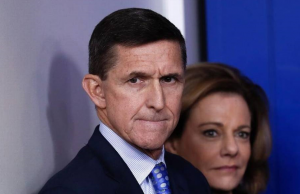
One of the Trump administration’s first decisions about the fight against the Islamic State was made by Michael Flynn weeks before he was fired – and it conformed to the wishes of Turkey, whose interests, unbeknownst to anyone in Washington, he’d been paid more than $500,000 to represent.
The decision came 10 days before Donald Trump had been sworn in as president, in a conversation with President Barack Obama’s national security adviser, Susan Rice, who had explained the Pentagon’s plan to retake the Islamic State’s de facto capital of Raqqa with Syrian Kurdish forces whom the Pentagon considered the U.S.’s most effective military partners. Obama’s national security team had decided to ask for Trump’s sign-off, since the plan would all but certainly be executed after Trump had become president.
Flynn didn’t hesitate. According to timelines distributed by members of Congress in the weeks since, Flynn told Rice to hold off, a move that would delay the military operation for months.
If Flynn explained his answer, that’s not recorded, and it’s not known whether he consulted anyone else on the transition team before rendering his verdict. But his position was consistent with the wishes of Turkey, which had long opposed the United States partnering with the Kurdish forces – and which was his undeclared client.
Trump eventually would approve the Raqqa plan, but not until weeks after Flynn had been fired.
Now members of Congress, musing about the tangle of legal difficulties Flynn faces, cite that exchange with Rice as perhaps the most serious: acting on behalf of a foreign nation – from which he had received considerable cash – when making a military decision. Some members of Congress, in private conversations, have even used the word “treason” to describe Flynn’s intervention, though experts doubt that his actions qualify.
But treason or not, Flynn’s rejection of a military operation that had been months in the making raises questions about what other key decisions he might have influenced during the slightly more than three weeks he was Trump’s national security adviser, and the months he was Trump’s primary campaign foreign-policy adviser.
Even three months after he was fired, for lying to Vice President Mike Pence about a call with Russian Ambassador Sergey Kislyak, his role in the White House resonates.
With word that the president may have asked FBI Director James Comey to drop any criminal probe of Flynn – failure to register as a foreign agent is a federal crime – there is renewed focus on getting to the bottom of what Flynn did, and what Trump knew.
Despite the Trump administration’s attempts to downplay the red flags, it is becoming increasingly apparent that the administration was repeatedly warned about Flynn’s foreign involvement.
“This was a serious compromise situation that the Russians had real leverage,” former acting Attorney General Sally Yates said in an interview with CNN on Tuesday, after White House Press Secretary Sean Spicer downplayed her warning about Flynn’s interactions with Russian officials as just “a heads up.”
Flynn’s actions were also the subject of discussion just last week at a Senate Intelligence Committee hearing on national security threats, with Sen. Ron Wyden, D-Ore., zeroing in on the 18 days that passed between Yates’ warning that Flynn might be subject to Russian blackmail and Flynn’s forced resignation.
“Blackmail, by an influential military official, that has real ramifications for global threat,” he said. “So this is not about a policy implication, this is about the national security adviser being vulnerable to blackmail by the Russians.”
Flynn’s connections to Russia have been widely discussed. In 2015, he was paid more than $33,000 to speak at a gala dinner in Moscow where he was seated next to President Vladimir Putin. That alone may have exposed him to criminal charges: As a retired U.S. military officer, Flynn was required to seek permission to travel and to receive payment from a foreign entity, something the State Department and the Pentagon have told Congress he did not do.
But it is his paid work on Turkey’s behalf that offers the clearest evidence of his role as a foreign agent – and of his legal problems, since he did not declare his foreign agent status till weeks after he’d left the Trump administration.
After he was fired, Flynn disclosed work as foreign agent
It was a fact Flynn disclosed himself in a declaration to the Foreign Agent Registration Unit of the Justice Department in early March. According to Flynn’s paperwork, he was paid $530,000 for work that “could be construed to have principally benefited the Republic of Turkey.” The contract ended last November.
Under the Foreign Agent Registration Act, U.S. citizens who lobby on behalf of foreign governments or political entities must disclose their work to the Justice Department within 10 days.
Ekim Alptekin, the Turkish businessman whose company paid Flynn, disputes that he was “taking directions from anyone in the government” of Turkey. But Flynn’s filing shows he set up a meeting with Turkey’s foreign minister, Mevlut Cavusoglu, and energy minister, Berat Albayrak, who is President Recep Tayyip Erdogan’s son-in-law, at a New York hotel last September.
As then-candidate Trump’s national security adviser, Flynn sat in on classified briefings in the summer and fall of 2016. According to the filing, he signed the contract with Alptekin’s firm on Aug. 9. Trump received his first classified intelligence briefing on Aug. 18 – a meeting that Flynn attended. As Trump’s national security adviser in the White House, Flynn had access to even more highly classified intelligence. He sat in on most, if not all, of Trump’s phone conversations and meetings with foreign leaders.
How much Trump knew about Flynn’s paid foreign-agent work is uncertain. When Flynn’s firm filed the Justice Department paperwork in March, the White House said Trump was unaware that Flynn had been paid to lobby on Turkey’s behalf. But Flynn’s lawyer has said he called Trump’s transition team before the inauguration, asking whether Flynn should register as a foreign agent.
Met w/General Flynn,who will assume the position of National Security Advisor, and other officials at a working breakfast in Washington D.C.
— Mevlüt Çavuşoğlu (@MevlutCavusoglu) January 18, 2017
When asked why the call had not been an obvious indication to act quickly, the White House tried to smooth it over by saying their legal counsel had considered it a private decision the transition team should not get involved in.
Read the rest of the article HERE
Ask me anything
Explore related questions


