





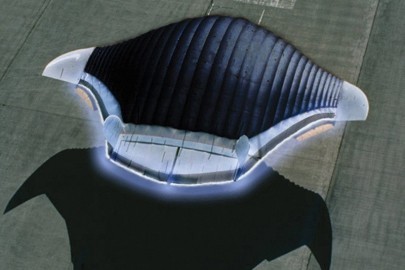
Forget fuel-powered jet engines. We’re on the verge of having aircraft that can fly from the ground up to the edge of space using air and electricity alone.
Traditional jet engines create thrust by mixing compressed air with fuel and igniting it. The burning mixture expands rapidly and is blasted out of the back of the engine, pushing it forwards.
Instead of fuel, plasma jet engines use electricity to generate electromagnetic fields. These compress and excite a gas, such as air or argon, into a plasma – a hot, dense ionised state similar to that inside a fusion reactor or star.
Plasma engines have been stuck in the lab for the past decade or so. And research on them has largely been limited to the idea of propelling satellites once in space.
Berkant Göksel at the Technical University of Berlin and his team now want to fit plasma engines to planes. “We want to develop a system that can operate above an altitude of 30 kilometres where standard jet engines cannot go,” he says. These could even take passengers to the edge of the atmosphere and beyond.
The challenge was to develop an air-breathing plasma propulsion engine that could be used for take-off as well as high-altitude flying.
Plasma jet engines tend to be designed to work in a vacuum or the low pressures found high in the atmosphere, where they would need to carry a gas supply. But now Göksel’s team has tested one that can operate on air at a pressure of one atmosphere (Journal of Physics Conference Series, doi.org/b66g). “We are the first to produce fast and powerful plasma jets at ground level,” says Göksel. “These jets of plasma can reach speeds of up to 20 kilometres a second.”
The team used a rapid stream of nanosecond-long electric discharges to fire up the propulsion mixture. A similar technique is used in pulse detonation combustion engines, making them more efficient than standard fuel-powered engines.
It’s the first time anyone has applied pulse detonation to plasma thrusters. Jason Cassibry at the University of Alabama in Huntsville is impressed. “It could greatly extend the range of any aircraft and lower the operational cost,” he says.
But there are several hurdles to overcome before the technology can propel an actual plane. For a start, the team tested mini thrusters 80 millimetres long, and a commercial airliner would need some 10,000 of them to fly, which makes the current design too complex for aircraft of that size. Göksel’s team plans to target smaller planes and airships for now. Between 100 and 1000 thrusters would be enough for a small plane, which the team thinks is feasible.
The biggest limitation, though, is the lack of lightweight batteries. A huge amount of electricity is required to generate and sustain the plasma. “An array of thrusters would require a small electrical power plant, which would be impossible to mount on an aircraft with today’s technology,” says Dan Lev from the Technion-Israel Institute of Technology. The power supply is also a barrier to making the individual thrusters bigger. Doing so would reduce the number needed to propel a plane, but each would require more power.
Göksel is hoping for a breakthrough in compact fusion reactors to power his system. Other possible options could be solar panels or beaming power wirelessly to the engines, he says.
In the meantime, he is looking into hybrid planes, in which his plasma engine would be combined with pulse detonation combustion engines or rockets to save on fuel.
Ask me anything
Explore related questions