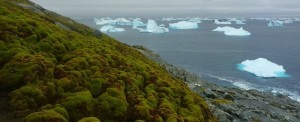
Researchers in Antarctica have discovered rapidly growing banks of mosses on the ice continent’s northern peninsula, providing striking evidence of climate change in the coldest and most remote parts of the planet.
Amid the warming of the last 50 years, the scientists found two different species of mosses undergoing the equivalent of growth spurts, with mosses that once grew less than a millimetre per year now growing over 3 millimetres per year on average.
“People will think of Antarctica quite rightly as a very icy place, but our work shows that parts of it are green, and are likely to be getting greener,” said Matthew Amesbury, a researcher with the University of Exeter in the UK, and lead author of the new study.
“Even these relatively remote ecosystems, that people might think are relatively untouched by human kind, are showing the effects of human induced climate change.”
The study was published Thursday in Current Biology, by Amesbury and colleagues with the University of Cambridge, the British Antarctic Survey and the University of Durham.
Less than 1 percent of present-day Antarctica features plant life. But in parts of the peninsula, Antarctic mosses grow on frozen ground that partly thaws in the summer – when only about the first foot of soil ever thaws.
The surface mosses build up a thin layer in the summer, then freeze over in winter. As layer builds on top of layer, older mosses subside below the frozen ground, where they are remarkably well preserved due to the temperatures.
Amesbury said that made them “a record of changes over time”.
Soil samples from a 400-mile (640-km) area along the northern part of the Antarctic peninsula found dramatic changes in growth patterns going back 150 years.
The Antarctic peninsula has been a site of rapid warming, with more days a year where temperatures rise above freezing. The consequence, the study found, was a four- to five-fold increase in the amount of moss growth in the most recent part of the record.
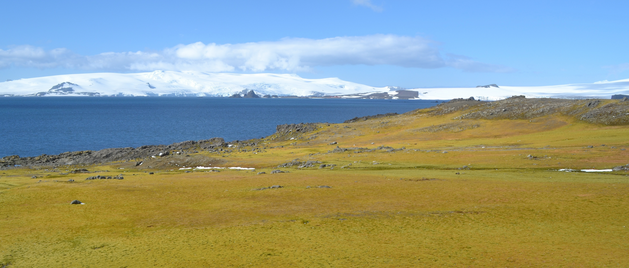
Photos taken by the authors during the research also captured some strikingly green Antarctic landscapes, like this one on Green Island:
“This is another indicator that Antarctica is moving backward in geologic time – which makes sense, considering atmospheric CO2 levels have already risen to levels that the planet hasn’t seen since the Pliocene, 3 million years ago, when the Antarctic ice sheet was smaller, and sea-levels were higher,” said Rob DeConto, a glaciologist at the University of Massachusetts, Amherst, who was not involved in the study but reviewed it for The Washington Post.
“If greenhouse gas emissions continue unchecked, Antarctica will head even further back in geologic time… perhaps the peninsula will even become forested again someday, like it was during the greenhouse climates of the Cretaceous and Eocene, when the continent was ice-free,” DeConto continued by email.
The authors agree the current observed changes are probably just the beginning.
“These changes, combined with increased ice-free land areas from glacier retreat, will drive large-scale alteration to the biological functioning, appearance, and landscape of the [Antarctic peninsula] over the rest of the 21st century and beyond,” they wrote.
The moss growth is still modest compared to what’s happening in the Arctic, where a large-scale greening trend has even been captured by satellite. In the Arctic, there’s now so much plant growth that some scientists are hoping it will at least partially offset the loss of carbon from thawing permafrost beneath those plants.
Those days are probably very far off for the Antarctic, but it’s clear the continent used to be a very different landscape.
“We’re starting back on a journey towards that sort of environment,” said Amesbury. “Certainly, Antarctica has not always been the ice place it has been now on very long timescales.”
Ask me anything
Explore related questions