





Two potentially habitable “super-Earths” orbit a star just 12 light years away that is our nearest sun-like neighbour, scientists have discovered.
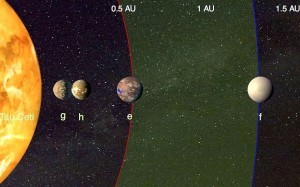
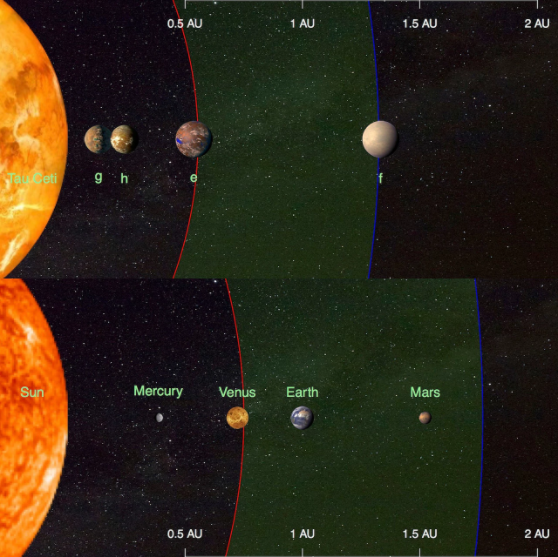
The worlds at the edges of Tau Ceti’s “habitable zone” belong to a solar system of four rocky planets similar in size to Earth.
British-led astronomers speculate that the system might be a potential candidate for future interstellar colonisation.
But life on the new outposts may be far from peaceful. There is evidence of a massive debris disc circling the star, increasing the chances of the planets being pounded by asteroids and comets.
A key aspect of the discovery was the detection of exoplanets with masses as low as 1.7 times the Earth’s, making them the smallest worlds ever spotted around a sun-like star.
The scientists used the “wobble” method of planet finding that measures the influence of gravitational interaction on a star.
As a planet orbits, it causes its parent star to wobble by a tiny degree. Astronomers can see the signature of this effect in the star’s light.
Lead researcher Dr Fabo Feng, from the University of Hertfordshire, said: “We’re getting tantalisingly close to observing the correct limits required for detecting Earth-like planets.
“Our detection of such weak wobbles is a milestone in the search for Earth analogues and the understanding of the Earth’s habitability through comparison with these.”
Sun-like stars hold out the best hope of finding planets beyond the solar system that host life. Tau Ceti, a favourite destination of science fiction writers, is very similar to the sun both in size and brightness.
Like the sun, it has a “habitable zone”, a narrow region around it where conditions are favourable for Earth-like life.
Within the habitable, or “Goldilocks” zone, temperatures are not too hot or too cold but just right for surface water to exist as a liquid. A habitable zone planet could have oceans, lakes and rivers.
Neither of Tau Ceti’s “super-Earths” lie in the centre of its habitable zone. One orbits on the inner border and the other on the outer. The Earth is situated halfway between the middle of the sun’s habitable zone and its inner boundary.

The astronomers analysed starlight wavelength data obtained from the European Southern Observatory in Chile and the Keck observatory on Mauna Kea, Hawaii. Their findings are to be published in the Astronomical Journal.
Co-author Dr Mikko Tuomi, also from the University of Hertfordshire, said improved techniques were making it easier to distinguish between light signals caused by the presence of planets and stellar activity.
Two Tau Ceti signals previously identified in 2013 were now known not to have a planetary origin.
“But no matter how we look at the star, there seems to be at least four rocky planets orbiting it,” Dr Tuomi said.
“We’re slowly learning to tell the difference between wobbles caused by planets and those caused by stellar active surface.
“This enabled us to verify the existence of the two outer, potentially habitable, planets in the system.”
Ask me anything
Explore related questions