×
GreekEnglish

×
  • Politics
  • Diaspora
  • World
  • Lifestyle
  • Travel
  • Culture
  • Sports
  • Cooking
Friday
16
Jan 2026
weather symbol
Athens 15°C
  • Home
  • Politics
  • Economy
  • World
  • Diaspora
  • Lifestyle
  • Travel
  • Culture
  • Sports
  • Mediterranean Cooking
  • Weather
Contact follow Protothema:
Powered by Cloudevo
> technology

A giant exoplanet is hiding at the center of the Milky Way galaxy

The exoplanet has been given the clunky label OGLE-2016-BLG-1190Lb

Newsroom November 8 07:22


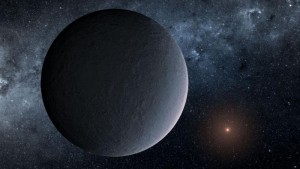
Scientists have spotted a gigantic exoplanet that they believe is hiding deep at the center of the Milky Way, about 22,000 light-years away from Earth, a large team is reporting in a paper recently posted on the physics pre-print server arxiv and submitted to The Astrophysical Journal.

The new planet orbits a star a little smaller than our own sun at about twice the distance that Earth orbits the sun. The exoplanet has been given the clunky label OGLE-2016-BLG-1190Lb, but don’t let the name bore you. It’s a little bigger than 13 Jupiters smooshed together, which means that for a planet, it’s really, really big—in fact, it may actually be large enough to be a tiny little star, what’s called a brown dwarf, instead.

Brown dwarfs are less charitably known as “failed stars” since they don’t actually have a stellar oven at their heart creating energy by fusing together atoms. But they’re still classified as a star because they produce light. The boundary between planet and brown dwarf falls right at 13 Jupiter masses, so given the scientists’ uncertainty about the new object’s precise size, it’s having a bit of an identity crisis.

But the scientists are actually less intrigued by its precise size than by how it formed: Traditionally, the things we call planets formed by lumps of stuff sticking together in a disk around a star, whereas stars are formed by a giant cloud of gas breaking down into stars.

Astronomers are particularly intrigued by the new planet because it is tucked deep in the heart of the Milky Way, in what’s called the galactic bulge. Usually, it’s hard to spot planets in this region since they’re tens of thousands of light-years away and don’t produce light.

>Related articles

Elon Musk: Don’t save for retirement – It won’t matter

Erich von Däniken, Swiss bestselling author who linked ancient civilizations to extraterrestrials, dies at 90

Sick astronaut on mission – NASA considers early return of International Space Station crew

The scientists were able to spot the planet by using a technique called microlensing, the only approach that allows them to spot planets deep in the galaxy’s heart. If a very large cosmic object with a very strong gravity, like a star, lies between Earth and a target, it bends the light of the distant object. That pattern varies when the distant star is accompanied by a planet. So scientists are able to work backward from what they know of the distant star and how its light changes to figure out precisely what’s coming between it and Earth.

NASA’s Spitzer Space Telescope, which has been chasing Earth in orbit around the sun for 14 years, has helped spot exoplanets before using the same microlensing technique.

Source: yahoo.com

Ask me anything

Explore related questions

#astronomy#brown dwarfs#center#discovery#distance#earth#exoplanets#galaxy#giant#hiding#journal#Milky Way#nasa#orbit#planets#science#space#space exploration#star#technology#telescopes
> More technology

Follow en.protothema.gr on Google News and be the first to know all the news

See all the latest News from Greece and the World, the moment they happen, at en.protothema.gr

> Latest Stories

The historic cafes of Athens: 12 legendary hangouts lost to time

January 16, 2026

Why seasonal flu is so “aggressive” this year: An infectious disease specialist from “Sotiria” explains the two main causes

January 16, 2026

Mitsotakis attends the inauguration of the renovated Emergency Department at Red Cross Hospital

January 16, 2026

Where insects go in winter

January 16, 2026

Zelensky: If an agreement is reached, we are ready to sign even next week

January 16, 2026

Actress Melpo Zarokosta dies at 93

January 16, 2026

11 Iconic meze dishes from Volos

January 16, 2026

Sports broadcasts: Where to watch the Conference League play-off draw, the derby in volleyball, and the EuroLeague

January 16, 2026
All News

> Greece

Why seasonal flu is so “aggressive” this year: An infectious disease specialist from “Sotiria” explains the two main causes

“Internationally, this year there is a relative severity in the flu epidemic, and far fewer people have been vaccinated,” says internist–infectious disease specialist Eleni Kakalou

January 16, 2026

Study in Greece: International students apply for a place in Greek universities through a single platform

January 16, 2026

Users on X respond to Rama’s comments on whether modern Greeks are descendants of the ancient Greeks

January 16, 2026

Cold wave from Ukraine to hit Greece: Temperatures drop to 10°C, Gale-Force winds in the Aegean and Ionian Seas

January 16, 2026

Mercosur agreement sparks concern over olive export tariffs: Greek and European producers face 12.6% duty

January 16, 2026
Homepage
PERSONAL DATA PROTECTION POLICY COOKIES POLICY TERM OF USE
Powered by Cloudevo
Copyright © 2026 Πρώτο Θέμα