
×
GreekEnglish

×
  • Politics
  • Diaspora
  • World
  • Lifestyle
  • Travel
  • Culture
  • Sports
  • Cooking
Sunday
18
Jan 2026
weather symbol
Athens 6°C
  • Home
  • Politics
  • Economy
  • World
  • Diaspora
  • Lifestyle
  • Travel
  • Culture
  • Sports
  • Mediterranean Cooking
  • Weather
Contact follow Protothema:
Powered by Cloudevo
> Economy

Economist: Greece exits its bail-out programme, but its marathon has further to go

Growth is disappointing, article points out

Newsroom August 3 08:28

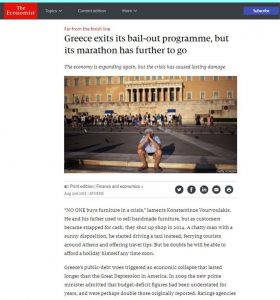
The Economist magazine underlines that despite Greece exiting its bailout programme, the country is a long way from returning to normality. In a piece entitled “Greece exits its bail-out programme, but its marathon has further to go”, the article points out that growth is disappointing while doing business in Greece is very difficult.

Form The Economist:

“NO ONE buys furniture in a crisis,” laments Konstantinos Vourvoulakis. He and his father used to sell handmade furniture, but as customers became strapped for cash, they shut up shop in 2014. A chatty man with a sunny disposition, he started driving a taxi instead, ferrying tourists around Athens and offering travel tips. But he doubts he will be able to afford a holiday himself any time soon.
Greece’s public-debt woes triggered an economic collapse that lasted longer than the Great Depression in America. In 2009 the new prime minister admitted that budget-deficit figures had been understated for years, and were perhaps double those originally reported. Ratings agencies downgraded its debt. Interest rates surged. In 2010 the government turned to the euro zone and the IMF for help. Their loans had strings attached: that Greece implement deep spending cuts and structural reforms.

>Related articles

President of Air Traffic Controllers: Another communications blackout possible in the near future

X is down, thousands report problems

Less alcohol and lower speeds with the new Highway Code and strict fines

On August 20th Greece exits the last of three bail-out packages. Both its creditors and its government think its public finances have improved enough for it to borrow from the markets again. Debt relief agreed on in June helps cushion its return. The maturity of some loans has been extended, and interest-rate relief offered on others. A cash buffer of €24bn, enough to cover nearly two years of Greece’s funding needs, should also reassure investors.


But the public finances and economy have miles to go before they reach normality. Public spending is still severely restrained. The Greek government has signed up to exceedingly ambitious targets: primary surpluses (that is, excluding interest payments) of 3.5% of GDP until 2022—which only a few non-oil-producing countries have achieved in the past 30 years—and an average of 2.2% until 2060. In the early years, creditors will monitor progress every quarter.
Euclid Tsakalotos, the finance minister, is confident that Greece will beat these targets, freeing up budgetary space for tax cuts and greater investment and social spending. But Greece’s public-debt burden of 180% of GDP means that creditors’ faith in the public finances is vulnerable to missed targets, slow growth or a sharp rise in interest rates. In a report released on July 31st the IMF said that further debt relief might be needed.

read more at economist.com

Ask me anything

Explore related questions
#bailout programme#Economist#greece#growth
> More Economy

Follow en.protothema.gr on Google News and be the first to know all the news

See all the latest News from Greece and the World, the moment they happen, at en.protothema.gr

> Latest Stories

War, diplomacy, or insurrection: What’s next in Iran

January 17, 2026

New tensions in the Middle East as Trump invites regional leaders to the Gaza Peace Council

January 17, 2026

Weather: A return to winter in the coming days – Cold and strong northerly winds – Kolydas’ post

January 17, 2026

A view of Nikolaos Stasinopoulos of Viohalco – The “enduring imprint” of Greece’s greatest industrialist

January 17, 2026

The horror of the “Tariff of the Dead”: how the Iranian regime prices the bodies of protesters

January 17, 2026

Mitsotakis on the Karystianou party: “There is a long distance between being the parent of a tragedy victim and being the leader of a political party”

January 17, 2026

Patras in carnival mode – This evening, the city’s official opening ceremony

January 17, 2026

Greenland as the first line ofdefense for the U.S. and NATO:

January 17, 2026
All News

> World

War, diplomacy, or insurrection: What’s next in Iran

The Iranian regime faces the most serious threat to its survival, despite the repression of protests - The possibility of a US strike remains on the table - The landscape for the next day is blurred

January 17, 2026

New tensions in the Middle East as Trump invites regional leaders to the Gaza Peace Council

January 17, 2026

The horror of the “Tariff of the Dead”: how the Iranian regime prices the bodies of protesters

January 17, 2026

Greenland as the first line ofdefense for the U.S. and NATO:

January 17, 2026

Changes at top universities: Oxford abolishes the term ‘doctores’ for inclusion reasons

January 17, 2026
Homepage
PERSONAL DATA PROTECTION POLICY COOKIES POLICY TERM OF USE
Powered by Cloudevo
Copyright © 2026 Πρώτο Θέμα