

×
GreekEnglish

×
  • Politics
  • Diaspora
  • World
  • Lifestyle
  • Travel
  • Culture
  • Sports
  • Cooking
Friday
16
Jan 2026
weather symbol
Athens 12°C
  • Home
  • Politics
  • Economy
  • World
  • Diaspora
  • Lifestyle
  • Travel
  • Culture
  • Sports
  • Mediterranean Cooking
  • Weather
Contact follow Protothema:
Powered by Cloudevo
> World

Feeding the Gods: Hundreds of skulls reveal massive scale of human sacrifice in Aztec capital (interactive map)

Death was just the start of the victim's role in the sacrificial ritual...

Newsroom June 24 10:30

The priest quickly sliced into the captive’s torso and removed his still-beating heart. That sacrifice, one among thousands performed in the sacred city of Tenochtitlan, would feed the gods and ensure the continued existence of the world.

Death, however, was just the start of the victim’s role in the sacrificial ritual, key to the spiritual world of the Mexica people in the 14th to the 16th centuries.
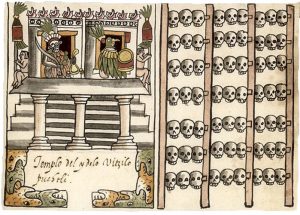
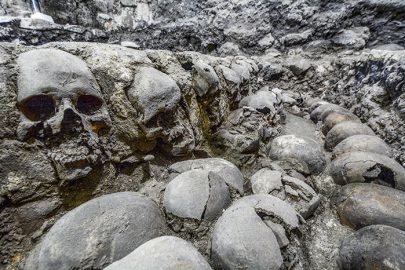
Priests carried the body to another ritual space, where they laid it face-up. Armed with years of practice, detailed anatomical knowledge, and obsidian blades sharper than today’s surgical steel, they made an incision in the thin space between two vertebrae in the neck, expertly decapitating the body. Using their sharp blades, the priests deftly cut away the skin and muscles of the face, reducing it to a skull. Then, they carved large holes in both sides of the skull and slipped it onto a thick wooden post that held other skulls prepared in precisely the same way. The skulls were bound for Tenochtitlan’s tzompantli, an enormous rack of skulls built in front of the Templo Mayor—a pyramid with two temples on top (interactive map). One was dedicated to the war god, Huitzilopochtli, and the other to the rain god, Tlaloc.
>Related articles

Trump threatens tariffs against those who oppose U.S. plans for Greenland

X is down, thousands report problems

CIA chief in Venezuela meets with Rodriguez

Eventually, after months or years in the sun and rain, a skull would begin to fall to pieces, losing teeth and perhaps even its jaw. The priests would remove it to be fashioned into a mask and placed in an offering, or use mortar to add it to two towers of skulls that flanked the tzompantli. For the Aztecs—the larger cultural group to which the Mexica belonged—those skulls were the seeds that would ensure the continued existence of humanity. They were a sign of life and regeneration, like the first flowers of spring.

But the Spanish conquistadors who marched into Tenochtitlan in 1519 saw them differently. For them, the skulls—and the entire practice of human sacrifice—evinced the Mexica’s barbarism and justified laying waste to the city in 1521. The Spanish tore down the Templo Mayor and the tzompantli in front of it, paved over the ruins, and built what would become Mexico City. And the great rack and towers of skulls passed into the realm of historical mystery.

Read more HERE

Ask me anything

Explore related questions

#archaeology#aztecs#gads#history#interactive#map#Massacre#mexico#Mexico City#photos#Priest#sacrifice#spanish#temple#Templo Mayor#Tenochtitlan#tzompantli#world
> More World

Follow en.protothema.gr on Google News and be the first to know all the news

See all the latest News from Greece and the World, the moment they happen, at en.protothema.gr

> Latest Stories

One dead after train–bus collision at the Port of Hamburg – see photos

January 16, 2026

President of Air Traffic Controllers: Another communications blackout possible in the near future

January 16, 2026

Trump threatens tariffs against those who oppose U.S. plans for Greenland

January 16, 2026

X is down, thousands report problems

January 16, 2026

“Her father cut her hair because she asked to go to a hair salon, they never gave her money”: New testimonies about Laura

January 16, 2026

Rama persists after rant at Greek journalist and questions the link between “Greek speakers” and Plato and Aristotle

January 16, 2026

CIA chief in Venezuela meets with Rodriguez

January 16, 2026

Less alcohol and lower speeds with the new Highway Code and strict fines

January 16, 2026
All News

> Greece

President of Air Traffic Controllers: Another communications blackout possible in the near future

The system is outdated and the problem may recur, warns the president of the air traffic controllers, Panagiotis Psarros

January 16, 2026

“Her father cut her hair because she asked to go to a hair salon, they never gave her money”: New testimonies about Laura

January 16, 2026

Less alcohol and lower speeds with the new Highway Code and strict fines

January 16, 2026

Why seasonal flu is so “aggressive” this year: An infectious disease specialist from “Sotiria” explains the two main causes

January 16, 2026

Study in Greece: International students apply for a place in Greek universities through a single platform

January 16, 2026
Homepage
PERSONAL DATA PROTECTION POLICY COOKIES POLICY TERM OF USE
Powered by Cloudevo
Copyright © 2026 Πρώτο Θέμα