×
GreekEnglish

×
  • Politics
  • Diaspora
  • World
  • Lifestyle
  • Travel
  • Culture
  • Sports
  • Cooking
Tuesday
13
Jan 2026
weather symbol
Athens 9°C
  • Home
  • Politics
  • Economy
  • World
  • Diaspora
  • Lifestyle
  • Travel
  • Culture
  • Sports
  • Mediterranean Cooking
  • Weather
Contact follow Protothema:
Powered by Cloudevo
> World

Astronomers capture first images of multiplanet system around Sun-like star

The European Southern Observatory's Very Large Telescope finds two giant planets orbiting a distant star that's just like our sun

Newsroom September 22 04:57

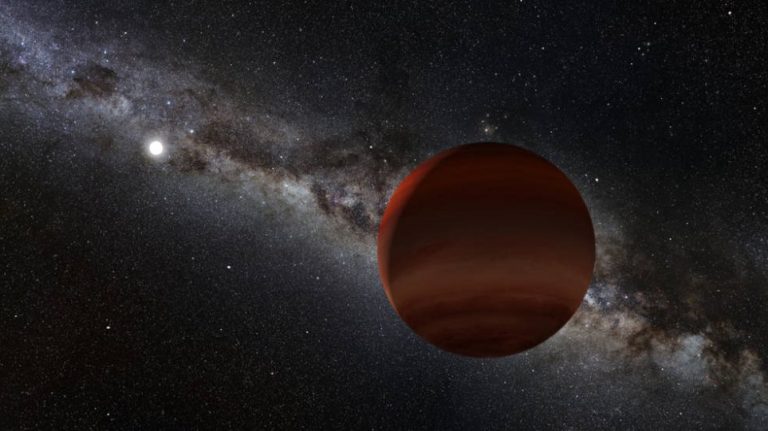
About 300 light-years from Earth lies TYC 8998-760-1, a star that resembles our own sun, kind of like a twin, but born around four and a half billion years later. In May, a team of astronomers studying the sunlike star discovered it wasn’t alone — a giant gas planet was keeping it company on its voyage through the cosmos. They dubbed it TYC 8998-760-1, as convention dictates.

Now, just two months later, the same team has discovered another planet, even farther away from the star, dubbed TYC 8998-760-1 c.

The discovery, published in the Astrophysical Journal Letters on Wednesday, is a significant one for planet hunters: It’s the first time multiple planets have been directly imaged orbiting a star similar to our sun.

“Our team has now been able to take the first image of two gas giant companions that are orbiting a young, solar analogue,” said Maddalena Reggiani, an astronomer at KU Leuven in Belgium and co-author on the study.

For the everyday skywatcher, what does that mean?

See Also:

Independent: Turkey is the biggest threat to Europe today and the Greeks need our help – Analysis

>Related articles

Tuesday the 13th: Why everyone thinks it’s bad luck

South Korea prosecutors seek death penalty for former President Yoon Suk Yeol

Parliamentary elections set for April 12 in Hungary as Orbán appears weakened in polls

Mount Athos lockdown under consideration by authorities after outbreak of cases

Well, first of all, directly imaging exoplanets is tricky work. The majority of these distant worlds are detected indirectly. Astronomers don’t actually see the planet in visible light, but they can tell it’s there by its effects on bright stars. Some telescopes, like NASA’s TESS, look for dips in the brightness of stars, suggesting a planet has crossed the field of view. Other planet hunters look for distinct changes in the velocity of stars, caused by the gravitational effect of an unseen world. Both methods have helped astronomers locate a huge trove of exoplanets.

Read more: Cnet

Ask me anything

Explore related questions

#astronomers#astronomy#astrophysics#discovery#exoplanets#nasa#physics#science#star#star system#technology#universe#world
> More World

Follow en.protothema.gr on Google News and be the first to know all the news

See all the latest News from Greece and the World, the moment they happen, at en.protothema.gr

> Latest Stories

“Digital noise” from outdated technology caused chaos in the Athens FIR – What the committee’s findings say

January 13, 2026

JPMorgan: Greece one of the most attractive markets for the Emerging Europe category

January 13, 2026

Kimon arrives at Faliro as Europe’s heavily armed frigate enters Greek waters

January 13, 2026

ELSTAT: Inflation up to 2.6% in December

January 13, 2026

Spain aims to control deepfakes created with AI

January 13, 2026

Le Pen’s party’s appeal to decide her presidential future begins

January 13, 2026

Pyrgos: man attacked his wife with a knife and then threatened to kill himself

January 13, 2026

Tuesday the 13th: Why everyone thinks it’s bad luck

January 13, 2026
All News

> Greece

“Digital noise” from outdated technology caused chaos in the Athens FIR – What the committee’s findings say

According to the report, the existing Voice Communications system of the Hellenic Civil Aviation Authority (HCAA) and the critical telecommunications infrastructure supporting it are based on outdated technology that is no longer supported by the manufacturer – Criticism over cooperation between the HCAA and OTE

January 13, 2026

Kimon arrives at Faliro as Europe’s heavily armed frigate enters Greek waters

January 13, 2026

Pyrgos: man attacked his wife with a knife and then threatened to kill himself

January 13, 2026

The Cypriot stewardess who did not board the fatal Falcon with the Libyan general was released by the Turkish authorities

January 13, 2026

Marasleio students presented innovative business ideas to Sophia Zacharaki

January 13, 2026
Homepage
PERSONAL DATA PROTECTION POLICY COOKIES POLICY TERM OF USE
Powered by Cloudevo
Copyright © 2026 Πρώτο Θέμα