





The Minoan civilization in Crete, Greek culture on mainland Greece and the Cycladic culture in the Aegean islands, despite their differences in burial customs, architecture and art, had genetic similarities in the early Bronze Age about 5,000 years ago.
This was discovered in a new international scientific study of ancient DNA analysis in the region by Greek and foreign researchers.
The discovery sheds more light on the origin of the first important Bronze Age cultures in Europe, the role of migration and the emergence of Indo-European languages.
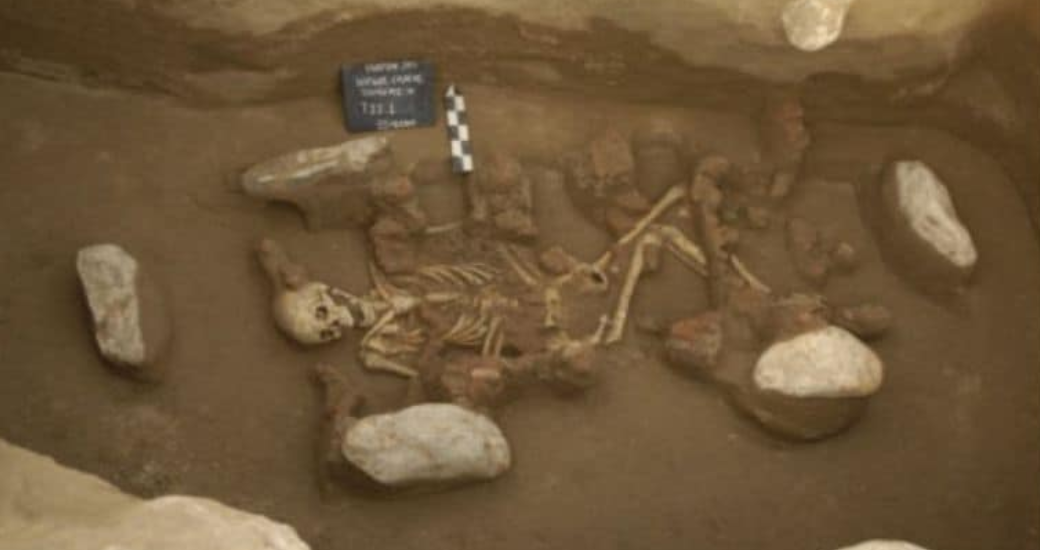
This is the first study that “read” (sequenced) complete genomes from skeletons found in various archaeological sites in the Aegean region and the wider Greek area, namely four from the Early Bronze Age and two from the Middle Bronze Age.
The mitochondrial genomes of 11 other early Bronze Age individuals were also analysed.
The analysis of all these genomes allowed scientists to carry out demographic and statistical analyses and draw conclusions about the histories of the ancient populations of the area.
Reading ancient DNA is a very difficult task due to the decay of such old biological material.
“The Early [Bronze Age] genomes are homogeneous and derive most of their ancestry from Neolithic Aegeans, contrary to earlier hypotheses that the Neolithic [Early Bronze Age] cultural transition was due to massive population turnover,” Democritus University of Thrace researcher Christina Papageorgopoulou and University of Lausanne and Swiss Institute of Bioinformatics researcher Anna-Sapfo Malaspinas, co-senior and -corresponding authors on the study, and their colleagues wrote in a study appearing in Cell.
“These culturally different populations were genetically homogeneous across the Aegean and western Anatolia at the beginning of the [Bronze Age],” they wrote, noting that the Early Bronze Age individuals carried ancestry from local Neolithic farming populations with a smaller proportion of Caucasus-related hunter-gatherer ancestry.
UNSI: Greece overhauling military with new helicopters & frigates, updating US Defense Pact
In fact, at the beginning of the study in the “Highlights” section, it says “Present-day Greeks are genetically similar to 2,000 BCE Aegeans from Northern Greece.”
The Findings
The findings, according to the researchers, are significant because they suggest that important innovations such as urban development, metal use and intensive trade, which occurred during the transition from the Neolithic to the Bronze Age, were not only due to mass migration from the East to the Aegean, as was the prevailing perception until now, but also in the cultural continuity of the local agricultural Neolithic populations of the Aegean.
The populations of the Aegean in the Early Bronze Age, based on paleogenetic data, seem to have formed to a relatively small extent from eastern migrations.
On the other hand, the study found that by the Middle Bronze Age 4,000 to 4,600 years ago, people from the North Aegean now had significant genetic differences compared to those of the Early Bronze Age.
According to the researchers, these people had about half (50%) common descent with people from the Pontic-Caspian Steppe, a large geographical area that stretched between the Danube and Ural rivers and north of the Black Sea.
Read more: Greek City Times
Ask me anything
Explore related questions