
×
GreekEnglish

×
  • Politics
  • Diaspora
  • World
  • Lifestyle
  • Travel
  • Culture
  • Sports
  • Cooking
Tuesday
13
Jan 2026
weather symbol
Athens 9°C
  • Home
  • Politics
  • Economy
  • World
  • Diaspora
  • Lifestyle
  • Travel
  • Culture
  • Sports
  • Mediterranean Cooking
  • Weather
Contact follow Protothema:
Powered by Cloudevo
> World

An ancient ocean floor has landed next to the Earth’s core, says study

Seismic waves from around the globe were sampled by equipment in Antarctica

Newsroom April 7 09:45

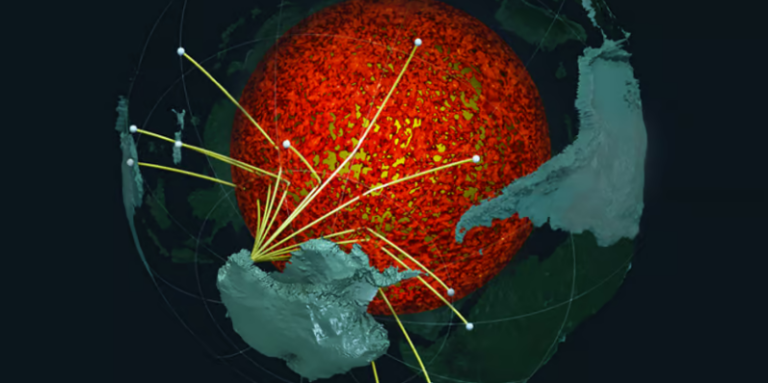
Everyone is familiar with the concept of finding sunken treasure on the ocean floor. Now, scientists may have found an ancient ocean floor that is itself a type of geological buried treasure. Using seismic readings acquired in Antarctica over three years, a research team concluded that millions of years ago, the ocean floor journeyed deep towards the heart of our planet, where it landed as a relatively thin layer surrounding the Earth’s core. The researchers say the finding could influence our understanding of how heat escapes from the core, or how oceanic material might return to the surface through volcanic eruptions.

When geoscientist Samantha Hansen and her team from the University of Alabama (UA) set up 15 seismographs in Antarctica in 2012, they were interested in using waves from earthquakes around the planet to image mountains that largely lay buried beneath the ice. While that research, which lasted three years, was successful and led to several papers, the data showed unusual energies showing up after the waves from earthquakes passed through the core-mantle boundary (CMB). This led Hansen and colleagues to conduct further investigations.

See Also:

>Related articles

Tuesday the 13th: Why everyone thinks it’s bad luck

South Korea prosecutors seek death penalty for former President Yoon Suk Yeol

Parliamentary elections set for April 12 in Hungary as Orbán appears weakened in polls

These are the 49 high value professions and specialties for the Greek tourism sector

The CMB is found about 2,000 miles (3,219 km) below the surface of the Earth. There, the research team found that seismic waves slowed down when they hit a certain layer that, while measuring about three to 25 miles (40 km) thick, is extremely thin in terms of planetary composition. The slowing of the waves through this area characterized it as an ultra-low velocity zone (ULVZ).

Read more: New Atlas

Ask me anything

Explore related questions

#Antarctica#earth#Geology#science#technology#world
> More World

Follow en.protothema.gr on Google News and be the first to know all the news

See all the latest News from Greece and the World, the moment they happen, at en.protothema.gr

> Latest Stories

“Digital noise” from outdated technology caused chaos in the Athens FIR – What the committee’s findings say

January 13, 2026

JPMorgan: Greece one of the most attractive markets for the Emerging Europe category

January 13, 2026

Kimon arrives at Faliro as Europe’s heavily armed frigate enters Greek waters

January 13, 2026

ELSTAT: Inflation up to 2.6% in December

January 13, 2026

Spain aims to control deepfakes created with AI

January 13, 2026

Le Pen’s party’s appeal to decide her presidential future begins

January 13, 2026

Pyrgos: man attacked his wife with a knife and then threatened to kill himself

January 13, 2026

Tuesday the 13th: Why everyone thinks it’s bad luck

January 13, 2026
All News

> Lifestyle

Next-level skylines: The towers transforming cities in 2026

From living and working spaces, to places of culture and tourism, these skyscrapers showcase contemporary architecture

January 13, 2026

Stefanos Kasselakis: The family “jewel” in Ekali is up for rent at €20,000 per month

January 10, 2026

Emily Ratajkowski in Athens with Romain Gavras

January 2, 2026

Sakkari on the marriage proposal from Konstantinos Mitsotakis: “I am a very lucky girl”

January 2, 2026

Konstantinos Mitsotakis proposed to Maria Sakkari

January 1, 2026
Homepage
PERSONAL DATA PROTECTION POLICY COOKIES POLICY TERM OF USE
Powered by Cloudevo
Copyright © 2026 Πρώτο Θέμα