




The legendary Siege of Syracuse, during which the Romans fought the Greeks of Sicily who defended themselves thanks to the pioneering inventions of Archimedes, fascinated a 13-year-old who managed to create a mini replica of the mechanism with the mirrors that burned the Roman ships.
Specifically, as reported by Business Insider, Brenden Sener, from Canada, designed a scientific exhibition project to see if such an achievement, like that attributed to Archimedes, was possible with a miniature of the…deadly ray. Of course, he did not attempt to set fire to anything, but rather to ascertain that his arrangement – which included thermal lamps and mirrors – significantly increased the temperature of the target.

Based on the results of his project, the 13-year-old concluded that Archimedes may indeed have achieved something like this, as historically it has not been proven that this particular mechanism existed, but it is attributed to Archimedes as an invention that lies between myth and reality. “If it were on a larger scale and with a sufficiently powerful heat source, it would certainly be feasible,” the 13-year-old told Business Insider.
Sener became interested in the famous Greek mathematician for the first time after seeing Archimedes’ screw in a documentary. He did a previous project for a science fair based on this device, which is often used in irrigation. “Because Archimedes was such an amazing inventor, I decided to research more of his inventions,” he said. That’s when he found the so-called death ray.
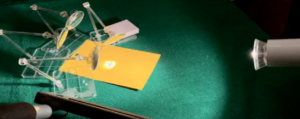
In his model, the 13-year-old student used heating lamps to simulate the sun. Small concave mirrors reflected the light onto a piece of cardboard with an “X” marking the target. “It was just a smaller version of it as close as I could get it to real life,” he said. An infrared thermometer measured the temperature increase each time Sener added a mirror. With a 100 Watt lamp, the first mirror heated the target by about 46 degrees Fahrenheit. Adding a second and third mirror increased the temperature by 38 to 40 degrees, while the fourth mirror increased it by 50 degrees to 128 degrees Fahrenheit.
Sener speculated that Archimedes’ death ray was not impossible if he had used many more mirrors and a hotter heat source.
Which Greek island does the Daily Telegraph recommend as an ideal family destination? (video)
The Siege of Syracuse
During the Siege of Syracuse between 214 and 212 BCE, the Roman general Marcus Claudius Marcellus attempted to invade the island of Sicily and capture Syracuse, one of the most significant Greek cities in the entire Mediterranean. However, he found himself not only against the staunch resistance of the Syracusans but also against Archimedes, who dedicated himself to defending his city by utilizing his knowledge.
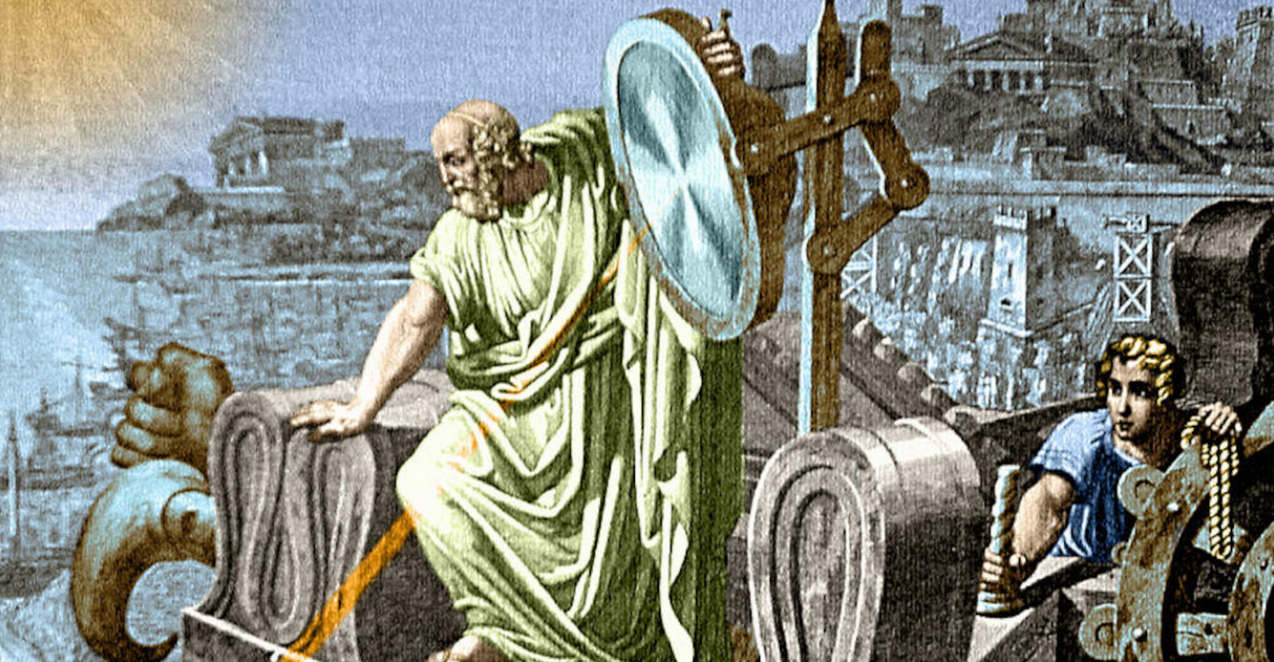
A historian of the 12th century wrote that “by turning a kind of mirror toward the sun,” Archimedes “burned the entire Roman fleet.” The author, John Zonaras, based this description on writings of an earlier historian, several hundred years after the siege.
Realizing how challenging the siege would be, the Romans brought their own unique devices and inventions to aid their attack. These included the sambuca, a floating siege tower with hooks, as well as scaling ladders on ships lowered by pulleys to the city walls.
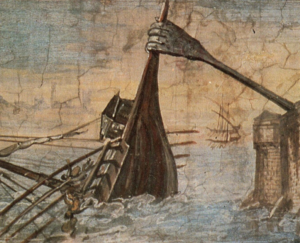
In addition to these innovative inventions, Archimedes devised defensive devices to counter Roman efforts, including a massive crane with a hook – Archimedes’ Claw – used to hoist enemy ships out of the sea before dropping them to their demise.
>Related articles
These inventions, along with the deadly ray from the mirrors, as well as the shots from the ballistae and the onagers positioned on the city walls, frustrated the Romans and forced them to launch costly direct attacks.
Ultimately, the city fell in 212 BCE when the Greeks neglected security measures on the walls due to the great festival of Artemis, allowing the Romans to seize the opportunity and invade, slaughtering indiscriminately except for those who were declared pro-Roman.
Marcus Claudius Marcellus had ordered that Archimedes not be killed. However, Archimedes continued his studies even as the Romans entered the city. A Roman soldier is said to have found him drawing circles in the sand as he was studying something. The Greek mathematician told him the famous phrase “Do not disturb my circles,” and the young Roman soldier, unaware of whom he was facing, killed him in cold blood.
Ask me anything
Explore related questions