




A horror movie scenario is revealed through classified Russian files unearthed by the Financial Times which speak of Vladimir Putin’s Russia rehearsing for a possible nuclear conflict with a major world power.
In particular, according to the Financial Times report entitled ‘Leaked Russian military files reveal criteria for nuclear strike’, Moscow has been considering the possibility of a nuclear conflict with a possible scenario of an invasion of its territory by China.
The classified documents, seen by the Financial Times, outline criteria for the use of tactical nuclear weapons that are lower than Russia has ever publicly admitted, according to experts who reviewed and verified the documents.
The package of documents consists of 29 classified Russian military files compiled between 2008 and 2014, including scenarios for war exercises and the use of nuclear weapons.
The criteria for a possible nuclear response range from a hostile invasion of Russian territory to more specific triggers, such as the destruction of 20% of Russia’s strategic ballistic missile submarines.
“This is the first time we have seen documents like this reported in the public domain,” said Alexander Gabuev, director of the Carnegie Russia Eurasia Center in Berlin.
“They show that the threshold for using nuclear weapons is quite low if the desired result cannot be achieved by conventional means.”
Russia’s tactical nuclear weapons, which can be delivered by land- or sea-launched missiles or aircraft, are designed for limited battlefield use in Europe and Asia, as opposed to larger “strategic” weapons intended to target the US.
Modern tactical warheads can even release significantly more energy than the weapons dropped at Nagasaki and Hiroshima in 1945.
Although the records date back more than 10 years, experts say they remain relevant to current Russian military doctrine. The documents were presented to the FT by Western sources.
The defence plans reveal deep-seated suspicions about China among Moscow’s security elite even as Putin began to form an alliance with Beijing, which as early as 2001 included an agreement not to carry out a nuclear first strike.
In the years since, Russia and China have deepened their partnership, especially since Xi Jinping took power in Beijing in 2012. The war in Ukraine cemented Russia’s status as a junior partner in their relationship, with China offering Moscow an economic lifeline to help avert Western sanctions.
Yet even as the countries grew closer, training materials show that Russia’s eastern military district rehearsed multiple scenarios depicting a Chinese invasion.
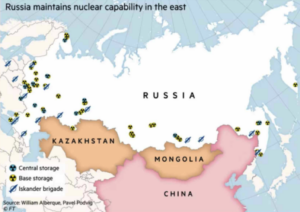
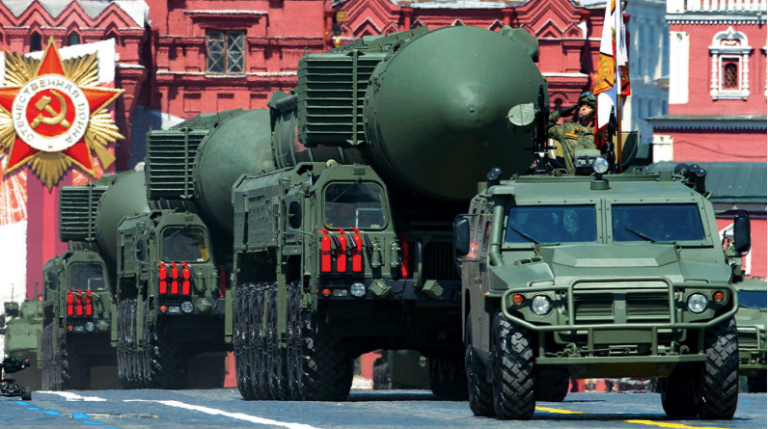
Russia’s nuclear arsenal on its territory
One exercise describing a hypothetical attack by China notes that Russia, dubbed the “Northern Federation” for the purposes of the war game, could respond with a tactical nuclear strike to stop the “South” from moving forward with a second wave of invasion.
Other possible conditions include the destruction of 20% of Russia’s strategic ballistic missile submarines, 30% of its nuclear-powered attack submarines, three or more cruisers, three airfields, or a simultaneous strike on main and reserve coastal command centers.
Russia’s military is also expected to be able to use tactical nuclear weapons for a wide range of objectives, such as “restraining states from using aggression […] or escalating military conflicts, or containing aggression, or preventing the loss of territory by Russian forces, and more effective” operation of the Russian navy.”
Putin said last June that he felt “negative” about the use of tactical nuclear strikes, but then boasted that Russia has a larger non-strategic arsenal than NATO countries.
Putin said last year that Russian nuclear doctrine allows for two possible limits on the use of nuclear weapons: retaliation to a first nuclear strike by an enemy and if “Russia’s very existence as a state is threatened even if conventional weapons are used.”
But Putin himself added that neither criterion was likely to be met and rejected public calls by hardliners to lower the limit.
The disputed documents reflect patterns seen in exercises when the Russian military conducted regular drills before and after Putin’s full-scale invasion of Ukraine in 2022.
Queen Letizia: With Felipe at the memorial service of the former King Constantine – Photos
While Russia’s president has the sole authority to launch a first nuclear strike, the low threshold for tactical nuclear use set out in the documents conforms to a doctrine that some Western observers refer to as “escalation for de-escalation.”
Under this strategy, a tactical weapon could be used to prevent Russia’s involvement in a full-scale war, particularly a war in which the United States could intervene.
Using what it calls “fear mongering,” Moscow would seek to end the conflict on its own terms by shocking the adversary with the premature use of a small nuclear weapon – or securing a settlement through the threat to do so.
Ask me anything
Explore related questions