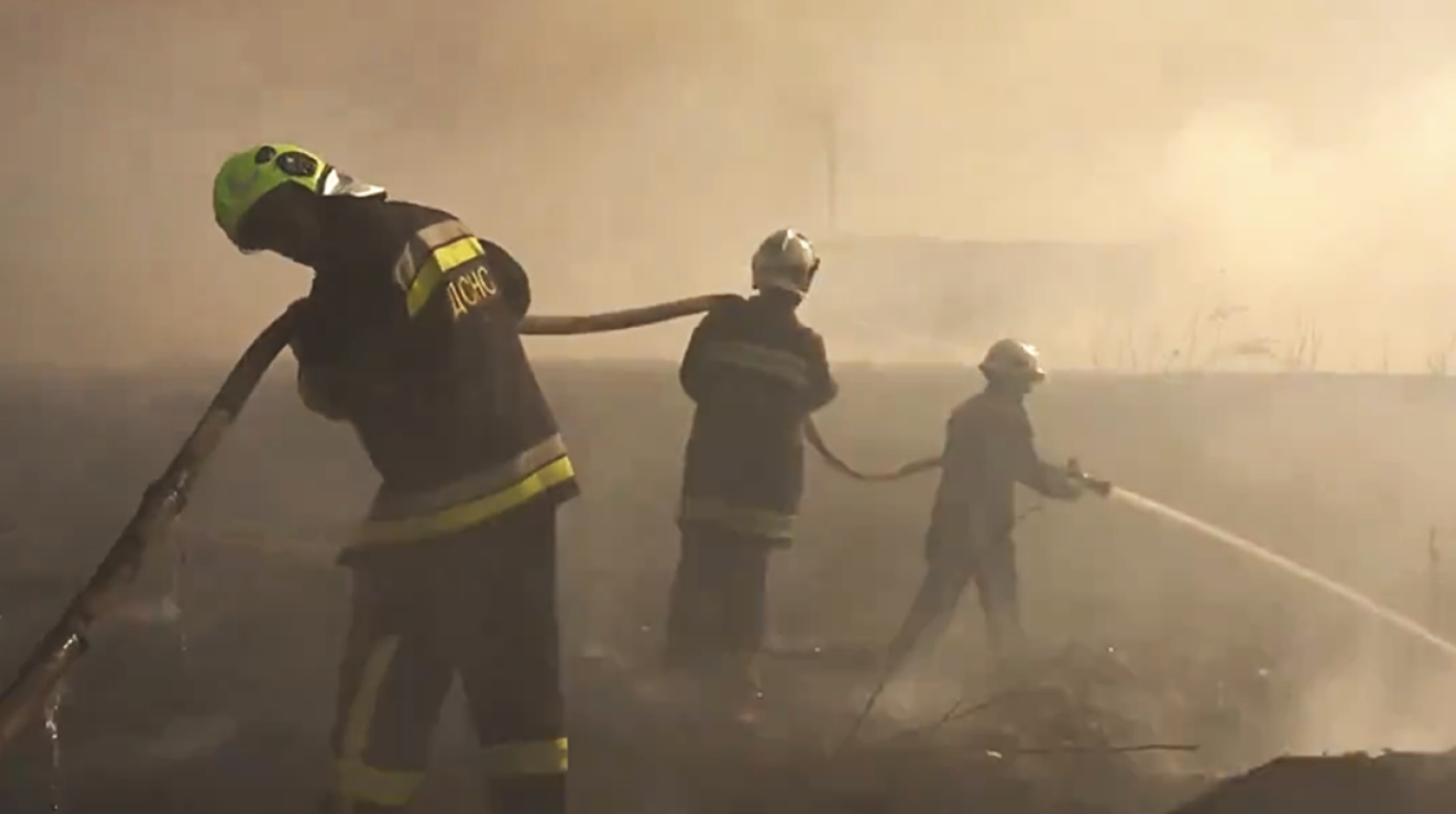
Norway announced today that the elevated levels of radioactive cesium (Cs-137) detected near the border with Russia in the Arctic are likely due to a forest fire near Chernobyl in Ukraine, the site of the world’s worst nuclear accident.
The Norwegian Radiation and Nuclear Safety Authority (DSA) stated in a press release yesterday that measurements showed “very low” levels of radioactive cesium in Svanhovd and Viksjøfjellet near the Russian border in the Arctic.
Chernobyl Zone fire. Firefighters saved an inhabited village
— Belsat in English (@Belsat_Eng) September 10, 2024
Areas contaminated after the Chernobyl disaster have been burning since September 3, posing a significant risk to the health and safety of the local population and the environment.
Today, the State Emergency… pic.twitter.com/lCOKhzhMvs
The authority added that increased levels of cesium (Cs-137) were detected in Svanhovd from September 9-16 and in Viksjøfjellet from September 5-12, but these levels did not pose a risk to people or the environment.
“DSA always finds cesium at all air filter stations in Norway, and this often comes from the resuspension of dust from old fallout from the Chernobyl accident,” the statement said.
“This time it is very likely that the forest fire around Chernobyl is responsible.”
Higher Levels of Cesium and Radon
The Finnish Radiation and Nuclear Safety Authority also reported slightly higher levels of cesium at all six of its monitoring stations.
“The quantities detected are very small,”
The highest level observed is now 11 microbecquerels per cubic meter, whereas normal measurements at the stations are less than one microbecquerel per cubic meter, the report added, noting that these measurements are very small.
The statement also mentioned that the average radon concentration in Finnish homes is 90 becquerels per cubic meter, which is one million times higher.
“Therefore, these are indeed microscopic quantities,” the statement concluded.
On April 26, 1986, Reactor 4 of the Chernobyl Nuclear Power Plant in the Soviet Union went out of control, resulting in an explosion and fire that destroyed the reactor building and released large amounts of radioactivity into the atmosphere.
The accident resulted in the dispersion of iodine-131, cesium-134, and cesium-137 over parts of northern Ukraine, Belarus, Russia, and northern and central Europe.
The Chernobyl zone is on fire. The fire has spread to 421 hectares contaminated after the nuclear accident in 1986.
— Belsat in English (@Belsat_Eng) September 4, 2024
The fire in the Chernobyl exclusion zone broke out yesterday. The head of the Kyiv regional military administration, Ruslan Kravchenko, reported that 20 hectares… pic.twitter.com/MSl80PO2bI
Large Mobilization of Firefighters – Expert Opinions
On September 9, the Ukrainian State Emergency Service (DSNS) stated that 399 firefighters were involved in extinguishing a fire in an outdoor area near Kyiv.
The statement indicated that experts assessed the situation and found radiation levels to be within normal limits. The statement did not specify the location of the fire, but a DSNS representative later confirmed to the Ukrainian news outlet Ukrainska Pravda that the fire was in the Chernobyl exclusion zone.
“We assumed that the emissions could potentially be coming from forest fires in the Ukrainian area, which may have lifted radioactivity into the air,” said the Finnish Nuclear Authority, adding that the air currents were coming from the direction of Chernobyl.
When asked about the announcement, Kremlin spokesperson Dmitry Peskov said: “There were no warnings from our relevant agencies regarding increased levels of isotopes in the atmosphere, and no warnings about threats to human health, so I have nothing to say on this matter.”
Ask me anything
Explore related questions