





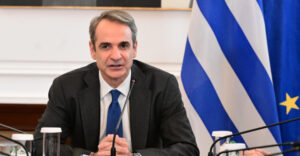
Sunday post of Prime Minister Kyriakos Mitsotakis included a reference on the oversights that led to the fatal traffic accident in Chania with the 22-year-old Panagiotis, criticism of PASOK for the “irresponsible opposition”, the measures for housing policy with the latest being the House of My 2 program, but also the government’s actions on electricity prices, the improvement of health services in hospitals and public transport.
“The recent fatal traffic accident in Crete involving a man under the influence of alcohol and the victim, 22-year-old Panagiotis, is not just another tragic loss. It is a glaring reminder of the road barbarism that dominates our streets and the urgency for a change in mentality and stricter adherence to rules. We cannot turn a blind eye to reckless drivers who drive drunk, break speed limits, or disregard the safety of others. This behavior kills. However, the responsibility doesn’t stop there. It also concerns the police officers, who must show consistency and strictness, as well as the police administrations, which bear the ultimate responsibility for how their services operate. That is why I requested the heads of the Chania police department be changed. I am categorical on this: safe roads for all are not a luxury. They are a duty,” says the Prime Minister regarding the shocking accident.
In light of the government’s intervention to put a “brake” on insurance companies’ price hikes and the statements made by PASOK, Mr. Mitsotakis criticizes Charilaou Trikoupi, writing, “the solutions it proposes on issues it raises, such as those regarding banks or now insurance companies, are unfeasible and outside the community framework. Populism, after all, is known for raising legitimate questions, but it doesn’t do so well when asked to provide implementable solutions.”
Regarding the government’s housing policy, the Prime Minister reminds that in 5.5 years, the government has allocated 6.5 billion euros, adding that “since ‘My House I,’ already 7,608 of our fellow citizens have bought their new home, 7,681 have signed contracts with the bank, and 9,002 have joined the program.”
The detailed post by Kyriakos Mitsotakis
Good morning! 2025 has started dynamically, with many initiatives and developments that I will share with you in today’s review. Let me warn you from the start: this is a detailed – perhaps lengthy – review, but I promise it’s worth your attention!
I’ll begin immediately with the new program “My Home II,” worth 2 billion euros, through which 20,000 citizens aged 25 to 50 can acquire their own first home with an affordable loan. Interested parties can submit an application via gov.gr – the special platform opened on Wednesday – and use the same application to approach the banks. So far, 42,359 applications have been registered, which clearly shows the existing need as well as the program’s attractiveness.
What are the advantages of this program? The loan covers up to 90% of the property’s value, as stated in the purchase agreement, while any remaining amount will be covered by the buyer. Practically, this means that if the value of the property is 200,000 euros, the maximum loan amount will be 180,000 euros (90% of the value). The maximum loan amount granted is 190,000 euros, but in any case, 50% will have a zero interest rate, while the remaining 50% will be subject to an interest rate that does not exceed the current limits for mortgage loans. For “My Home II,” we have expanded the income limits for all categories of beneficiaries, while for special categories of citizens (families with three or more children, large families, and families with two children in the municipalities of Orestiada, Soufli, and Didymoteicho in the Evros Regional Unit), 50% of the interest on the portion of the loan with an interest rate will be subsidized. With this new program, the housing policy for affordable housing that we have been implementing for the last 5.5 years continues even more vigorously, with total funds of almost 6.5 billion euros. From “My Home I,” 7,608 of our fellow citizens have already bought their new home, 7,681 have signed contracts with the bank, and 9,002 have joined the program.
In another program, “Exoikonomo 2025,” applications have already exceeded 31,000. Starting Monday, the submission of applications has also begun for the “Change Heating System and Water Heater” program, worth 223.2 million euros, of which 44.6 million euros will go to energy-vulnerable households (families with disabilities, large families, low-income households, as well as those affected by natural disasters). More than 100,000 of our fellow citizens have the opportunity to reduce their energy costs, thus contributing to the national effort for the green transition. Interest in this program is also proving to be particularly strong, as applications have already surpassed 35,500.
In the past week, I sent a new letter to the President of the European Commission Ursula von der Leyen on energy issues. The reason for the letter was the surge in electricity prices that affected most EU countries in the second half of 2024, resulting in the average wholesale price in Europe being significantly higher compared to 2019. This indicates that bold reforms are needed in the way the European electricity market operates in order to ensure what is highlighted in the Draghi report: the competitiveness and energy self-sufficiency of the European economy. With the new mandate of the Commission, we have submitted specific proposals so that the progress we are making in renewable energy sources (RES) is immediately reflected in electricity bills, and I am optimistic that Greece’s positions will once again serve as a guide for European initiatives.
In our country, electricity prices for households have stabilized. According to ELSTAT, the price index remained the same between 2023 and 2024, while the cumulative increase in final retail prices for consumers compared to 2019 is lower in Greece than in the rest of the EU by 10 percentage points. This also demonstrates the success of “colored” tariffs, which have intensified competition and facilitated price comparisons among providers. I encourage you to visit the highly practical and consumer-friendly website of RAE, https://invoices.rae.gr/, where you can easily compare the prices of each provider and find the best offers that can secure you, among other things, very competitive rates.
Next topic, the new modern service “tap2ride,” i.e., contactless payments on public transport in the capital (buses, trolleys, metro, and trams), which places Athens on the list of European metropolitan authorities with “smart city” practices. Now, passengers can use a bank card – in physical form, on their mobile phone, or smartwatch – as a ticket on buses, trolleys, metro, and trams, while also benefiting financially. What do I mean by this? At the end of each day, they will be charged an amount corresponding to the journeys they made, but based on the cheapest available fare package from OASA. The passenger will not need to stand at the machine to issue a ticket, nor search for points of sale or know the available travel products to choose the appropriate one. They will be charged, as I said, the cheapest fare.
Contactless payments had started on a pilot basis last April on the Airport bus lines, and so far more than 90,000 passengers have chosen them. The new service is part of the overall design we are implementing for the upgrade of public transport and the improvement of citizens’ daily lives. I remind you that 278 new buses, with anti-pollution technology, are already operating, an additional 127 new buses are in the O.S.Y. depot, and the procedures are progressing for their deployment. Our goal is for a total of 950 new vehicles to be in circulation by the end of this summer, significantly upgrading city mobility. At the same time, on Line 1 of the Metro, 14 trains are being renovated, and 9 others are being upgraded, so that many of them will be in operation by 2025. Interventions will also take place on Lines 2 and 3 of the Metro, while on Line 4, the tunnel boring machines will have completed their work by 2026.
I continue with the new program worth 70 million euros for the creation of an additional 20,000 places in nurseries and early childhood care centers for infants and toddlers from 2 months to 2.5 years old. Again, the resources come from the Recovery and Resilience Fund, highlighting the social dimension of our plan that disproves the unfair and unrealistic attacks of the opposition that claim it concerns only the few and the wealthy. The program is aimed at municipalities and owners of infant, child, and kindergarten nurseries, in order to increase the places in existing municipal nurseries or to create new ones. It is another intervention to make working parents’ daily lives easier. I should point out that this year, the budget for vouchers has increased, approaching 380 million euros!
We take care of all children, especially children with disabilities. In this context, we are increasing the monthly compensation for foster care professionals who care for children with disabilities, from 1,561 euros to 1,850 euros. Additionally, for the first time, foster parents will have the opportunity to receive special training, in cooperation with public universities, such as the University of Western Attica, so they can meet the increased needs involved in caring for children with disabilities. It is another program of our National Strategy for the Rights of Persons with Disabilities that contributes to removing the barriers to their social inclusion, providing them with a stable and safe family environment. We want, and this is what we work for, “One Greece, with all, for all.”
Now, let me address the measures for improving emergency services in hospitals in Attica and the new initiatives of the Ministry of Health. The interventions aim to reduce waiting times for citizens as much as possible, so they do not exceed 5 hours. Today, in some cases, waiting times are particularly long, which causes inconvenience to patients and is, of course, unacceptable. So, what are we doing? We are reinforcing the Emergency Departments with more staff, improving their building infrastructure and equipment, and using technology to become more efficient. With the new digital tracking system, we will be able to monitor the waiting times of patients and intervene promptly when necessary. Additionally, volunteers from the Red Cross will be present in the Emergency Departments, helping to better organize and serve citizens. But we are doing something else: we are integrating selected Health Centers into the emergency shifts, so they can support hospitals. At the same time, we are strengthening them with additional personnel, in addition to the recruitment of permanent staff, for better and faster service of citizens. This way, access to healthcare services is facilitated, and pressure on hospitals is reduced. Our goal is a healthcare system that respects people, providing immediate and quality care.
And there is something else, this time concerning mental health. From February 1st, the National Network of Mental Health Services will be operational, with 7 regional networks corresponding to the Health Regions of the country. One of the changes accompanying their operation is that, when a patient needs compulsory hospitalization based on a prosecutor’s order, the order will request that they be hospitalized as close as possible to their place of residence, thus reducing the inconvenience and expenses for their relatives.
I move on to the truly serious issue that arose with the unjustifiably high increases in premiums for long-term health insurance contracts. We had committed to government intervention, and that is exactly what happened. After the government’s stance, insurance companies voluntarily granted discounts of around 50% for long-term contracts for 2025, recognizing that we need to carefully reconsider the factors that determine premium prices, so that both the private healthcare market and the insurance market operate with competition and without unfair practices. On Thursday, the Minister of Development submitted an amendment to the Parliament that establishes greater transparency in the charges of both sectors, as well as a new, more comprehensive index that will objectively record market trends starting in 2026. I repeat for those who have not understood: Greece is not a banana republic. Competition must function as it does in any European country.
As for PASOK, which insists on engaging in irresponsible opposition, I would like to say that the solutions it proposes on issues it raises, such as those concerning banks or now insurance companies, are unworkable and outside the EU framework. Populism, after all, is known for raising legitimate questions but fails miserably when it is called upon to offer applicable solutions.
The impunity of corrupt public servants is a long-standing pathology that undermines citizens’ trust in the public sector. It is justified that people are frustrated when disciplinary proceedings last from 3 to 7 years, even for serious cases, and often result in “slap-on-the-wrist” penalties. This issue had concerned me over a decade ago when I was Minister for Administrative Reform. At that time, we had for the first time recorded all pending disciplinary cases. However, the truth is that despite the progress made, today we still have more than two and a half thousand cases, which remain stagnant in 92 disciplinary councils, and in half of them, the investigative process has not even begun, no reporter has been assigned, and often the time to complete the proceedings can exceed five years.
We are moving forward with a revision of the way disciplinary councils in the public sector operate: from now on, they will function as small disciplinary councils with full and exclusive engagement on these matters, staffed solely by members of the State Legal Council, not by the employees themselves. A central digital registry will be created to track the start and end of each case, so the duration of its progression and resolution can be monitored. We are setting final deadlines for issuing the relevant decisions, with the aim of completing the procedures within 3 months. At the same time, unnecessary stages in the process will be removed, and penalties will be made stricter. We want the public sector to operate with transparency and accountability, rewarding good public servants, but imposing fair and substantial penalties on the few who break their oath.
I had mentioned last Sunday the stricter provisions of the new Road Traffic Code for violator drivers, who will face penalties corresponding to the severity of each violation, which are also categorized according to their danger. In fact, the penalties will be scaled for those who frequently commit violations, and now, the focus is on the driver. The recent fatal traffic accident in Crete, with the perpetrator being a man under the influence of alcohol and the victim being 22-year-old Panagiotis, is not just another tragic loss. It is a glaring reminder of the road barbarity that dominates our streets and the urgency for a change in mentality and stricter adherence to the rules. We cannot turn a blind eye to reckless drivers who drive drunk, violate speed limits, or disregard the safety of others. This behavior kills. However, the responsibilities do not stop there. They also concern the police officers, who must demonstrate consistency and strictness, as well as the police administrations, which bear the ultimate responsibility for how their services operate. That is why I requested the change of the heads of the Chania police department. I am categorical on this: safe roads for all are not a luxury. They are an obligation.
I conclude today’s review with two significant distinctions for Greece. The first concerns satellite communications and our country’s selection for the installation of the European Union’s secure satellite communications program, GOVSATCOM. By decision of the President of the EU, Greece, together with Germany, will play a central role in implementing this critical security infrastructure until 2051. What will this program do? Essentially, it will ensure secure satellite communications to protect critical services from external threats. It is a major success for our country that strengthens the geopolitical position of our homeland, positioning it as a key player in the European Union’s security architecture. At the same time, it is a project expected to attract significant investments and specialized personnel in the field of space technology, further strengthening the domestic innovation ecosystem.
The second significant distinction concerns the field of culture, specifically the 39th European Film Awards in 2027, which will be hosted in Athens! This is the first time that the premier event of European cinema will take place in a city in Southeastern Europe, and for this, many congratulations go to the Ministry of Culture and the Greek Film Center, Audiovisual Media and Creation – Creative Greece, who worked hard for this purpose. The award ceremony will be held at the Stavros Niarchos Foundation Cultural Center, with the presence of 1,300 international guests, members of the Academy, representatives of the European film community, and international media. At the same time, events dedicated to the great celebration of European Cinema will be organized throughout the city, honoring the art, creativity, talent, and spirit of innovation of artists from all over Europe.
It was indeed a great review! I’ll close here, and thank you for your time. Have a great Sunday!
Ask me anything
Explore related questions