





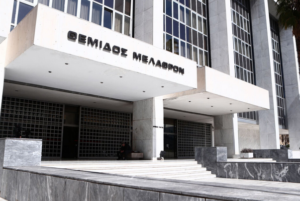
“The leadership of the judiciary must, without fail, proceed with the necessary updates,” emphasizes the spokesperson of the Supreme Court, Supreme Court judge Panagiotis Lymperopoulos, in a comprehensive statement regarding the tragic railway accident in Tempi that has come to public attention.
The Supreme Court clarifies the institutional procedures followed for assigning the investigation of the Tempi accident to an appellate judge and invites anyone who has relevant evidence to submit it. “If anyone claims that all the judicial officials of the Larissa Court of Appeals, who decided to appoint an appellate judge as the investigator in the Tempi case, are at the mercy of extrajudicial authorities, they must immediately submit the evidence to the competent institutional authorities and support it with their signature.”
“In a democracy, no one, under any capacity, is entitled to ‘terrorize’ judicial officials if their decisions or actions are not subject to their approval,” the statement stresses.
Specifically, Mr. Lymperopoulos’ statement is as follows:
“The judiciary speaks through its decisions and judicial actions. However, whenever institutional bodies, political or non-political figures, through statements, publications in print and online media, or posts on the internet, either distort and abuse judicial actions or exploit them, with the potential yet immediate risk of misleading citizens—who neither know nor are obligated to know—the leadership of the judiciary must, without fail, provide the necessary updates for anyone genuinely interested in understanding the truth about its institutional actions.
Therefore, we present the following:
Article 28 of the Code of Criminal Procedure states:
• The plenary session of the appellate court convenes by request of the appellate prosecutor (or if one-third of its members request it in writing, as specified today in Article 15, paragraph 2a of the Code of Court Organization and the Status of Judicial Officials, following its amendment by Law 4938/2022, with an identical provision previously found in Article 14, paragraph 2a of the same Code as amended by Law 1756/1988).
• The plenary session has the right to instruct the appellate prosecutor to initiate criminal proceedings for crimes of exceptional significance.
• If criminal proceedings have already been initiated by the prosecutor of the Court of First Instance, the plenary session has the right to order the documents to be submitted to the appellate prosecutor.
• In all cases, the appellate prosecutor is present at the plenary session.
• The plenary session appoints one of the appellate judges, along with a deputy, to fulfill the duties of an investigator in the case.
• The appellate prosecutor has all the rights and duties of the prosecutor of the Court of First Instance.
• The appellate council has the rights and duties of the council of the Court of First Instance.
It is, therefore, absolutely clear that through a process of full transparency (proposal—deliberation—reasoned decision—publication), the highest body of an appellate district, the plenary session of the appellate court, sovereignly decides on assigning the main investigation of exceptionally significant crimes to an appellate judge-investigator, only if it deems it appropriate and provided that the request has been properly submitted as outlined above.
The Greek judiciary has, to date, effectively and justifiably applied this provision, determining that crimes of exceptional significance should be investigated by judges with greater experience and legal expertise (as has occurred in numerous cases of corruption, Greek and international terrorism, the Golden Dawn case, the Siemens case, the Vatopedi case, etc.).
Therefore, those who claim that the application of Article 28 of the Code of Criminal Procedure in the Tempi case is the result of dark dealings should consider whether it is plausible for this to have been orchestrated simultaneously by the President of the Court of Appeals, who convened the Plenary Session of the Larissa Court of Appeals, along with another President of the Court of Appeals, one Appellate Prosecutor, and seventeen Appellate Judges, who unanimously decided (Plenary Session of the Larissa Court of Appeals 4/10-3-2023) to assign the case to an appellate judge-investigator. This judge, as the now natural judge of the case, was obliged to carry out the judicial duties assigned to him. Moreover, since then, he has been assisted by six Deputy Appellate Prosecutors of Larissa, who, acting strictly within the framework set by the Code of Criminal Procedure, support the investigative process.
Anyone who possesses evidence proving that all the judicial officials of the Larissa Court of Appeals who decided to appoint an appellate judge as the investigator in the Tempi case are at the mercy of extrajudicial authorities must immediately submit it to the competent institutional authorities and support it with their signature.
Otherwise, by spreading speculation and conspiracy theories, slandering and morally defaming judicial officials, they directly attack democratic institutions.
In a democracy, no one, under any capacity, is entitled to ‘terrorize’ judicial officials if their decisions or actions are not subject to their approval.
Additionally, we must inform that promotions, placements, transfers, and secondments of all judicial and prosecutorial officials, from the rank of associate judge to Supreme Court judge and Deputy Prosecutor of the Supreme Court, are decided, based on legal criteria, solely by the Supreme Judicial Council—an eleven-member or fifteen-member body (for the rank of President of the Court of Appeals, Appellate Prosecutor, Supreme Court judge, and Deputy Prosecutor of the Supreme Court)—consisting exclusively of judicial and prosecutorial officials of the Supreme Court, selected by lot from those who have served at least two years in the Supreme Court. The Council meets with the presence of judicial and prosecutorial observers from other ranks (see Articles 90 of the Constitution, 59-63 of the Code of Court Organization and the Status of Judicial Officials).
Finally, we must emphasize that, according to the provisions of the Code of Court Organization and the Status of Judicial Officials, the leadership of the Supreme Court (President) is not entitled to interfere with the judicial judgment of judges or to dictate judicial actions.
This information is provided for those who, either out of ignorance or self-interest, argue otherwise, undermining the independence of judicial officials.
The citizens of this country should feel assured that the personal and functional independence of Greek judges and prosecutors is fully guaranteed by the Constitution and the laws, with safeguards not found in many legal systems of developed countries. These officials remain steadfastly dedicated to their oath, subjected daily to rigorous institutional scrutiny, regardless of the case they handle, whether of exceptional significance or not, despite the defamation, ridicule, insults, and threats they endure due to unpleasant decisions they are occasionally forced to make.
The citizens of this country would feel more secure if all the factors influencing their daily lives, in every sector and level, acted accordingly.”
Ask me anything
Explore related questions