




In an analysis of the cause that brought Donald Trump and Volodymyr Zelensky closer together as they prepare to enter into agreement on precious minerals and rare earths of Ukraine, the Guardian newspaper reported.
According to the US president the deal, revealed yesterday, could be signed as early as Friday.
The British newspaper plotted the areas of mineral wealth and rare earths claimed by Trump on behalf of the US.
What are critical minerals?
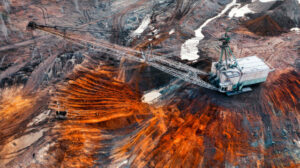
Critical minerals are the metals and other raw materials needed to produce high-tech products, particularly those related to the transition to green energy, but also consumer electronics, artificial intelligence infrastructure and weapons.
The urgency of addressing the climate crisis and moving away from fossil fuels has created a frenzy for energy transition minerals such as cobalt, copper, lithium and nickel, which are useful for electrifying transportation and building wind turbines. The same minerals are also used to make mobile phones, artificial intelligence data centers and weapons such as the F-35 fighter jets.
As the global economy and technology are transformed, the value of critical minerals has skyrocketed and geopolitical competition for access to them is increasing. In 2023, the International Energy Agency (IEA) estimated that the minerals market for the energy transition had reached £320 billion in 2022, double the value of five years earlier. And if countries fully implement their clean energy and climate commitments, demand is expected to more than double by 2030 and triple by 2040, the organisation said.
Which minerals are considered critical?
The term critical minerals is not so much a scientific term as a political one, and different countries have different lists of critical minerals depending on their domestic and geopolitical goals.
In 2022, the US Geological Survey (USGS) published a list of 50 minerals, from aluminum to zirconium, that it considered to “play an important role in our national security, economy, renewable energy development, and infrastructure.”
In this list one finds minerals such as arsenic for semiconductors, beryllium used as an alloy in the aerospace and defense industries, cobalt, lithium and graphite, which are vital for battery manufacturing; indium, which makes screens touch; and tellurium, used for solar power generation. Phillium, which is used to produce electricity for use in solar energy.
Under US law, the list must be updated every three years, which means that this year it will have to be revised.
What are rare earths?
The rare earths are a subset of 17 minerals that are essential for mobile phones, electric vehicles, rocket guidance systems and other electronic, industrial and energy applications.
Despite that title, rare earths are not very… rare, but their extraction and exploitation is difficult and environmentally damaging, meaning that production is concentrated in very few places, mostly in China.
They are also used in other materials such as aluminium and aluminium alloys.
Which critical minerals does Ukraine have?
In a 2022 article, the president of the Association of Geologists of Ukraine, Anna Liventseva, argued that her country contains about 5% of the world’s mineral resources, despite covering only 0.4% of the planet’s surface, thanks to a complex geology that includes all three main components of the earth’s crust.
According to Ukraine’s own data, cited by Reuters, the country has deposits of 22 of the 34 minerals designated as critical by the EU, including rare earths such as lanthanum, cerium, neodymium, erbium and yttrium.
Before the outbreak of war with Russia, Ukraine was a key supplier of titanium, providing about 7% of global production in 2019, according to a European Commission survey. It also possessed 500,000 tonnes of lithium reserves and 1/5 of the world’s graphite, a critical component of nuclear power plants. However, with Russia controlling about 1/5 of Ukraine’s territory, much of these reserves have been lost.
According to estimates by Ukrainian think tanks cited by Reuters, up to 40% of Ukraine’s mineral resources are under occupation. Russian troops also hold at least two of Ukraine’s lithium deposits, one in Donetsk and another in Zaporizhzhya.
Why does Donald Trump want Ukraine’s critical minerals so badly?
There is a major reason why Trump is so keen to get his hands on Ukraine’s critical minerals: China. More than ever, the Asian superpower is the world’s factory, and that means that wherever in the world critical minerals are wrested from the ground, it remains a critical staging point in the supply chain.
Most of the world’s critical mineral processing capacity is in China. According to the International Atomic Energy Agency, China’s share of refining is about 35% for nickel, 50-70% for lithium and cobalt, and nearly 90% for rare earths.
According to USGS data, in 2024 China accounted for nearly half of the world’s rare earth reserves.
With Trump launching a trade war with China by imposing tariffs on Chinese goods, US access to critical minerals is potentially threatened, the Guardian concludes in its analysis.
Ask me anything
Explore related questions