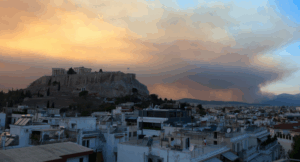
The Financial Times has put Athens and the risk of a potential fire outbreak, which could reach areas such as Zografou, under the microscope, ranking the capital among the “easy targets” for such a disaster.
“Athens, whose wider metropolitan area is home to 3.6 million people, narrowly avoided a catastrophic fire—but only just,” the FT article notes, reminding readers of the devastating fire in 2024, when flames reached the Halandri area after passing through Penteli.
“What was missing was the wind,” says Thomas Smith, an associate professor of environmental geography at the London School of Economics and Political Science, highlighting a critical factor that can turn a fire from manageable to disastrous.
Listing the Greek capital alongside major cities like Dallas, Lisbon, Sydney, and Cape Town, the article’s author points out that “these areas’ climatic and geographic conditions make them extremely vulnerable to disasters related to global warming. These can include fires, like the ones that broke out in Los Angeles in January, but also floods, like those that hit Valencia last year. In some cases, one disaster may follow the other.”
Although, according to Erin Cahlan de Perez, a professor at Tufts University and expert in climate risks, these areas “have been lucky,” she notes that “the odds may be against them. With 2025 expected to be one of the hottest years on record, despite the La Niña phenomenon bringing cooler weather earlier this year, scientists are warning about the growing risk of climate-related disasters,” the Financial Times reports.
Climate change is driving an increase in extreme heat, which fuels fires, while higher temperatures can also lead to more intense rainfall and flooding, as warmer air holds more moisture.
Studies have found that the warm, dry, and windy conditions that caused fires in Los Angeles were about 35% more likely due to climate change. In the case of Athens, Christos Giannakopoulos’ model from the National Observatory of Athens shows that, in a “business as usual” scenario with no progress in reducing greenhouse gas emissions, the city is on track to experience up to 40 more days per year with maximum temperatures above 35°C by 2050, compared to the 1981-2000 period.
Hymettus
In an interview with the Financial Times, Kostas Lagouvardos discussed the burned path of the 2024 wildfire and pointed to Mount Hymettus: “I think it will be next.”
Simulations carried out in collaboration with his colleague, Theodoros Giannaros, show that a fire starting in the northern foothills of Hymettus would develop “very quickly” if fueled by strong winds, says Lagouvardos.
“Using the dry forest and vegetation of the mountain as fuel, the flames could rapidly head toward the city, close to an area where the University of Athens is located,” the Financial Times notes, with Kostas Lagouvardos pointing out that the mountain “is very close to the city’s boundaries.” He adds that while the mountain is “under strict protection,” a fire “can still happen.”
The Perfect Fire Combination
According to Joe McNorton, an expert from the European Centre for Medium-Range Weather Forecasts, who spoke to the FT, “the wider Athens area, like other vulnerable areas, has the ‘perfect combination’ of elements required for a major fire.”
As he explains, “fires need fuel, often in the form of vegetation, an ignition source, such as extreme heat or a human-caused fire, and the right weather conditions, including strong winds.”
All of these factors are exacerbated by urban sprawl. Since the 1950s, urban development in Athens has spread from the compact historical center of the city, with new buildings increasingly approaching the mountains, hills, and seas that surround the area. This has contributed to the creation of a larger interface between wild nature and urban areas, or the interface between rural and urban areas — where buildings and wild nature meet or blend, and which is a hotspot for fire ignition.
In these zones, human activity can inadvertently spark a fire, and due to the concentration of the population, it poses a greater risk to people and their property.
The Los Angeles Example
At the same time, unstable weather conditions also make wild areas more flammable. In the case of Los Angeles, the city had experienced an exceptionally rainy period, leading to abundant growth of bush vegetation. This was followed by a prolonged drought that dried out the plants, creating fuel for a fire.
It was the perfect storm. Fires burned over 55,000 acres, causing the deaths of at least 30 people, destroying over 16,000 buildings, and causing economic losses in the hundreds of billions of dollars.
A similar situation could unfold in Athens, scientists warn, where a period of rain followed by drought would provide plenty of fuel. In addition to the pine forests, which often dry out during summer heatwaves, where temperatures can exceed 40°C, bush vegetation is also common in the area. This has increased due to the decline of agriculture and the loss of goats and sheep that traditionally kept the vegetation under control.
As McNorton points out, “the spread of vegetation on the outskirts of Athens — or in other cities — often means there are no natural firebreaks to stop the spread of fire.”
Santa Ana Winds
A distinct factor in the spread of wildfires are winds like the Santa Ana winds, which fueled the fires in Los Angeles. Athens is similarly exposed to strong, dry northerly winds (known as the “meltemi”) that blow across the Aegean region. These winds typically occur during the summer months when the risk of fires is highest.
This was tragically confirmed in the summer of 2018 with the fire in Mati, while it was also the strong winds that fueled the fires in Hawaii in 2023, where at least 102 people lost their lives.
Next Threat: Flooding
However, wildfires also have long-term consequences. By burning vegetation, they make the soil less capable of absorbing water, resulting in increased surface runoff and faster movement of floodwaters.
“A wildfire can cause damage to suburbs, especially to green areas, but the problem doesn’t end there. There is an increased risk of flooding,” says Michalis Diakakis, an expert at the University of Athens on climate-related disasters and extreme events.
According to Diakakis’ research, this risk can last up to a decade after a wildfire in certain areas and can be much more destructive for city centers. “It’s easy to block a critical river at one point, pushing the water outward and flooding the area. The flood will ultimately reach the city center.”
Ask me anything
Explore related questions