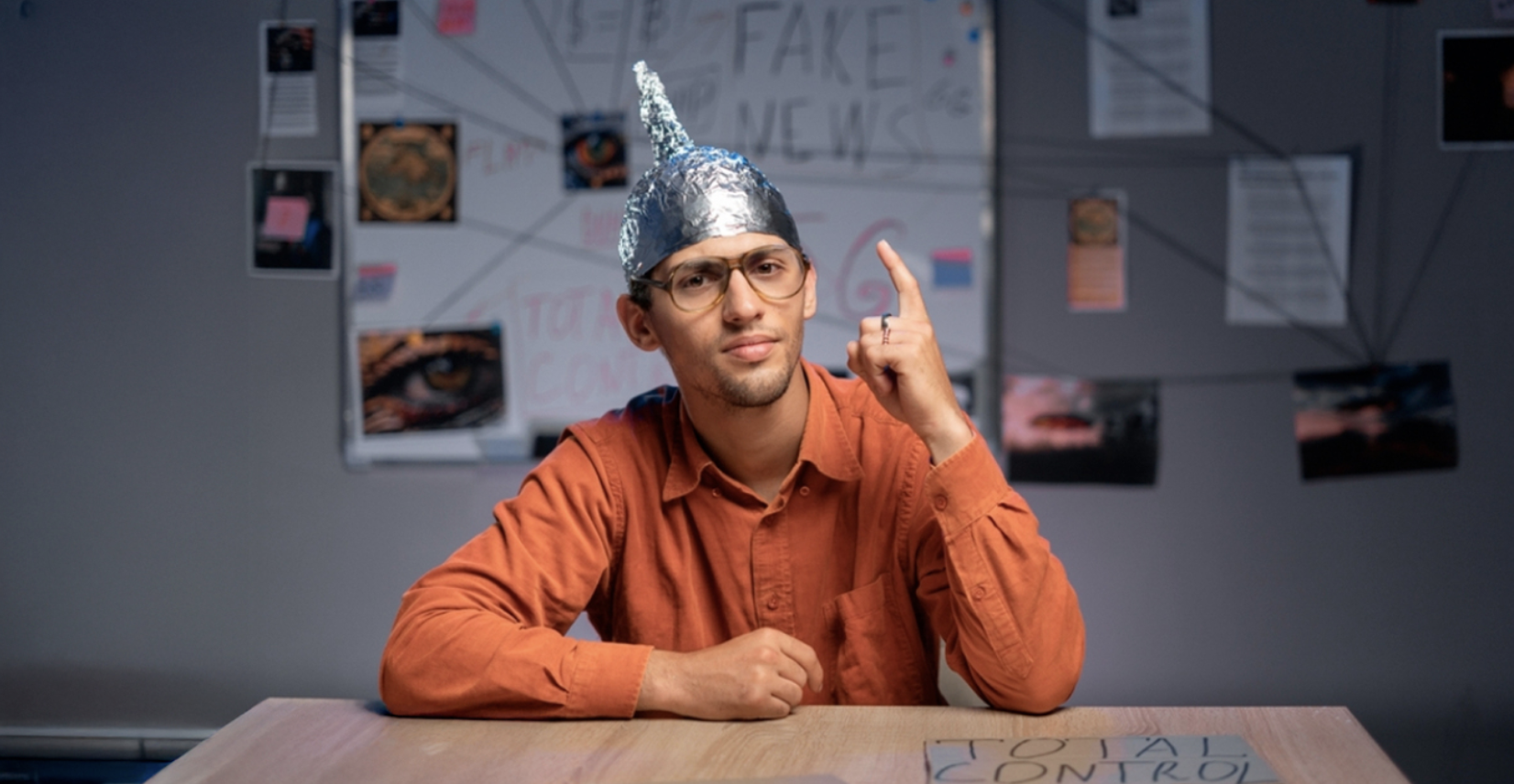
Who hasn’t heard someone at a family dinner or a night out claim that the Egyptian pyramids were built using alien technology or that COVID-19 was never real? If that someone happens to be between 18 and 35, they might very well argue their point at length—citing a TikTok video or a Facebook post from a guy who “seemed to really know what he was talking about.”
In a time defined by a constant flow of information and endless updates at the tap of a button or a swipe of a screen, a paradox emerges: despite unprecedented access to knowledge, belief in conspiracy theories continues to rise—especially among younger generations. But why are young people, who are often praised for their tech-savviness and progressive thinking, more prone to conspiracies? The answer lies at the intersection of digital media consumption and a profound crisis of trust.
Lack of Critical Thinking Skills
Today’s youth are digital natives. They’ve grown up in a content-saturated ecosystem—from TikTok and YouTube videos to Reddit threads and Instagram stories. According to a 2023 report by Common Sense Media, Gen Z (those born after 1996) spend an average of 4.5 to 6 hours daily on social media.
But the digital world isn’t a neutral playground. Algorithms are designed to maximize engagement—not accuracy. This means that emotional, provocative content, like conspiracy theories, tends to be boosted. A 2021 study published in Nature found that misinformation spreads six times faster than factual content on Twitter (now X).
Unlike traditional media—where content is filtered and subject to ethical standards—social platforms lack consistent fact-checking. Worse, conspiracy content is often disguised as “informative” or even “truth-revealing,” giving users the illusion that they’re accessing secret knowledge that “mainstream media won’t tell you.”
This environment is especially risky for younger users, many of whom haven’t been taught how to evaluate sources, spot fake news, or verify information through research. In a 2019 Stanford study, over 80% of high school students couldn’t distinguish between a news article and sponsored content. This deficiency isn’t just an educational failure—it’s a social threat.
Deep Crisis of Trust in Institutions
Conspiracies thrive where trust decays. Over the past two decades, studies consistently show declining trust in governments, media, and public institutions—especially among younger people. The 2025 Reuters Institute Digital News Report reveals that only 22% of Greeks trust mainstream media, and trust declines further among younger age groups.
This erosion of trust isn’t unfounded. From bailout packages that favored the rich and financial crises, to police brutality, climate inaction, and political hypocrisy, many young people have grown up witnessing the failures of institutions. The COVID-19 pandemic deepened this distrust: conflicting health guidelines, political polarization, and vaccine misinformation left many feeling confused and betrayed.
In such an environment, conspiracy theories offer an appealing alternative: a simplified narrative with clear villains and hidden truths waiting to be uncovered. For example, belief in pandemic-related conspiracies surged among young adults in 2020—partly because these stories gave them a sense of control and coherence in a world suddenly turned upside down.
Identity Formation
Beyond all that, let’s not forget that adolescence and young adulthood are times of exploration—of identity, values, and belonging. These formative years are also marked by cognitive and emotional turbulence. Developmental psychologists note that the prefrontal cortex—the brain region responsible for impulse control and critical thinking—continues to mature into the mid-20s. This makes young people more vulnerable to emotional reasoning, peer influence, and the search for meaning.
Conspiracy theories often feed these impulses. They offer a framework to interpret complex realities in emotionally satisfying ways. They also create a sense of belonging to a “different group,” which can be especially powerful for young people searching for meaning or a social identity. A 2017 study from the University of Kent found that feelings of powerlessness, anxiety, and low self-esteem are strongly linked to belief in conspiracies. For young people facing social isolation, economic insecurity, or academic pressure, conspiracy theories can offer a dangerous form of emotional refuge.
A Shared Responsibility
Belief in conspiracy theories isn’t just a fringe issue—it’s a mainstream challenge with broad implications for democracy, public health, and social cohesion. While young people may be more vulnerable, they are also uniquely positioned to become leaders in the fight against misinformation—if equipped with the right tools and confidence.
But the burden shouldn’t fall on them alone. Society must invest in education, rebuild institutional trust, and foster spaces where truth can rise above fear. If we don’t, the vacuum will be filled with voices that deceive, manipulate, and divide.
If we succeed, though, we can empower a generation not just to resist conspiracy theories—but to lead us toward a more informed and united future. So instead of simply pushing back, we should begin by asking: “What makes you believe that?” Even when we know that COVID was real and that the pyramids hold only the wisdom of an ancient civilization, we owe it to others to listen—and respond with strong, evidence-based arguments. Truth is often singular and objective, and showing it patiently may be our best tool in the long run.
Ask me anything
Explore related questions