




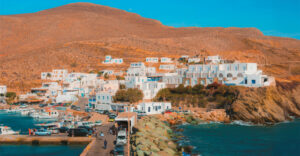
The major upheaval in the urban map of Mykonos and Santorini is being attempted by the State, imposing the most stringent building rules to date.
Areas that until recently were investment destinations pass into protection zones, sparsity is increased, and off-plan building is drastically restricted. The only safety concern is the first residence, where sparsity will be maintained at 4 acres, since in all other uses – residential and tourist – sparsity is being torn down.
Many feel that the intervention comes too late, since the two Cycladic islands have already lost much of their authenticity and character under the weight of overdevelopment of tourism and anarchic building. However, even belatedly, the new urban planning regulations are changing the game and causing an earthquake in the property market, opening up talk of an explosion in land values as restrictions leave few properties truly usable.
In the State Council in the spring
The new Special Urban Plans for Mykonos and Santorini will make their way to the Supreme Council of State next spring (there are still minor outstanding issues to complete the studies), with a view to their approval by Presidential Decrees that dramatically tighten building conditions.
Especially for Santorini, the new planning permanently closes the door to development, as it catalytically restricts it. “In practical terms, it is estimated that few plots – even a single-digit number – remain immediately usable under the new rules. All the rest will need – where feasible – property pooling, which is considered extremely difficult,” says an agent in the technical world.
The move signals the state’s intention to stop unregulated building, limit uncontrolled tourist expansion and protect the landscape, environment and cultural identity of the two islands, even if decades late.
The conditions in Mykonos
In the changes are sweeping. The area under protection is increasing significantly, now reaching a proportion approaching two-thirds of the island. Even more striking is the expansion of the absolute protection zones, where no new construction is allowed, and the percentage of land reserved for tourism and residential development, which is reduced by 20% and drops to under 30% from almost 35%.
The island, which for years has been experiencing the consequences of a hyper-intensive building activity and has recently been granted a new suspension of building permits until the end of 2026, is being driven into a regime where the potential for new construction is dramatically reduced.
What’s changing in the artisanal
The new Special Urban Plan appears to lock in the required spacing for tourist facilities from 10 to 30 acres, tripling the required spacing from what it was before. These aptitudes are not expected to change for the better, but could even be increased if the State Council so decides.
Similarly, for exceptional residences, the sparsity is doubled to 8 acres, while building will be restricted even on those plots that meet these requirements, since the rate will not exceed the current levels of 4 acres, i.e,. 200 sq.m. The only substantial exception remains the first residence, for which the sparsity is maintained at 4 acres in order to protect the needs of permanent residents.
The Secretary General of Spatial Planning, Efthimis Bakoyannis, during the presentation of the Mykonos EIA last year, had hinted at the possibility of increasing building possibilities through the “identification” road program that is in full swing. He had even amused the public’s impression of the strict building conditions, saying that they would be reviewed in five years when the island’s infrastructure projects (water supply, roads, etc.) are completed.
Recently, the Council of State issued a new decision, in which it declared illegal building permits implemented without the approval of work by the Archaeological Service.
In Mykonos, where half the buildings are arbitrary, dozens of lawsuits have begun to be filed against engineers who have been found to have lavishly issued similar permits for construction without the required approvals from the Ministry of Culture. The extent of the urban anarchy has also been revealed by the study of the EPS of Mykonos, according to which in the western part of the island there are about 200 sq m. per resident, when a fair ratio is considered from 40 to 80 sq m. In Santorini, there are areas such as Fira, Hmerovigli, and Akrotiri, where the ratio of square meters per resident ranges from 203 to 278 square meters.
In Santorini
If Mykonos’ framework is strict, Santorini’s is almost absolute. The island, recorded as one of the most built-up in the Mediterranean in proportion to its size, now sees protection zones covering an area approaching 70%.
More importantly, the zones in which tourist development is allowed are shrinking from around 60% to just 6.8%, which practically eliminates the prospect of new tourist units.
The restriction doesn’t stop there. The potential for off-site residential construction is reduced from 61% of the land to 13%, while the acreage for tourist facilities is raised to 40 acres (from 8 to 15 today, depending on the area), raising the bar to a level that almost no existing land can approach.
In fact, reports say that the municipal authority itself has come out in favour of tightening up the planning for tourist facilities, raising the issue of further increasing the limits, as it believes that even 40 acres is not enough to control uncontrolled building, proposing to go to 80 acres!
More islands to come
One of the interesting aspects of urban planning is the attitude of planners. According to industry players, in an effort to curb anarchic building and a stricter framework, the trend to put the brakes on the dominance of concrete is being followed by other islands. In this way, planners avoid objections and are not in danger of having to return the PDs back from the State Council with a rain of comments.
The next crash test concerns the special urban plan for the Western Cyclades (Kythnos, Serifos, Sifnos, Kimolos, Milos), which is scheduled to be presented to the local authorities in the coming days.
The remaining studies for the Local and Special Urban Plans are proceeding at an intensive pace. The goal is that by May 2026, 70%-80% of the studies, out of about 200 in total, will be completed and sent to the State Council for approval. Mykonos and Santorini will be the first EIAs to be institutionalised, setting a target of 2026, which remains to be seen.
However, the approval of the Presidential Decrees by the State Council for the completion of urban planning, due to the large volume of TPAs and EIAs, is expected to be completed after 2030.
Pressures for new units
As the Ministry of Environment and Energy prepares to take the next decisive step for the two Cycladic islands, the pressures facing the state machine for new construction are strong. Recently, the Ministry of Environment decided to press the stop button on the promotion of a major tourist investment that included a five-star hotel and villas on 108 acres in the Vlychada area of Santorini, halting public consultation before the new Special Urban Plan for the island was even completed and approved by the Council of State.
It is a 67.5 million investment, with Athenian Land (Santorini Valvis Volcanic SPA), with a total capacity of 166 beds, which includes a winery with a tasting complex, along with catering facilities.
At the same time, the hotel includes an on-site wine cellar with a complex of restaurants and a food court.
In a document forwarded in the past few days by the Environmental Licensing Directorate of the Ministry of Environment and Energy to the South Aegean Regional Council, and to the General Directorate of Strategic Investments of the Ministry of Development, the Ministry of Environment and Energy asks that the consultation be halted until the overall framework for strategic investments and other tourism infrastructure is evaluated.
This decision is a clear signal that no new tourism development will be considered outside the framework of the island’s carrying capacity, which will be institutionally defined by the forthcoming EIA.
The investment in Vlychada would take advantage of the status of the Special Strategic Investment Spatial Development Plan (SSPSP), which allows for tailored building conditions in the respective investment projects. This is a development model that seems to undermine urban planning, as a large proportion of tourism facilities are among the strategic investments.
A large proportion of tourism projects are strategic in nature.
With the move by the Ministry of Environment, the debate around this particular investment is postponed in time and essentially put into a new context, as it will now be judged in the context of a more stringent, updated planning process, which aspires to put the brake on further pressure on the already saturated island.
Ask me anything
Explore related questions