




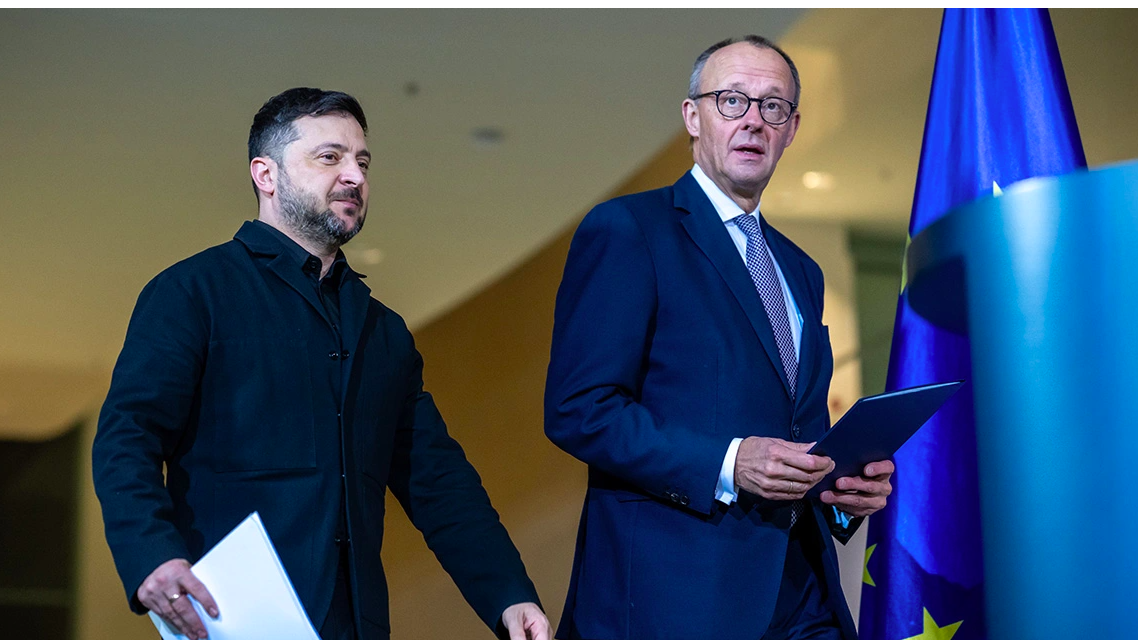
At a press conference with Volodymyr Zelensky early Monday evening in Berlin, the German chancellor first praised Donald Trump’s efforts to bring about peace. Without Trump, there would not be the positive momentum in the talks in Berlin, Friedrich Merz said.
He added that “we have hope for a real peace in Ukraine,” explaining that “we know the price of war and the price of peace.” He even praised the role of Steve Whitcoff and Jared Kushner, Trump’s two envoys.
Finally, he noted that he hoped for further progress at the dinner with European leaders.
For his part, the Ukrainian president said that many rounds of talks have been held today and more will be held. “We are constantly working” to achieve peace, but “not all questions are easy,” he said. The negotiations were tough but important, he added, saying that “our partners are listening to Ukraine and are ready to help.”
Security guarantees are essential for the agreement, the Ukrainian leader stressed. Ukraine needs clarity on guarantees before it can consider territorial claims, he said.
On the territorial issue, he insisted his country is ready to work for a “strong peace talk.” The talks are painful as the territorial issue is difficult to resolve, the Ukrainian president said.
Interestingly, he said the US is not demanding anything for the territories, but is passing on Russian demands.
“There are very difficult issues, especially when it comes to territories. It is very important that we all work on this, and that these issues are resolved fairly,” the Ukrainian leader said.
On other Ukraine-related issues, Merz, when asked about the use of frozen Russian assets, which some member states still oppose, suggested that this is the only option the EU can approve. Alternative proposals, such as new loans, would require unanimity and would be blocked by countries such as Slovakia or Hungary.
The EU’s credibility is at stake if member states fail to reach an agreement on the way forward on this issue at this week’s European Council.
Ask me anything
Explore related questions