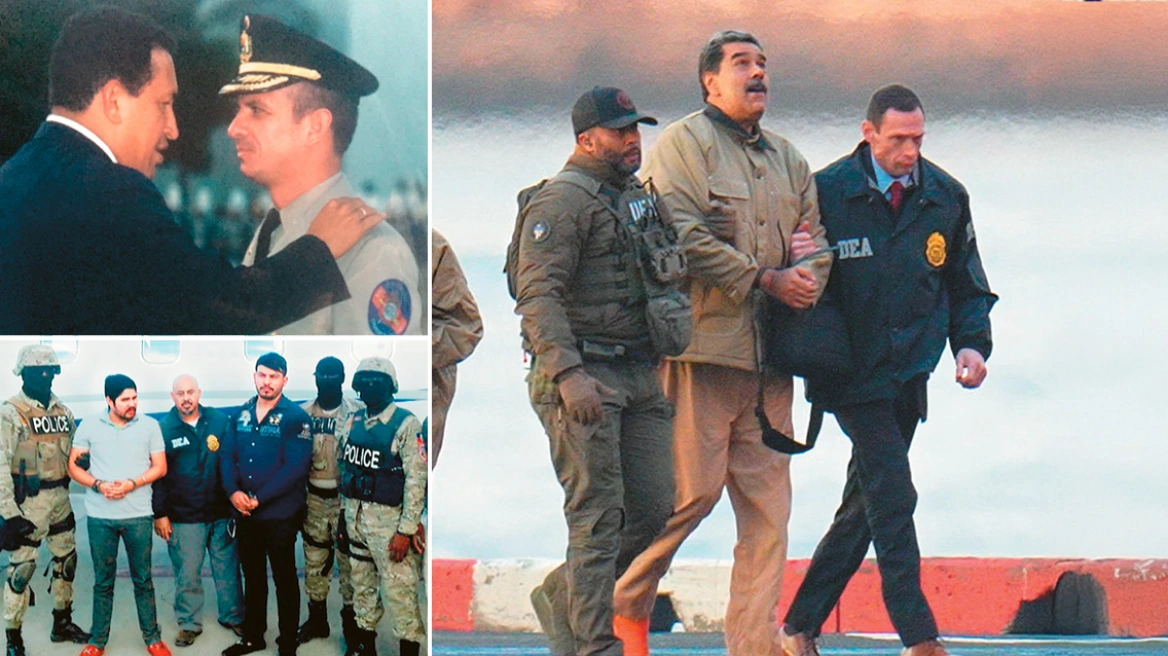
The White House, the U.S. President himself, and American law-enforcement agencies claimed that Venezuela was a narco-state. They regarded the country’s president as a narco-terrorist, the head of a criminal drug-smuggling network and an international fugitive. Truth or pretext? The question hangs in the air. On the ground, however, there were signs, indications, and fingerprints. All the actions, deeds, and behaviors of the arrested and abducted Maduro are expected to be clarified and documented by the courts in the United States.
In his “explanations” to the American people for the piratical military invasion of Venezuela that he ordered—without congressional authorization—Donald Trump was bluntly crude. He revived the “Monroe Doctrine” and asserted as a priority the exploitation of the South American country’s oil. In the name also of the “war on drugs,” he argued for the bully-style removal from power of Venezuela’s “illegitimate leader,” explicitly calling him a direct threat to U.S. national security. With this narrative he defended the violation of international law, implying that his country had acted in self-defense. This likely reassured the rough-and-ready diplomatic networks of drug traffickers. In their immoral world the scales are always calibrated: they prefer to be a well-oiled cog in the engine of a dirty but profitable train rather than an expendable puppet of the engineer.
The avenues of coca
Seventy-five-year-old Carlos Lehder, one of the co-founders of the Medellín cartel, heard on German television the news of Maduro’s arrest and abduction. The paranoid criminal and drug lord who spent 33 years in U.S. prison now lives, after his release in 2020, in Germany—the country of his father’s origin. The notorious Colombian thug who proclaimed that cocaine was Latin America’s “atomic bomb” was in his time a master of financing political campaigns with drug money. He specialized in relations between drug traffickers and guerrillas, and was a maestro of cooperation between traffickers and Caribbean governments for drug distribution. As a deep connoisseur of the sprawling structure of this illegal system, he could have fully and revealingly narrated what had been going on all these years in supposedly socialist Venezuela. For half a century, the traffickers’ modus operandi has not changed. Even so, he said nothing. In the past he had fingered Panama’s de facto military dictator Manuel Noriega for drug trafficking and money laundering; Noriega died in prison.
Lehder would very much have liked to do the same to Maduro and collect the $50 million bounty. He knew the Venezuelan’s methods, tactics, and techniques perfectly well, but lacked inside details. Others closer to Maduro surely benefited—his nearest informants. Inevitably, Lehder sank into memories of Pablo Escobar, who never managed to turn the Colombian state into a shield and platform for his criminal activities—something the tyrannical absolutism of Chavismo achieved in Venezuela. It fused political with criminal power into a single gangster mechanism. From Lehder’s perspective, that deserved congratulations. But now it was far too late for “bravo.”
The Mexican barons
At the same time, 10,000 kilometers to the west, the bosses of Sinaloa—the multinational and most sophisticated organized-crime syndicate—were conferring via undetectable, upgraded video-call technology about the “Maduro issue.” They were not unprepared for such a development. For the moment it sufficed that they themselves remained untouched and safe in their luxurious hideouts in Culiacán, at the foothills of the Sierra Madre, and in coastal Los Mochis on the Pacific coast of Sinaloa state. Their country, after all, had recently declared that it had no evidence of ties between the Maduro regime and Mexican cartels—neither the bloodthirsty Los Zetas in the east, nor the gruesomely criminal Sinaloa cartel in the west, nor the extremely murderous Jalisco New Generation Cartel in northern Mexico. Evidently, the Mexican government had no proof linking the Maduro family and its governmental collaborators with the violent narco-terrorist organizations south of the Río Grande—as if the drugs they trafficked passed through customs. With such official laundering, Sinaloa’s powerful leaders felt entirely satisfied.
At the helm of the organization is no longer the “legendary” drug lord Joaquín “El Chapo” Guzmán, nicknamed the “Houdini of escapes.” Since 2019 he has been serving life plus 30 years at the ADX Florence supermax in Colorado. He has been succeeded by his sons, “El Güero Moreno” and “El Chapito.” Both, after the American night-time commando raid in Caracas, praised their own country’s good fortune. Their homeland may have a strict, left-wing president of Jewish origin, but not a frenzied extremist and loud anti-imperialist like “Niño Guerrero”—“the Child of War”—Maduro’s nickname. Perhaps that very day they sent some of their gangster underlings to light a candle at the chapel of bandit Jesús Malverde—in downtown Culiacán, opposite the Government Palace—who is venerated locally as the patron saint of drug traffickers.
Meanwhile, news of events in Venezuela passed almost unnoticed at Ecuador’s newly built port of Posorja on the Pacific coast of South America. On the docks, pallets were being loaded into containers and ship holds without concern. What if last year 15.4 tons of cocaine hidden among stacks of bananas and mangoes were seized there? What if the bulk of coca products cultivated in neighboring Colombian departments Nariño and Putumayo are gathered there? After all, the port is considered the world’s top exporter of cocaine. For the two brutally violent gangs, Los Choneros and Los Lobos, which prey on its facilities, not a leaf stirred in worry. On the contrary, they thanked their luck that their homeland was not a major oil producer like Venezuela.
Drug business continued just as carefree in Honduras. Because of its geography, the Central American country is a key cocaine transit hub. The state is plagued by extensive, endemic corruption due to deep entanglement between organized crime—led by the local gang Los Cachiros—and major political parties, the economic elite, the police, and the army. Yet all those involved in the perennial crime feel they enjoy constant impunity. A prime example is the pardon granted by U.S. President Trump to former Honduran president Juan Orlando Hernández—a pimp of local cartels—who was arrested in Tegucigalpa, extradited to the U.S. in 2022, and sentenced by a federal court to 45 years in prison in 2024. He was released from the high-security Hazelton prison in West Virginia on December 1, 2025.
The intervention in Caracas
All this was happening across international drug-trafficking networks as Venezuela’s dictator, together with his wife Cilia Flores—the primera combatiente (“first combatant”) as she is known in Chavista rhetoric—were forced to change scenery. From the first hours of the previous Saturday, they had already bid farewell to their residence in the Fuerte Tiuna military complex in Caracas.
At the same time, across the vast coca fields of Colombia, Peru, and Bolivia, life went on quietly—unconcerned with the troubles of an authoritarian tyrant ruling an entire country. Across an area totaling nearly four million acres, poor farmers continued their routine harvest of coca leaves and transported them for pulping to guarded laboratories in the South American jungle. Despite the crack caused by Maduro’s fall, the compact narco-system remains strong. It appears so solid that Trump’s delirious boasts of eliminating “97% of drug trafficking” sounded like childish exaggerations. Even the arch-liar Nixon, who launched the war on drugs in 1973, was less clumsy in spinning tall tales. Today, however, such claims need no justification—they are on the daily agenda in overdose.
Maduro’s network
The truth is that the charges against Maduro are based on a 2020 federal investigation. According to it, the arrested Venezuelan president ran the Cartel de los Soles—the Cartel of the Suns—named after the insignia adorning the uniforms of Venezuela’s high-ranking military officers. Although Americans quietly withdrew the claim of an organized drug cartel, stating instead that it was a “network of state corruption and patronage,” the substance of the accusations barely changed. For them it was a patronage ring with Maduro at its core: an illegal circuit in which generals oversaw routes and shipments; ministers and governors controlled ports, airports, and borders; intelligence officers eliminated “obstacles”; diplomats facilitated links with international criminal networks and provided political cover; trusted financiers and loyal businessmen laundered money for a fee and financed the totalitarian regime; and members of the militarily trained Bolivarian National Guard conveniently overlooked a kilo less per shipment—without extra supervision—to pocket the difference.
In short, it was an entrenched system with illegal and unfair aims that turned official state institutions into service structures for drug smuggling to the U.S., with the head of state as the cynical manager of flows—not heavy, dense, black oil, but lighter, whiter, easily packaged, and infinitely more profitable ones. He never admitted trafficking drugs. In his vocabulary, “state export facilitation” might have fit better—serving the interests of himself, his clan, and his close government associates. Although Venezuela is not a cocaine-producing country but a transit point, Washington insisted that Maduro collaborated for years with the Marxist-Leninist guerrillas of Colombia’s FARC, granting them bases in sparsely populated, border-control-free areas between Venezuela and Colombia to facilitate exports of their “white powder” to the United States.
He was also linked to coordinating the notorious gang Tren de Aragua, which began its international criminal activity a decade ago inside Tocorón prison in Aragua state. He was accused of continuing the operation of illegal cocaine labs and derivative synthetic opioid fentanyl labs—deadly facilities that the late former president Hugo Chávez had set up twenty years earlier in impoverished western Caracas neighborhoods in cooperation with Mexico’s Sinaloa cartel. Over time, vast areas of the country fell under the influence of criminal networks inextricably tied to the state—especially in the southern border regions of the Orinoco Mining Arc—where state law ceased to apply and morbid mafioso rules prevailed.
Local residents struggled to distinguish between lawful authorities and criminals. In any case, the latter bought police and military uniforms from private shops—most requiring no certificates—stuck on fake badges and issued orders. Similar commands were strictly dispensed by Colombia’s “Che Guevarist” National Liberation Army (ELN), to which the ruling United Socialist Party of Venezuela (PSUV) granted bases and makeshift airstrips in the wooded plain near Lake Maracaibo—perfect for the covert, silent movement of drugs from Venezuela to North America.
“El Pollo”: the deep throat
In a disintegrated country with collapsed state structures, porous geography, an extensive corruption network, and deep social crisis, Maduro answered to nothing and no one. Acceptance by Moscow, Tehran, Beijing, Havana, and other “progressive” forces sufficed—fueling his monumental contempt for international rules. He should have had a shock when the deposed former head of military intelligence, General Hugo “El Pollo” Carvajal, began to sing instead of cluck about his political superior’s drug dealings.
After breaking with Maduro, Carvajal fled by boat to the Dominican Republic, then reached Spain under an alias, where he was arrested and extradited to the U.S. There he provided incriminating information about Maduro’s “deep and rotten” state and his vile, corrupt entourage. He himself was no innocent: as a Chávez confidant, he had taken part in “dirty” activities—first and foremost the 2006 DC-9 case that flew from the presidential hangar in Caracas to Ciudad del Carmen on Mexico’s southern Gulf coast carrying 5.6 tons of cocaine packed in 128 suitcases, destined for illegal entry into the U.S. Those were the days when former bus driver and unionist Maduro played foreign minister despite speaking no foreign language. In any event, Maduro brushed off Carvajal’s testimonies to U.S. prosecutors last summer.
The nephews and the one ton
Ten years ago, one night in November 2015, two of Maduro’s nephews—29-year-old Efraín Antonio Campo Flores and 30-year-old “Franky” Francisco Flores de Freitas—were arrested near Toussaint Louverture airport in Port-au-Prince, Haiti. They were transporting 800 kilograms of cocaine on a private Cessna that had taken off from Terminal 4 of Caracas’s Maiquetía “Simón Bolívar” airport, reserved exclusively for presidential flights. They were escorted by officers of the Bolivarian Intelligence Service (SEBIN) as an honorary presidential guard. Both held Venezuelan diplomatic passports but lacked diplomatic immunity, and planned to export the cached cargo to New York. The U.S. DIA, which participated in the arrest, transferred them to the U.S. for interrogation. There they revealed they were nephews of First Lady Cilia Flores, and that one had been adopted by the president. They confessed the $5 million proceeds were intended to finance their aunt’s congressional campaign and the president’s race.
A raid followed on Efraín’s Casa de Campo villa and yacht in the Dominican Republic, uncovering another 130 kilograms of cocaine and 10 kilograms of heroin. Later, the Cessna pilot, Antonio Lamas Rondón, was arrested at Bogotá’s El Dorado airport—a man who had ferried countless tons of drugs on more than 100 flights to remote private airstrips across the U.S. It was also the period when Venezuela’s anti-drug chief, Néstor Luis Reverol Torres—now a fugitive—was bribed $100,000 per illegal flight.
The two “narco-nephews” were sentenced in December 2017 by a federal court to 18 years each. Venezuela’s controlled media deflected the scandal, avoiding any mention—heaven forbid—of their family ties to the president. The facts were obvious, yet grotesque cover-ups ensued. The proud uncle, in his familiar anti-American refrain, spoke of a coup-style kidnapping, imperialist ambushes, and systematic plots against the country’s people-friendly system—one that, among other evils, relied on pushing a few tons of drugs toward its enemies. The nephews got off relatively lightly: in October 2022 they were released in a prisoner swap involving five CITGO executives held for five years in the hellish El Helicoide prison. They returned to the U.S. so the president’s nephews could come home to Caracas with honor—without any public reference to their disgraceful drug-trafficking crime.
The “Bolibourgeoisie”—a blend of Bolivarian Revolution and a favored new bourgeoisie—formed a corrupt, plunderously wealthy, ruthlessly greedy oligarchy that grew under the protection of the Chavista-Madurista machine. While a people crushed by repression and condemned to dramatic poverty without medicine, wages, or voice suffered, this new elite enriched itself under the pretext of socialism—enjoying flashy financial and luxurious pleasures in Miami, Spain, and Panama. Meanwhile, eight million Venezuelans, sunk in unbearable deprivation and terrorized by relentless persecution, were forced into migration and exile.
This privileged caste didn’t care if tens of thousands of compatriots suffered arbitrary arrests, torture, kidnappings, disappearances, and killings. Nor did it bat an eye as the Colectivos—pro-government armed paramilitary biker militias in red berets—intimidated and threatened not only dissidents but anyone suspected of criticism, always with the consent and coordination of domestic security forces. This army of fanatical praetorians, benefiting from the scraps of major drug deals by top officials, was slated to wage urban guerrilla warfare if the regime fell. Shielded by this para-state orchestra, the privileged prospered on. What if there were already 254 open corruption cases in 31 countries involving Venezuelan politicians and citizens with assets worth tens of billions? Why worry about accountability while ensconced in the lawless vineyard of “Maduristan”?
Unrestrained, after looting state coffers they moved assets to banks in Turkey, the UAE, Caribbean offshore islands; bought mansions in Florida, private yachts and jets; filled garages with supercars; added thoroughbred racehorses; amassed precious metals, gemstones, solid-gold treasures; invested laundered money in crypto, commercial real estate, and businesses worldwide—living lavishly while, according to the UN, another eight million urgently needed humanitarian aid.
This destructive enterprise could not last forever. The shameless confidence of an unaccountable dictatorship, backed by international autocracies, had limits. The delusional belief that weaponizing drugs against U.S. national security had an expiration date. The Maduro experiment would be paid for dearly—above all because it showed that one doesn’t need a gang of criminals to commit crimes: it suffices to run a corrupt, unfree state of institutional decay to perpetrate felonies repeatedly. Something that would not be internationally tolerated—by both crude political hypocrites and refined moralizers alike.
Ask me anything
Explore related questions