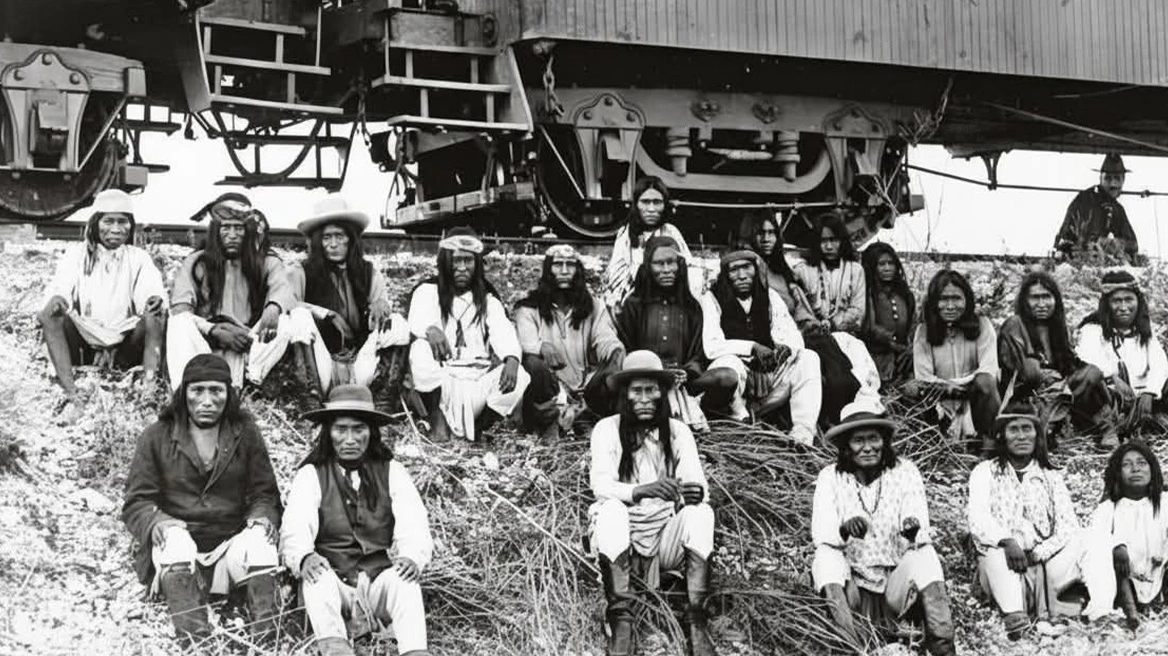
A widely known Native American people, with a long history, legendary leaders such as Geronimo, and a similar fate and treatment to that of the Comanches, were the Apaches. Today we will present their history, their battles with the U.S. Army—mainly between 1850 and 1886—as well as the policies of “cleansing” which, according to some, approach the limits of genocide.
Who were the Apaches?
The Apaches are a Native American people who live in the southwest of North America. They took their name from the word Apachu of the Zuni tribe, meaning “enemy, bad dog.” Together with the Navajo, they belong to the southern Athabaskan linguistic family. This is one of the largest linguistic families of Native Americans in North America, consisting of about 38 languages.
The Apaches migrated from the far north of America before Spanish colonization, to areas that today include the U.S. states of Arizona (central and southeastern), southeastern Colorado, New Mexico (southwestern and eastern), western Texas, as well as the northern Mexican states of Chihuahua and Sonora.
Culturally, the Apaches are divided into Eastern Apaches—who include the Mescalero, Jicarilla, Chiricahua, Lipan, and Kiowa Apache—and Western Apaches, which include the Cibecue, Mimbreño, Coyotero, and Northern and Southern Tonto Apaches.
The Kiowa Apaches joined the Kiowa, adopting their customs. The Apaches lived mainly by hunting and gathering. They did not eat reptiles, nor animals that fed on reptiles, because they did not consider them clean food. They were skilled hunters and excellent runners. They could walk even 100 kilometers in a single day across difficult terrain in order to hunt or fight. They were of short stature (average height about 1.60 meters) and extremely capable in hand-to-hand combat. They trained from a young age. Their main weapons were the bow, spear, axe (tomahawk), and the knife they carried at their belt. They quickly became familiar with the rifles of the whites. They were accustomed to scalping their enemies if these were soldiers. The Chiricahua claimed they learned this practice from the Mexicans, who took the scalp (the skin of the head with the hair) from dead Apaches.
The Apaches were among the fiercest groups along the U.S.–Mexico border. Initially, they tried to befriend the Spanish, the Mexicans, and the Americans. However, attacks by Apaches on Spanish missions are recorded. The failure of the Spanish to protect the Pueblo peoples from the Apaches during a five-year drought in the late 17th century led to the Pueblo Revolt, in cooperation with the Apaches (1680). The Pueblo maintained their independence until 1692, when they again came under Spanish rule. To avoid reprisals, many Pueblo fled to the Navajo.
1830: The Indian Removal Act and Cochise’s ten-year war
On May 28, 1830, the Indian Removal Act was passed in the United States. According to it, all Native American tribes living in the east were required to abandon their lands and settle west of the Mississippi. Thus, the U.S. government reneged on all the promises it had made to the Native Americans that they would remain in their territories.
In 1848, after the end of the Mexican–American War, Mexico ceded to the United States territories of Texas, California, Arizona, New Mexico, Utah, and Nevada. This meant that the Native Americans of these regions also had to be restricted. Settlers lived peacefully with the indigenous people, except in some cases where warlike Native Americans carried out raids against them. After the Treaty of Hidalgo (1848), which ended the U.S.–Mexico War, American soldiers began to make their presence increasingly felt in the territories ceded to the United States, causing concern among the Native Americans.
Nevertheless, in the 1850s Native Americans attacked Americans traveling on the Santa Fe Trail and the Southern Butterfield Route, but mainly within Mexico, as they crossed the U.S. border.
From a mistaken assessment of a domestic incident, the great Apache uprising under Cochise, chief of the Chiricahua Apaches, began in 1861, before the American Civil War. Specifically, a ranch owner, John Ward, 65 kilometers south of Tucson, brutally beat his mixed-race son, who then ran away from home. Ward believed that the boy had been kidnapped by Chiricahua Apaches under Cochise. At the same time, he blamed Cochise for the theft of a herd of his cattle and informed the detachment at Fort Buchanan.
Lieutenant George Bascom assembled a detachment of 54 men to attack the Apache Pass through the Chiricahua Mountains. At the same time, he invited Cochise to a meeting, having set a trap for the Chiricahua chief. On February 4, 1861, Cochise, unsuspecting, went to Bascom’s tent, accompanied by his brother, two nephews, a woman, and two children.
He denied any involvement in what had happened at Ward’s ranch. In fact, considering the Coyoteros—White Mountain Apaches—responsible, he offered to mediate in order to free the boy. Bascom replied that Cochise and his companions were under arrest. Cochise drew his knife and slashed the tent, managing to escape. Those accompanying him, however, were held hostage. Cochise then captured three white men and began negotiations to exchange them for his own hostages. Bascom refused. Enraged, Cochise killed one hostage and dragged the body behind his horse in front of a military detachment. When his people were not returned, he killed the other two as well.
In retaliation, the whites hanged six innocent Chiricahua. Cochise and a group of warriors began ambushing along the Butterfield Pass, killing Mexicans and capturing Americans. From a rash action by an American lieutenant, a war began with Cochise’s Indians that lasted ten years.
The Chiricahua were aided by the White Mountain Apaches and the Mimbreño Apaches under Mangas Coloradas, Cochise’s father-in-law. Their main target was the government stagecoaches that crossed the Butterfield Pass. After a series of fierce battles, two companies of dragoons from Fort Breckinridge drove the Apaches into Mexican territory. Before leaving, the Indians killed all the hostages. In turn, Bascom hanged all the Indian hostages he had captured, including Cochise’s brother. This enraged the Apaches, who within two months killed at least 150 Americans and Mexicans.
The American Civil War, as expected, also affected operations against the Apaches. The U.S. Army abandoned the forts in the Chiricahua region. To fill the gap and secure the northern and southern routes to California, Governor John Downey organized two columns of volunteers: one sent to Utah under Colonel Patrick Connor, and the other to the southwest under Colonel—and later General—James Carleton. Cochise and Mangas Coloradas decided to defend themselves and fortified positions near the abandoned station close to Apache Pass.
The vanguard company of Carleton, under Captain Thomas Roberts, entered the station on July 15, 1862, with two howitzers and repeating rifles. Soldier John Teel shot Mangas Coloradas in the chest. The Apaches retreated into the desert, and some men carried Mangas Coloradas to Janos, Mexico, where at gunpoint they forced a doctor to remove the bullet. Carleton realized the importance of Apache Pass and ordered the construction of Fort Bowie. He ordered his soldiers to treat the Apaches as if they were wild beasts. In September, he took command of New Mexico, succeeding General Edward Canby. General Joseph West took command of southern New Mexico.
The murder of Mangas Coloradas, Kit Carson, and the Sand Creek Massacre (1864)
In the following years, a series of events of decisive importance occurred—events that were deeply shameful for the United States. The ruthless West decided to eliminate Mangas Coloradas, the most respected Apache chief, through treachery. He sent one of his captains to Mangas and asked him to come to the camp near Pinos Altos. Unsuspecting, the Indian went there on January 17, 1863, and was immediately arrested. He was then imprisoned at Fort McLane on the Mimbres River. As a soldier later testified, West made it clear that he wanted Coloradas murdered.
That same night, two soldiers heated their bayonets and pressed them, almost red-hot, against the feet of the sleeping Mangas. The Indian sprang up, and the soldiers emptied their weapons into him.
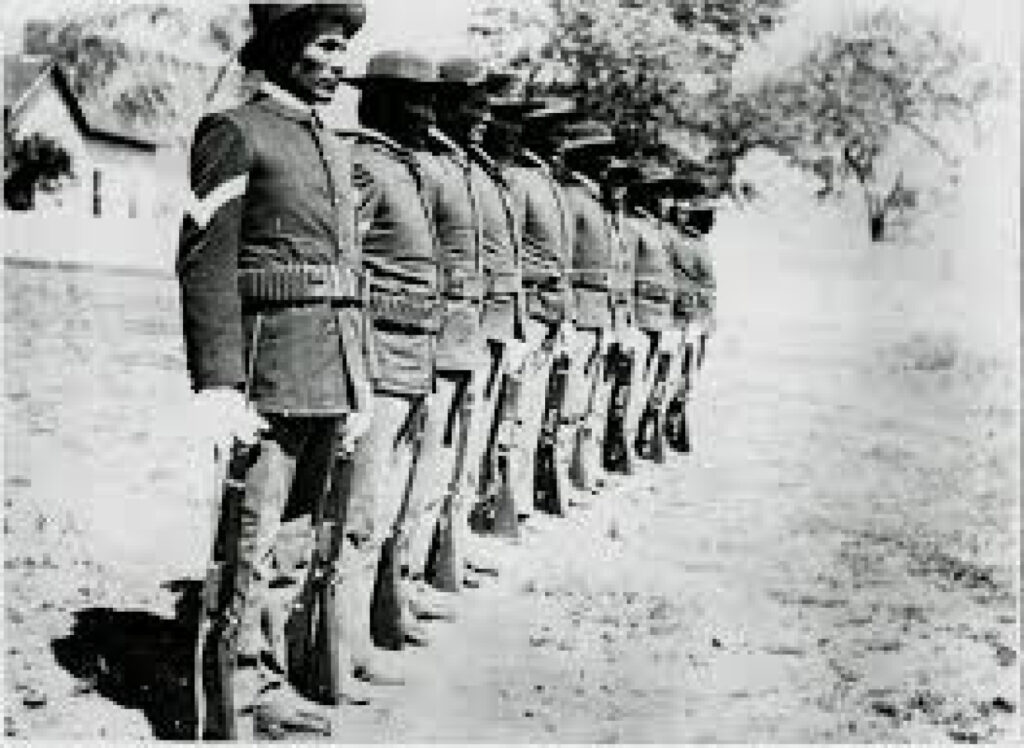
(American Army Indian scouts)
West ordered an inquiry, but those involved were acquitted, claiming that Mangas had attempted to escape. In the east, the Mescalero continued their activities. Carleton decided to move against them and made use of Kit (Christopher) Carson, a legendary figure of the Far West—former trader, guide, and Indian agent—who had fought in the Civil War on the side of the Union.
At the beginning of 1863, Carson established his base at Fort Stanton in southeastern New Mexico and conducted numerous attacks. In a battle with the Indians, Carson’s men under Lieutenant William Graden killed two of their chiefs. By late spring, worn down by constant fighting and pursuit, the Mescalero agreed to settle at the camp near Fort Sumner, in the Pecos River valley at Bosque Redondo. Soon, Navajo captives from subsequent campaigns by Carleton and Carson were also sent there.
In 1864, a horrific event occurred which does not directly concern the Apaches, but two other tribes familiar to anyone who has read—even comic books—about cowboys and Indians: the Cheyenne and the Arapaho. This was the so-called Sand Creek Massacre, essentially the massacre of civilians—mostly Arapaho and Cheyenne—by the U.S. Army on November 29, 1864. A force of 675 men of the Third Colorado Cavalry Regiment, under the command of volunteer Colonel John Chivington, attacked and destroyed a Cheyenne and Arapaho village in southeastern Colorado. One hundred fifty Indians, two-thirds of them women and children, were killed and mutilated. Chivington claimed the dead numbered 500–600, but this figure is likely exaggerated. The site is now designated the Sand Creek Massacre National Historic Site and is administered by the National Park Service.
The Aravaipa Massacre (the Camp Grant Massacre)
The most heinous crime against the Apaches—and Native Americans in general—was the Aravaipa Massacre (the Camp Grant Massacre) on April 30, 1871. A group of Aravaipa Apaches, also known as Western Apaches, under the leadership of Eskiminzin, seeking peace, moved toward Camp Grant, an outpost about 80 km northeast of Tucson, Arizona. Its commander was Lieutenant Royal Emerson Whitman, aged 37. Initially, relations between the Indians and American soldiers were peaceful. At some point, Whitman asked Eskiminzin to move his people to the White Mountains near Fort Apache, founded in 1870. Eskiminzin refused. As they left, the Indians turned their weapons toward Whitman and his soldiers.
The inhabitants of Tucson, who hated the Indians, decided to form a “vigilante group.”
On the afternoon of April 28, 1871, six Anglo-Americans, forty-eight Mexican-Americans, and ninety-two Papago Indians (who had submitted to the Spanish and been Christianized by Catholic priests) set out for Aravaipa Canyon, arriving at dawn on April 30, 1871. Most Apache men were away hunting in the mountains. Only eight warriors remained in the camp. The Papago carried out the killings, while the Anglo-Americans and Mexican-Americans blocked the Indians’ escape. About 144 Apaches and Pinal were killed and mutilated, and almost all were decapitated. The women who survived were raped, and 27 of the 29 children were sold as slaves in Mexico. The other two escaped. Whitman dealt with the burial of the dead. Only one woman survived the massacre.
Whitman sent interpreters into the mountains, who assured the Aravaipa that his soldiers had no involvement in the massacre. Whether this is true is unknown, though it is possible, considering that Arizona’s settlers regarded the massacre as “justifiable homicide.” When U.S. President Ulysses S. Grant (1869–1877) learned of what had happened, he was furious. He had designed post–Civil War Indian policy and considered such massacres unacceptable. He sent a peace commission to Arizona, led by General Oliver Howard and Vincent Colyer, to achieve peace, and informed Arizona Governor Safford that those responsible must be tried and punished exemplarily.
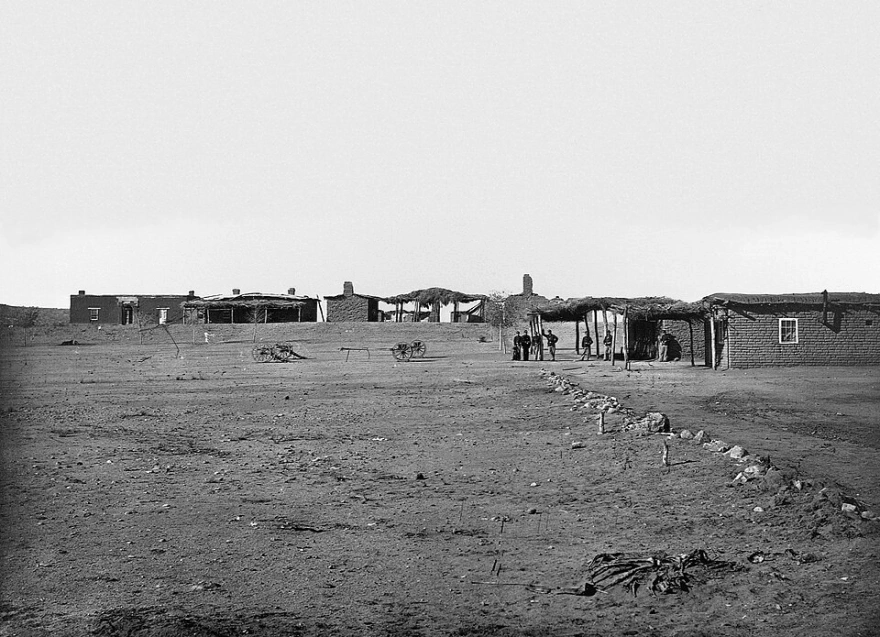
(Camp Grant in an 1870 photograph)
In October 1871, the trial of 100 perpetrators for 108 offenses began. After two months of hearings, the Apaches themselves were found accused of looting, as the trial focused on that! The verdict took 19 minutes: all acquitted.
The only positive outcome of the President’s well-intentioned peace initiative was that six of the 27 children sold as slaves were eventually found. Unfortunately, since the transactions had been secret, the remaining 21 were never found. Five Indian agencies were also established (four in Arizona and one in New Mexico). Cochise, still leader of the Chiricahua, asked Howard to allow a reservation on their land at Apache Pass, with border scout Thomas Jeffords in charge. Cochise promised to maintain order in the reservation, which he did until his death in 1874.
General Crook, the “Indian fighter” – Apache life on government reservations
Other Apache groups, however, continued their raids, mainly against suppliers of the Indian agencies. This fueled public anger and led to military organization against the raiders in central Arizona. Command of the operation was given to General Crook, transferred to the Southwest after gaining fame as an “Indian fighter” in the Snake War in Idaho and Oregon.
From 1872–73, with nine small detachments using Indian scouts recruited from the reservations, Crook’s forces fought 20 skirmishes and killed 200 Indians. Crook’s army won two very important battles on December 28, 1872, and March 27, 1873. From April onward, exhausted, the Apaches and their families began to surrender. By autumn 1873, the number of Apaches and Yavapai settled on reservations in Arizona and New Mexico reached 6,000.
Life on the reservations was a harsh ordeal. Food shortages, boredom, and disease decimated their population. Many, to avoid this situation, stayed off the reservations and lived by hunting, looting, and raiding. To control them better and to free land for settlers, the U.S. government ordered all Apaches living west of the Rio Grande to settle along the Gila River in Arizona in 1875. Some Apaches, however, continued to resist…
Victorio: successor of Mangas Coloradas and his mysterious end
One such group of “unruly Apaches” was led by Victorio, successor to Mangas Coloradas, who had grown up beside the murdered leader. This group operated between 1877 and 1880. On September 2, 1877, Victorio and 300 of his men left San Carlos. About 200 of them surrendered a month later at Fort Wingate in New Mexico. Victorio, with about 80 warriors, remained in the mountains, hoping to settle at the Mescalero reservation at Ojo Caliente in western New Mexico, but negotiations failed.
On September 4, 1879, Victorio and his warriors attacked a cavalry camp, killing eight guards. With the help of the Mescalero, Victorio led his group into Mexico and then back into the United States (Texas, New Mexico, and Arizona). The United States and Mexico allied against Victorio. American forces under Colonel Edward Hatch in New Mexico and Colonel Benjamin Grierson in Texas, and Mexican forces under General Gerónimo Treviño, pursued him.
Victorio and his men repeatedly deceived their pursuers and emerged unscathed from many battles. Meanwhile, American soldiers crossed into Mexican territory, violating government orders of non-intervention. Victorio was captured several times but always managed to escape. Even his enemies respected him for his bravery and perseverance.
In the autumn of 1880, Victorio tried to escape from Colonel George Buell. He entered the Chihuahua Desert and led his men within firing range of 350 Mexicans and Tarahumara Indians under Colonel Joaquín Terrazas. In the two-day Battle of the Three Peaks in October 1880, many Apaches were killed. Victorio and a few men were surrounded by Mexican soldiers. Though greatly outnumbered, they decided to fight to the end. Victorio was found dead. It is unknown whether he was killed in battle or committed suicide to avoid capture, according to legend. The 80-year-old Nana, Victorio’s uncle, assumed leadership after his death.
Geronimo: the legendary Apache whose name became a battle cry of American paratroopers
Even those who know little about Native Americans have likely heard the name Geronimo, perhaps the most important Apache leader. He was born in 1829 in the Dodoyon Canyon of Arizona. He was one of eight children and was originally known as Goyaałé (“the one who yawns”). According to one view, the name Geronimo came from Mexicans calling on Saint Jerome when they saw him, begging to be saved from the fierce Apache. According to another, Geronimo was respected as a holy man—a shaman (magician, healer).
He had eight wives—four Apache and four mixed-race—and eight children, four of whom were killed by Mexicans and four imprisoned by the U.S. government. He lived with the Nednhi band of Chief Juh on the Mexican side of the border after the dissolution of the Apache Pass reservation in 1875. The Mexicans attacked their camp several times but were repelled. The Nednhi frequently changed locations to avoid detection. On one occasion, 60 Nednhi faced two squadrons of Mexican cavalry. They methodically killed all the Mexicans’ horses, pinning them among the rocks. Suddenly, on Geronimo’s command, the Apaches attacked and killed them all.
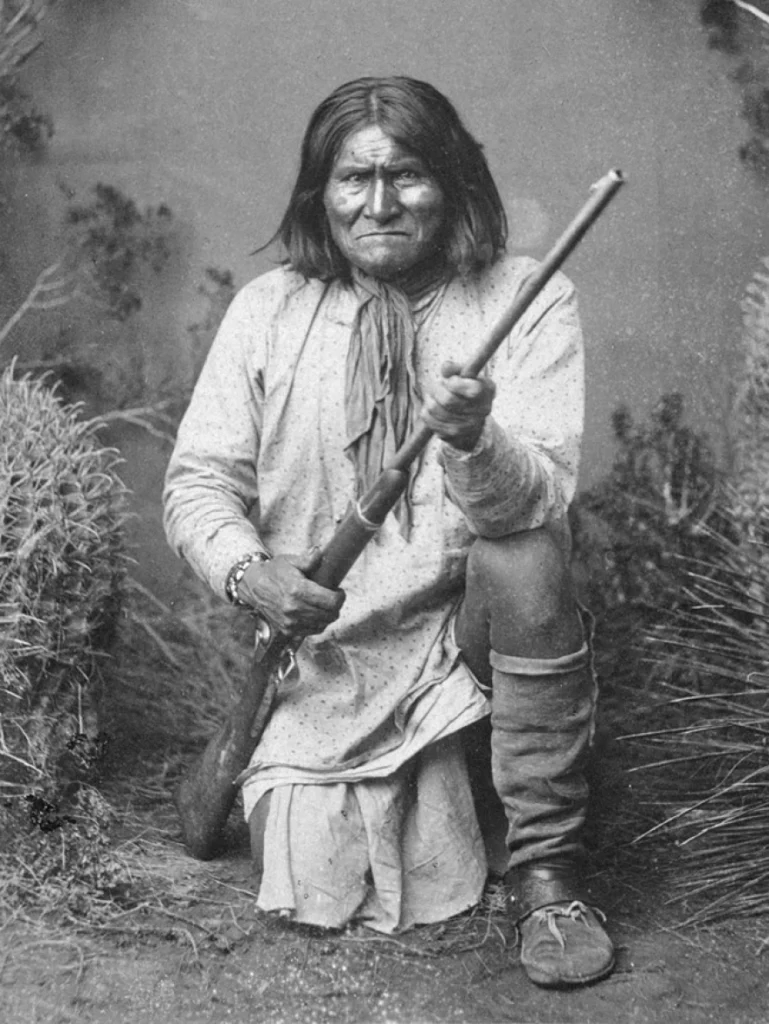
From 1876 to 1881, Geronimo lived intermittently on reservations, from which he often fled, returning when he felt endangered. On August 30, 1881, soldiers from Fort Apache killed Nakaidoklini at Cibecue Creek. He taught a new religion that believed in the return of dead warriors to help the natives fight the whites. Many soldiers arrived at San Carlos as the Indians grew enraged. One month after Nakaidoklini’s killing, Geronimo and Juh, along with Naiche, son of Cochise, the brave Chato, and 74 others, left San Carlos for Mexico.
In April 1882 they returned to the reservation, killed the chief of the police force, and forced Loco, chief of the Mimbreño Apaches, and his men to follow them south. Warriors from the White Mountains also rose against the Americans, not having forgotten Nakaidoklini’s murder (Battle of Big Dry Wash). Geronimo began to become a legend. U.S. authorities again sent Crook to Arizona.
Geronimo surrendered reluctantly in January 1884, but fled again from San Carlos in May 1885 with Naiche, Nana, and 150 men, due to the ban on tizwin, the Indians’ alcoholic drink, on the reservation. All headed for the Sierra Madre. Crook launched a new relentless pursuit. Geronimo surrendered on March 27, 1886, at Los Embudos Canyon, agreeing under Crook’s terms to be confined in the East for two years. Shortly before reaching Fort Bowie, Geronimo, Naiche, and 24 Indians escaped. Crook fell from favor and was replaced by another “Indian fighter,” Brigadier General Nelson Miles. Miles used 5,000 soldiers and 500 Indian scouts to capture Geronimo.
On July 15, 1886, Captain Henry Lawton temporarily captured Geronimo, who again escaped. In late August 1886, Geronimo sent word that he would surrender only to Miles. He was located in the Sonora Mountains. It is estimated that he had traveled 1,645 miles (about 2,650 kilometers). On September 3–4, 1886, at Skeleton Canyon, Arizona, Geronimo surrendered to Miles, who promised that they would be taken to Florida and eventually returned to Arizona. This never happened.
Geronimo and 500 Apaches, including many Army scouts, were transported in chains to Fort Pickens in Pensacola, Florida. Only in May 1887 was he allowed to see his family. They were then transferred to Mount Vernon Barracks in Alabama. There, due to appalling living conditions, one quarter of the Apaches died. Eskiminzin’s Aravaipa returned to Arizona, but the settlers there would not accept Geronimo and the Chiricahua. The Comanche and Kiowa offered to share their land with the Apaches, but this too did not happen. The latter were taken to Fort Sill, Oklahoma, in 1894.
Geronimo tried to integrate into “white society.” He worked in agriculture and joined the Dutch Reformed Church, from which he was expelled due to his gambling addiction. He never returned to Arizona. With special permission from the War Department, he was allowed to sell photographs of himself and handicrafts at fairs. In 1905, he dictated his autobiography (Geronimo: His Own Story) to S.S. Barrett. He died in 1909. His name, however, is still used today as a battle cry by American paratroopers.
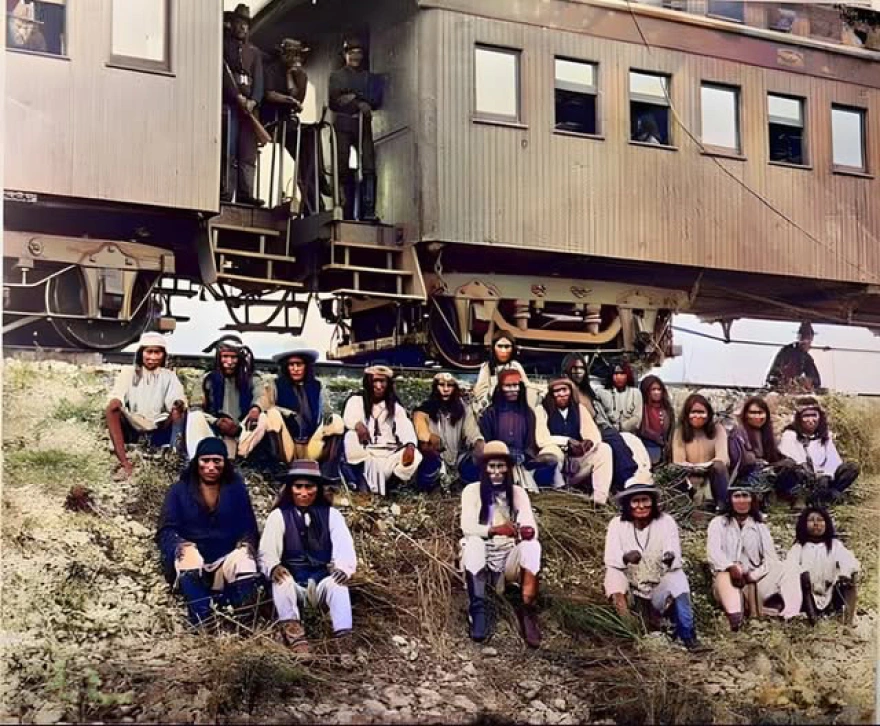
(Colorized photograph of shame – Geronimo and 500 of his men being transported in chains by rail to Florida, September 1886)
Epilogue
With the two features on the Comanches and the Apaches, we believe we have largely covered the subject of “Native Americans of North America.” Beyond broken promises, appalling living conditions on reservations, and all the rest, U.S. authorities exterminated Native Americans by other means as well. Although they cultivated land, they were not self-sufficient and depended on Army supplies. There were many irregularities and murderous acts: bread kneaded with strychnine, blankets infected with smallpox and other diseases, and poisoned water led many Native Americans to death.
Who were the good and who the bad? Who were the savage and barbaric, and who were the civilized, in the end?
In 1976, the South African musical duo Bolland & Bolland (who became widely known with “You’re in the Army Now” in 1981) released the song “The Last Apache.” Another hit by B&B, perhaps known only to Mr. Yiannis Petridis, is “The Dogs of War.” Watch “The Last Apache” here and—especially younger readers—look up the other two on YouTube.
Sources:
Dimitrios Bopis, 1850–1886: The 35-Year Apache Uprising, Military History Magazine, Issue 197, January 2008, Periskopio Publications.
Britannica.org (online edition).
Ask me anything
Explore related questions