What is particularly notable is that the package announced a few days earlier was improved both quantitatively and qualitatively and now amounts to €3.8 billion.
As competent government sources explain to protothema.gr, a key measure concerns low-cost agricultural electricity, which is set at 8.5 cents/kWh. Those who were outside a settlement and had overdue debts, provided they remain compliant for one year, will be included in the low tariff. Given that the GAIA program has been in effect since August 2024, some will be included immediately and others in the coming months.
There is also an open window for rejoining the GAIA program until March for those who neglected their obligations; however, they too must remain compliant for one year and will receive the low tariff starting in spring 2027.
As for agricultural fuel, the discount applied at the pump is further improved with the abolition of the Special Consumption Tax (SCT). It is recalled that for this year, the system with invoices and a subsidy covering 100% of consumption will apply, while from November 2026 and based on the new OSDE declarations, the new system will be implemented through an electronic application on mobile phones and at fuel stations.
In addition, beyond the SCT, the corresponding VAT is also removed, meaning the benefit amounts to €0.51 per liter.
Approximately €30 million will be allocated to those cultivating alfalfa, who suffered significant losses due to foot-and-mouth disease (loss of income following the culling of livestock). This was a key demand, as the income replacement scheme had already included livestock farmers as well as cotton and grain producers.
For livestock farmers in particular, there will be a new meeting with the prime minister next or the following week to hold an in-depth discussion on sector-specific issues. However, the government has already committed to supporting them in 2026 as well for income replacement, as it is considered unlikely that they will be able to rebuild their herds in time.
The issues raised at the discussion table, according to government sources, included the following:
- Technical issues regarding property ownership
- Transition of OPEKEPE to AADE
- Young farmers
- Professional representation of farmers
- Green transition
- Need to increase productivity
- New CAP – nationwide dialogue
- Redistribution of resources to honest farmers – basic and eco-schemes
- Linking subsidies to production – new model
- Production costs – electricity and fuel – methodology update
- Support for alfalfa in affected areas
- Support for greenhouses
- Infrastructure – irrigation and rural roads
- Climate change – water scarcity
- Agricultural laborers
- ELGA – regulation changes
- Farmer training
- Utilization of unused agricultural land
- Pesticide prices
- Foot-and-mouth disease
Hard line on roadblocks
At the same time, ELGA compensations will be accelerated, while the prime minister, as also reflected in his statement immediately after the meeting with producers, is set to adopt a hard line toward union leaders who remain at the roadblocks.
Mitsotakis’ statement on government measures for farmers
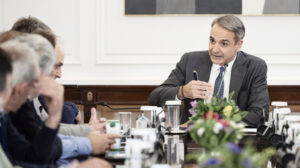
“The government has exhausted the economy’s capacity by supporting farmers more than ever before. But it has also exhausted the limits of its understanding toward a sector it has stood by for years. Therefore, we will not tolerate blackmail, illegality, or irrationality. And, of course, we will not wrong the rest of society,” Mr. Mitsotakis emphasized.
Ask me anything
Explore related questions