




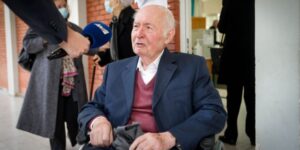
Giorgos Vasileiou has breathed his last at the Nicosia General Hospital, at the age of 94, where he had been hospitalized for the past few days. For the past two years, he had been a guest in a private facility. His death was made public by his wife, former Commissioner to the EU, Androulla Vassiliou, in a post on X.
Ms Vassiliou wrote: “After 2 years of suffering, my beloved George, my life partner for 59 years, passed away quietly in our arms tonight at Nicosia General Hospital. It is difficult to part with this man who was an excellent husband and father, a man full of kindness and love for his country and his people.”
Μετά από 2 χρόνων ταλαιπωρία, ο αγαπημένος μου Γιώργος, σύντροφος τ ζωής μου γ 59 χρόνια, έσβησε ήσυχα στην αγκαλιά μας απόψε σ ΓΝΛ. Είναι δύσκολο ν αποχωριστώ αυτό τ άνθρωπο π υπήρξε ένας εξαιρετικός σύζυγος κ πατέρας, άνθρωπος γεμάτος καλωσύνη κ αγάπη για τ τόπο κ τ λαό του.
— Androulla Vassiliou (@VassiliouEU) January 13, 2026
The loss of George Vassiliou marks the end of a journey that was identified with the transition of Cyprus into the modern era. The man who was elected in 1988 as the ultimate outsider managed to transform a traditionally conservative political scene into a field of technocratic modernization. His death was recorded in the early hours of the morning, after hospitalization that began on Epiphany Day for an acute respiratory infection. His health deteriorated rapidly in the last few days and despite medical support, his body did not respond.
Realist and Europeanist
George Vassiliou was a unique case in political annals. Although the son of the historical leftist Vassos Vassiliou, his career was not trapped in ideological rigidities. He studied in Hungary, where his father had fled as a political refugee after the Greek Civil War. He went on to study in Vienna, Geneva, and London, and on his return to Cyprus, he founded the Middle East Research Centre, turning market research into a powerful business tool. His election to the presidency of the Republic of Cyprus with the support of ACEL in 1988 alienated many but he quickly proved that his agenda was clearly liberal and westernised.
Reforms and modernisation
The five years from 1988 to 1993 were characterised by an unprecedented reform momentum aimed at bringing Cyprus into line with European standards. C. Vassiliou was the President who dared to introduce the FPA despite the fierce opposition of the time, as he realized that without this step, economic harmonization with Europe would remain an empty letter.
The establishment of the University of Cyprus in 1992 is perhaps his most emblematic legacy in the field of education. Until then, Cyprus had been exporting its human resources abroad, while the foundations for the intellectual and scientific autonomy of the island were laid with the operation of the state university. At the same time, the modernisation of the public administration and the introduction of new technologies were priorities that changed the structure of the state.
Cyprus, “Gali Plan”
In Cyprus, the Kingdom Presidency coincided with a period of intense mobility under the United Nations, with the framework that came to be known as the Gali Initiative. It did not result in an agreement, but it marked those years with negotiations and efforts to get the issue back on track, at a time when Ankara and the Turkish Cypriot leadership often put obstacles in the way of any attempt at substance.
European strategy
On the national issue, George Vassiliou was a believer in pragmatism and active diplomacy. His application for membership of the then EEC in 1990 was the crowning foreign policy act of his tenure. He understood in time that the armouring of Cyprus could not come from the traditional Cold War balances but from full integration into the great European family. In his effort to turn Cyprus towards Europe, he was encouraged by the late Yiannos Kranidiotis and Theodoros Pangalos, who considered the left-wing AKEL to be a stumbling block because of its ideological opposition.
Even when it lost the 1993 election to Glafkos Klerides by just two thousand votes, it did not withdraw. His contribution as head of the negotiating team for Cyprus’ accession to the European Union was a catalyst, as his technocratic competence and connections in Brussels overcame much resistance.
In the last years of his life, Giorgios Vassiliou remained an active citizen, publicly expressing his views on the economy and the Cyprus problem, always with a Western orientation and modernization in mind. His health, although fragile due to his age, did not prevent him from following developments until his recent hospitalization.
Ask me anything
Explore related questions