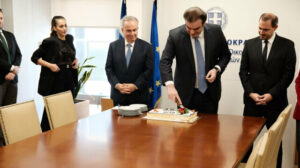





The meeting between government officials and representatives of farmers and livestock breeders, held at the Vice Presidency of the Government at the Bodossaki Foundation, has concluded.
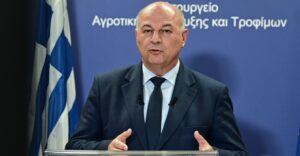
Statements after the meeting were made by the Minister of Rural Development, Kostas Tsiaras, who noted that there had been communication with the farmers currently at the roadblocks. As he emphasized, the conditions that have been set from the very beginning were reiterated, adding that the government is now awaiting the farmers’ response. At the same time, he stressed that no one will remain with their hands tied, underlining that the Greek state cannot function on the basis of obsessions, egos, or stubbornness.
Kostas Tsiaras’ statements in detail
“There was communication with the farmers who are currently at the roadblocks. Once again, all the conditions that have been set from the very beginning were put on the table, and of course, as far as I know, we are now waiting for their response.
From that point on, I repeat, no one will remain with their hands tied, nor can the Greek state operate through a logic, I would say, of obsessions, egos, or stubbornness. We must all understand that we are all striving for the common good — for our homeland and for society.
Not only for the government, but for all people. It is about how we will keep the entire primary sector alive, through choices that will contribute both to its sustainability and its resilience.”
What was decided regarding OSDE, de minimis aid, and cotton
The abolition of the obligation to declare ATAK from 2026 for standalone agricultural plots under 20 stremmas was announced by the farmers’ representative and president of the Panserraic Agricultural Association, Diamantis Diamantopoulos, following the meeting with government officials.
As he stated, “For 2026, ATAK will not be required for standalone agricultural plots under 20 stremmas,” noting that this is a development that relieves the vast majority of producers, who had found themselves in a difficult position due to this requirement.
According to him, the measure concerns the overwhelming majority of farmers, since out of approximately 80,000 producer tax identification numbers (AFM), most are exempt from the obligation. “A large part will be disentangled from this issue,” he said characteristically.
At the same time, it was announced that the creation of a digital system called “Midas” was decided, in cooperation with the Independent Authority for Public Revenue (AADE). This system will serve as a unified database of all agricultural plots and their ownership details. The goal is that from next year onward — and if feasible, already from 2026 — OSDE declarations will be carried out in a more automated and simplified manner.
“We will move forward together with AADE to create a Midas system, so that the situation is smoothed out also with regard to ATAK,” Mr. Diamantopoulos emphasized.
Regarding whether farmers were satisfied with the meeting, their representative adopted a cautious stance, stressing that the final word belongs to the producers themselves. As he said, the representatives convey the positions and demands of the roadblocks, but the evaluation of the decisions will be made at the grassroots level.
Statements by farmers
The meeting lasted 3.5 hours
Participants in the meeting included the Minister of Rural Development Kostas Tsiaras, Deputy Ministers Christos Kellas and Giannis Andrianos, Deputy Minister of Finance Thanos Petralias, as well as the heads of AADE, Giorgos Pitsilis, and OPEKEPE, Ioannis Kavadias. The Minister of Digital Governance, Dimitris Papastergiou, was also present.
Also present were representatives from the 14 agricultural roadblocks that had participated in yesterday’s meeting with Prime Minister Kyriakos Mitsotakis at the Maximos Mansion.
At the center of today’s meeting was the issue of ATAK and KAEK. ATAK (Property Identification Number) had until now been declared even through official statements. However, following the OPEKEPE case, full documentation is now required, with the result that many farmers, after cross-checks, were excluded from payments. The problem mainly concerns agricultural plots that farmers lease from third parties, where ownership transfers have not been completed.
Government sources explained that the issue is complex and difficult, due to problems in inheritance transfers, many of which had been carried out informally and handwritten.
Before the meeting, Giannis Panagis, from the Panserraic Farmers’ Association, stated that the problem concerns 80,000 tax identification numbers (AFM), of which 4,000 are located in Serres. After the conclusion of the meeting, farmers are expected to inform the wider agricultural community and make their decisions.
Ask me anything
Explore related questions