





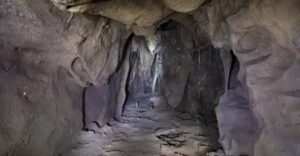
Archaeologists were stunned when, during excavations in the extensive cave network of the Rock of Gibraltar, they spotted a new chamber that had remained sealed for about 40,000 years. The discovery is considered particularly important as it may shed new light on the life and activity of the Neanderthals, who inhabited the region for centuries.
The Gorham’s Cave is located on Governor’s Beach, on the southeastern side of the Rock of Gibraltar, and seems to be home to a real “treasure trove” of finds. The artifacts that have been identified act as an informal museum, offering valuable information about the daily life of a population that has been extinct for thousands of years.
Neanderthals, an extinct species of archaic humans and the closest relatives of modern humans, lived in Europe and Asia from about 400,000 to 40,000 years ago. Although no skeletons have been found in this cave, the evidence suggesting their presence is numerous.
According to UNESCO, there is “evidence of hunting of birds and marine animals for food, use of feathers for decoration, and the presence of abstract rock paintings”. The international organization also notes that scientific research in the caves has “contributed substantially to discussions about the evolution of Neanderthals and humans.”
In 2024, researchers made another striking discovery, locating an oven about 60,000 years old that appears to have been used to make glue. The layer of sediment, dated between 67,000 and 60,000 years old, was judged to have been “clearly” created by human hands.
Scientists believe that this hearth was used to produce birch tar, a sticky substance that prehistoric humans utilized to attach handles to tools or weapons. The construction was circular, with two channels and a thick-walled lining.
The director and chief scientist of the Gibraltar National Museum, Clive Finlayson, had told CNN in 2021 that the cave walls also contained carvings of an unknown carnivorous animal.
As he reported, a seashell was found at the bottom of the cave, about 20 meters away from the beach. He pointed out that someone transported the shell there more than 40,000 years ago, which gave him strong evidence of human presence inside the cave. As he explained, because of the dating, these people could be none other than Neanderthals.
Finlayson admitted to feeling intense emotion when he first entered the sealed chamber, describing the moment as one of the most exciting of his career. As he noted, it is extremely rare to come face to face with a space that no human has entered in 40,000 years.
At the same time, he expressed the belief that as the excavations progress, the cave may prove to be even larger, with new passageways being revealed at deeper levels. As he pointed out, the chances of this being a huge cave are high, which makes continued exploration particularly exciting for the scientific community.
Ask me anything
Explore related questions