





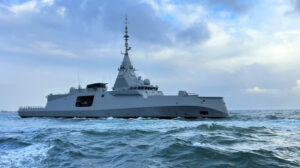
The frigate “Kimon” is the first of three frigates of the type Belharra that the Greek Navy is acquiring, marking a qualitative upgrade with a clear operational footprint in the Aegean and the Eastern Mediterranean. It is the first Greek FDI HN frigate, built by Naval Group, and is now at the Salamis Naval Station, where the reception by the country’s political and military leadership, led by Prime Minister Kyriakos Mitsotakis.
Mitsotakis: “The country’s deterrent power should not be questioned by anyone.”
After the event, Prime Minister Kyriakos Mitsotakis referred to the role of the new frigate in the overall modernization plan of the Armed Forces. “We have talked a lot about the operational capabilities of this state-of-the-art ship, but it is a link in the ongoing effort to modernise the Armed Forces, both in terms of equipment and manpower,” he said, stressing that the country’s deterrent power should not be questioned by anyone. He said that Greece’s goal is to project its strength “as a pole of stability and solvency in the Eastern Mediterranean.”
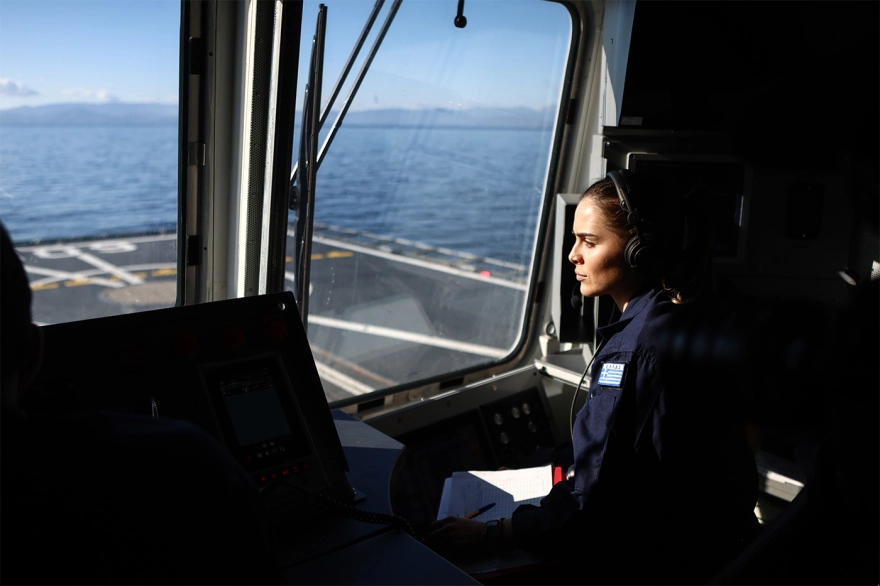
The prime minister also put a personal political stamp on the moment, noting that it is the duty of every government to deliver a country more secure than the one it received. “Well done to Kimon and may we welcome the rest of the ultra-modern Belharra,” he said, linking the ceremony to the continuation of the arms programme.
Dedia: “A great day for the Navy and for the country.”
For his part, National Defence Minister Nikos Dendias described yesterday as a “great day for the Navy and for the country”. He stressed that the frigate “Kimon” is, without exaggeration, “the most powerful frigate on the planet” and that its mission is clear: to safeguard the sovereignty and sovereign rights of the country. At the same time, he particularly focused on the transition of the Armed Forces, through Agenda 2030, to a model based on knowledge, interoperability, and rapid information processing.
The frigate “Kimon” will be followed by the frigates “Nearchos” and “Formion” in late 2025 and in 2026, respectively.
These new units not only strengthen the fleet numerically but also introduce a different operational doctrine, adapted to the modern requirements of a particularly demanding environment, such as the Aegean.
New generation diving ship
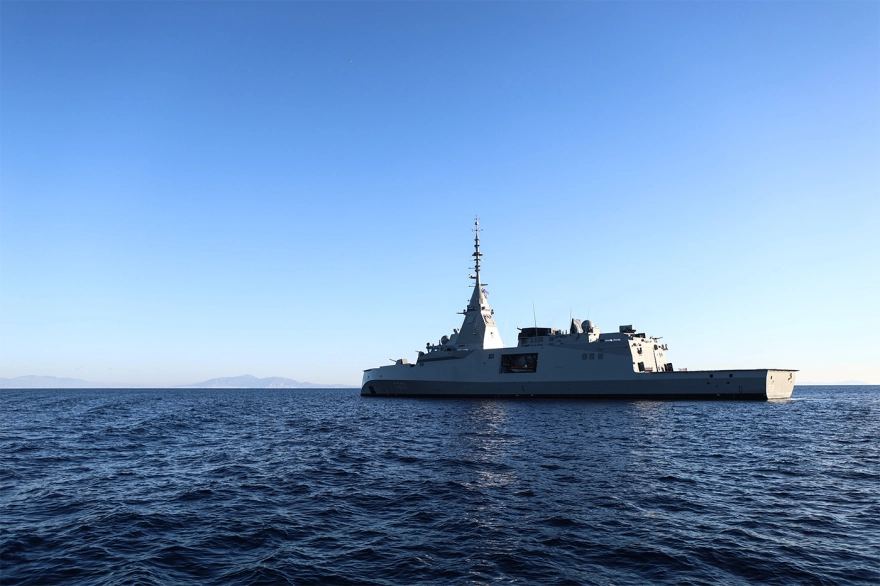
Kimon has been designed from the outset as a fully digital warship, belonging to the latest generation of multi-role frigates. With a length of approximately 122 metres and a displacement approaching 4,500 tonnes, it combines high performance with a reduced operational footprint. Its crew ranges between 120 and 130 people, reflecting the high degree of automation of its systems.
The maximum speed, in excess of 27 knots, combined with the low acoustic signature, makes the frigate suitable for both high-intensity operations and surveillance and deterrence missions.
Sensors that “see” far away
Central to Kimon’s capabilities are its sensors. The Sea Fire AESA 4D radar, mounted on the integrated PSIM mast, provides simultaneous air and surface surveillance over long distances, enabling early warning and effective engagement of multiple threats.
At the same time, the towed CAPTAS-4 sonar decisively enhances the ship’s anti-submarine capabilities. The ability to detect submarines at long distances gives the Navy a clear advantage, especially in areas with complex geography and increased submarine activity, such as the Aegean and Eastern Mediterranean.
Heavy armament and air defence of the region
Kimon’s armament is perhaps the most decisive game-changer. The vertical A50 Sylver launchers for Aster 30 missiles offer, for the first time on a Greek frigate, area air defence capability. This translates into a broad “umbrella” of protection that can cover groups of ships, critical sea zones or island complexes.
In the offensive role, the Exocet MM40 Block 3C missiles provide long-range strike capability, while the RAM proximity air defence system enhances the ship’s protection against short-range threats. The weapon system is complemented by MU90 torpedoes, further enhancing the anti-submarine arm.
Power multiplier for the Navy
The Belharra frigates and, in particular, the “Kimon” act as power multipliers for the Navy. The fully network-centric combat system enables real-time intelligence and threat management, interfacing with air, land, and naval assets.
This capability gives the Navy the ability to “see” earlier and farther, coordinate forces, and counter saturation attacks in a highly complex environment. At the operational level, it increases the cost of any offensive action and enhances the country’s deterrent power.
Shifting the balance in the Aegean
The inclusion of the Kimon in the fleet marks a substantial change of balance. For the first time, the Navy is acquiring ships with area defence and long-range anti-submarine surveillance capabilities, adapted to modern threats.
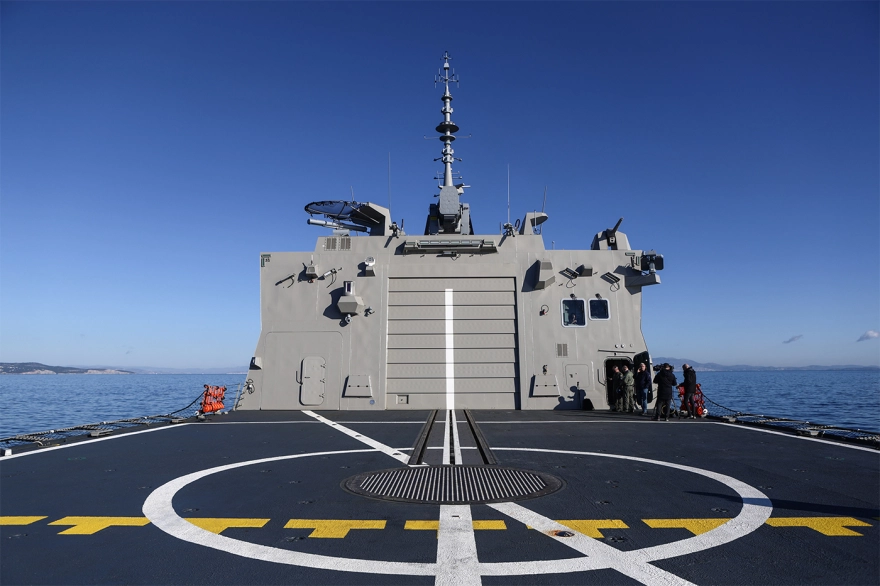
Combined with helicopter naval cooperation and interconnection with other assets, the new frigates are not just new units, but the core of a new operational model. A model that enhances deterrence, increases flexibility, and makes the Greek Navy a primary actor in a particularly critical geopolitical environment.
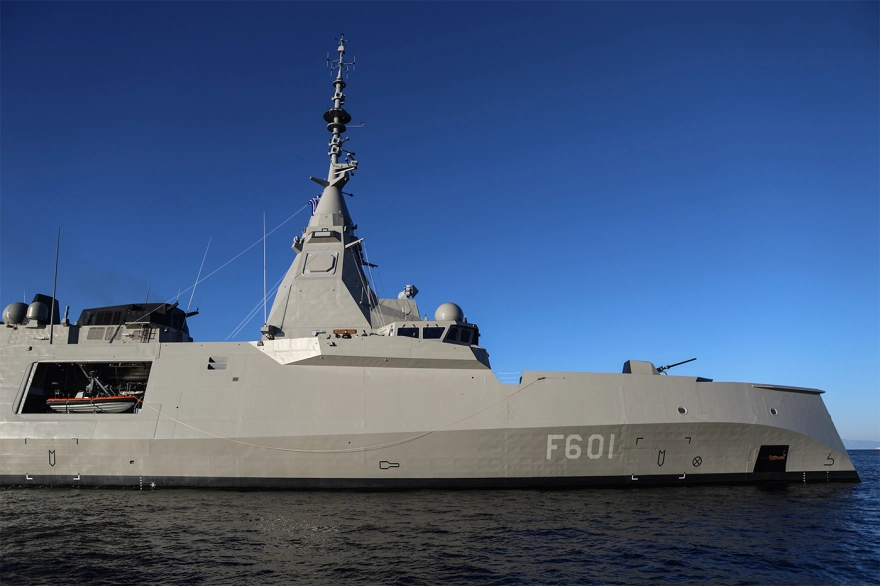
The technical characteristics
– Length: about 122 meters
– Half of the length of the vehicle
– Displacement: about 4,500 tons
– Crew: 120-130 people
– Propulsion: combination of diesel engines and electric propulsion, with emphasis on low acoustic signature
– Maximum speed: over 27 knots
Sensors and a combat system
– Thales Sea Fire AESA 4D radar, mounted on the PSIM (Panoramic Sensor & Intelligence Module)
– Hull sonar and sliding CAPTAS-4 sonar, giving a strong anti-submarine footprint
– Fully network-centric combat system, designed for simultaneous management of multiple threats
Armament
– VLS A50 Sylver launchers for Aster 30 missiles, providing for the first time a Greek frigate with area air defence capability
– Exocet MM40 Block 3C anti-ship missiles
– RAM close air defence system
– MU90 torpedoes
– Naval cooperation helicopter operations capability
Ask me anything
Explore related questions