





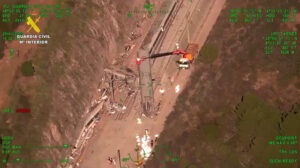
Another fatality was found this afternoon by rescue crews in the wreckage of trains that collided in Adamuth, Andalusia, in southern Spain, bringing the death toll to 42. But the suspense is mounting as reports put the number of missing at more than 40, and the death toll is still not final, 48 hours after the crash.
Searches in the wreckage are continuing, and the possibility that more bodies could be found is open. To speed up the investigations and end the agony of the relatives of the missing, rescue crews have brought large cranes to the scene of the tragedy so that they can lift the derailed and overturned wagons, since more victims are estimated to have been trapped there. The rescue teams have carried out initial work to stabilise the ground, using special supports and embankments. And the Spaniards, as had happened in the case of the Tempi tragedy, intervened immediately at the scene of the railway tragedy to determine whether there were other victims. In fact, Spain’s Civil Protection agency released videos showing both the cranes being seen and the backfilling that has been done to press the heavy machinery to lift the wagons and remove the still-missing dead.
Two giant cranes in difficult conditions
The two giant cranes at the scene of the tragedy have lifting capacities of 300 and 400 tonnes respectively. As the head of operations for the company at the site, Rafael Marin, told El País newspaper, the cranes arrived on Monday under the escort of the Spanish Civil Guard (Guardia Civil), following an earthen route.
Despite the difficulties of the terrain at the accident site, the two cranes were stabilized, and shortly after midnight, the lifting of car number 8 of the Iryo train, the only one that had overturned on the tracks, began. At the moment the wagon began to be lifted in Spain, the body of one person was found, which led to the immediate halt of the work.
Critical role of wagon 6 in research
As Spain’s Transport Minister Oscar Puente said this morning in an interview with RNE, the focus of today’s operation falls on wagon 6, which derailed first and is considered pivotal to unraveling the causes of the accident. This particular wagon has been immobilised on the instructions of the Civil Protection and will not be moved until a full examination is completed. Sources said there were about 50 people in these two coaches.
According to reports, police experts will proceed with detailed photography and collection of critical samples, as this particular wagon may contain evidence to explain how and why the derailment occurred. Once the on-site investigation is complete and it is determined that there are no other victims, the material will be allowed to be moved to clear the line.
The Commission of Investigation of Railway Accidents (CIAF) has already announced that it will request the transfer of the material from the two trains to Madrid to undergo laboratory tests. At the same time, data from the track recorders – the so-called “black boxes” – including driver conversations and speed data will be retrieved.
Passable terrain and risk of delays
While cranes are working at the site of the Iryo train, crews are also operating near Renfe’s Alvia train, which ended up on a slope. The terrain is characterized as very rough, with bushes and trees, making it difficult to stabilize the site. “It’s a very steep area, Oscar Puente stressed, noting that the safety of handling is a top priority.
Weather conditions may further aggravate the situation, as Spain’s Meteorological Service is forecasting rainfall from Wednesday afternoon.
La Guardia Civil ha concluido ya la inspección ocular de los vagones 7 y 8 del Iryo https://t.co/LoiQI09dxA 🎥@jaalba10 pic.twitter.com/IiRD5400zj
— Cadena SER (@La_SER) January 20, 2026
Hospitalized, all three motorcyclists are missing
According to the latest figures, 39 injured remain hospitalized – 35 adults and four children. Of those, 13 are being treated at the Cordoba Reference Hospital, five in intensive care units and eight in ordinary wards. The rest are in private and public hospitals in Cordoba and Ulva.
Three engineers were aboard the two trains. The Alvia engineer, 27-year-old Pamplo from Alcorcon, was killed instantly. The Iryo’s engineer emerged unscathed, while a third driver, riding as a passenger, was also uninjured.
Ask me anything
Explore related questions


