




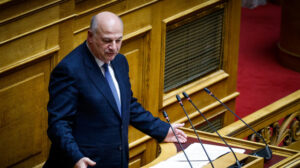
A call for opposition parties to support the government’s initiative by participating meaningfully in the bipartisan committee that will plan the reconstruction of the primary sector was made by the Minister of Rural Development and Food, Kostas Tsiaras, from the floor of the plenary session of the Bouliaments.
“Today, we must rise to the occasion and deal with the serious problems that concern Greek producers, our own producers. Because today’s meeting for the establishment of a bipartisan committee for the primary sector is not just a formal procedure,” he said, intervening in the parliamentary debate on the matter, adding that “every political party, every political party, should contribute to a debate that is necessary to organize a national plan for the coming years for the primary sector. This is the moment for us to open a meaningful dialogue on the future of Greek agriculture and livestock farming and to discuss the long-standing problems and plan the prospects of a sector that supports the entire economy of the country”.
The minister admitted that farmers and livestock farmers are under pressure from high production costs, fluctuations in international prices, and extreme weather.
“This is the harsh reality. We must not sugarcoat it, but neither should we downplay it. We have to face it honestly, because only then can we move towards sustainable solutions,” he said, adding that “the state stood by the primary sector in a meaningful way. Last year alone – these are figures which are proven – 3.8 billion euros were paid out. An unprecedented amount, which, in truth, kept farms on their feet, gave liquidity to the region and boosted producers’ confidence that the State is not leaving them alone.
“At the same time, the completion of the transfer of the OPEKEPE to ADEA closed one circle and opened a new one, more demanding but fairer. Aid management has now become more transparent, with modern tools and increased reliability. Finally, the Prime Minister himself – you know it, we all know it – met with producers, announced new measures to reduce production costs and sent a clear message: the state does not stand against the agricultural world, but next to it.”
The government has not turned its back on the farmers, but it is not on the side of the farmers.
Regarding the scope of the bipartisan committee, he said that “its goal is to examine all the major critical issues of the agricultural world: high production costs, low productivity, farm structure, the position of the farmer in the value chain, and the major challenges brought by the new Common Agricultural Policy. The Prime Minister addressed all opposition parties, calling on them all to assume their responsibilities and participate in a process of policy co-creation. This invitation is not a communicative one. It is a call of national responsibility, because the primary sector – I think we all realise this – cannot stand party improvisation.
He went on to say, “We have seen the two main opposition parties, both PASOK and SYRIZA, present their own proposals. If you really wanted to participate in this process in a meaningful way, you are really welcome to submit your proposals through a procedure provided for by the parliamentary process itself, not through procedures that are not institutionalized and, of course, cannot work.”
Tsiaras said that “fiscal support, however important it may be without structural changes, is not enough. It needs organization, market linkage, education, innovation, and strategic planning. And all of these must be included in a national strategic plan for the primary sector. Greek agriculture needs a transition from individuality to collectivity. Fragmentation and small plots can only be tackled through cooperation and economies of scale. Today, out of 2,651 cooperatives, only 858 are fully active, and less than 20% of products are traded collectively.
To change this picture, the Ministry of Rural Development and Food promotes the modernization and strengthening of existing cooperatives, the creation of new cooperatives, access to markets, the financing of infrastructure for collective production and processing, and innovative tools to reduce costs and increase competitiveness.
Investing in infrastructure, technology, and innovation: PPP projects, irrigation projects of more than 600 million euros, 42 water and irrigation projects with a total funding of 75.5 million euros, and the greenhouse programme, which we believe can pump up to 600 million euros and create a great innovation in a production process that directly brings the so-called added value.”
.
Regarding the Mercosur agreement, he said “the agreement, does not open the European market in an uncontrolled way nor does it leave Greek producers unprotected. On the contrary, it creates new export opportunities in markets of more than 275 million consumers. Greece has a very negative trade balance with the Mercosur countries: it exports only 34 million euros worth of products to them, while importing 525 million euros worth of products. This large deficit represents an opportunity for high-quality Greek products, such as feta cheese, olive oil, kiwis, and processed products, to be exported abroad.
The agreement provides for special protection status for 21 Greek PDO and PGI products out of the 344 protected in total at the European level. Feta is fully protected, as are Kalamata olives, olive oil, Chios mastic, Kozani saffron, PDO wines, tsipouro, and retsina. These products gain added value and will be sold at a higher price.
At the same time, there are safety clauses for sensitive products such as olive oil, cheese, citrus fruits, meat, and honey. In cases where imports would increase excessively, or prices would be under pressure, safeguard measures are automatically triggered.”
Ask me anything
Explore related questions