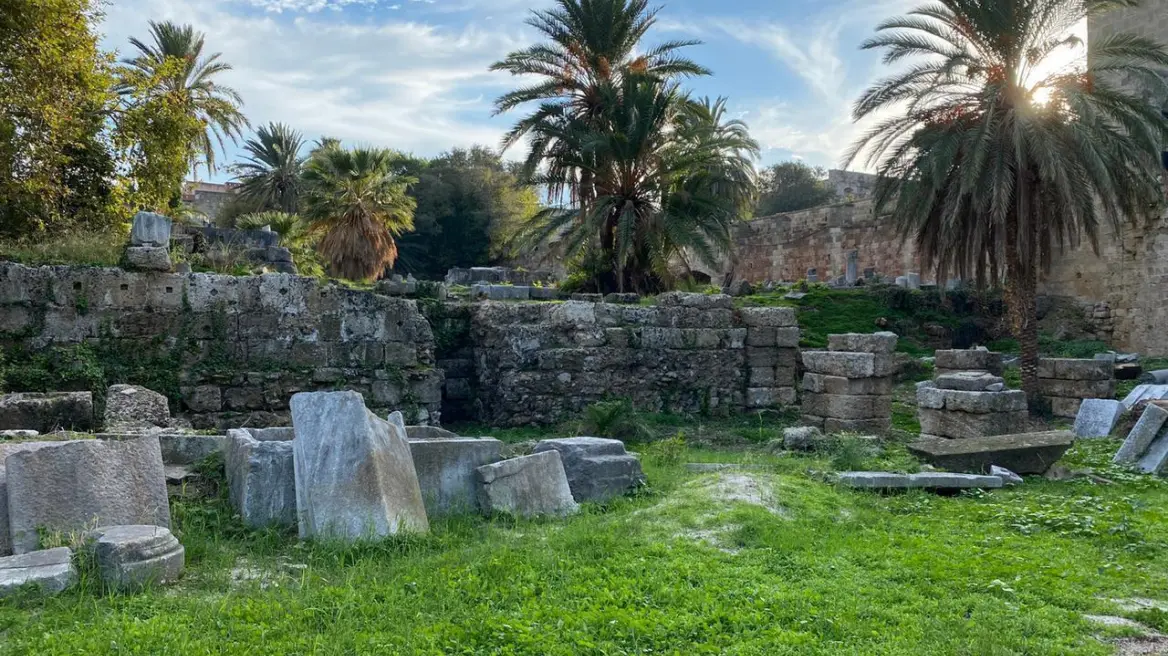
The Ministry of Culture is highlighting the significant archaeological site of “Pervola” in the medieval city of Rhodes through a project involving the stabilization and enhancement of individual elements of the monumental complex, as well as the restoration of selected scattered architectural remains.
The stabilization and restoration project, with a total budget of €4,500,000, funded by the Recovery and Resilience Facility, aims to address structural, constructional, and aesthetic issues of the monument through mild restoration interventions. The goal is to highlight the remains of the Cardo road and its colonnades as part of the monumental complex of the Roman Tetrapylon, to aesthetically upgrade the site and integrate it into the broader archaeological park route, to showcase the archaeological value of “Pervola,” improve the legibility of the site, and make it accessible to the public.
The interventions follow the approved Master Plan for the conservation, configuration, and enhancement of the archaeological site of the Neoria (ancient shipyards) and the Medieval Gardens of the Palace of the Grand Master.
Statement by the Minister of Culture, Lina Mendoni
“The archaeological site of ‘Pervola’ documents the long and continuous history of Rhodes, as it was a key point of the ancient city, organically connected to the Palace of the Grand Master and in use during the Italian occupation. Until now, the archaeological value of this monumental complex had not been highlighted.
Its multiple auxiliary uses—where thousands of scattered ancient funerary and architectural elements discovered during at least the last 80 years of excavations in Rhodes were stored—did not allow for its restoration or the presentation of its overall image.
This monumental complex preserves sections of the shipyards of the ancient military harbor of Rhodes, the paved Roman processional road Cardo with stoas and shops, which led to the monumental Tetrapylon.”
She added:
“The interventions implemented by the Ministry of Culture respect the particular characteristics of the site. The goal is to highlight the existing archaeological remains through characteristic exhibits linked to the original function of the monuments, which represent important periods of the ancient city—from the Hellenistic and Roman eras to the period of the Knights.
We want this archaeological site to be returned by summer 2026 to the local community and visitors to the island, functionally unified with the Palace of the Grand Master, restored, and accessible to people with disabilities and reduced mobility.”
Historical background of “Pervola”
“Pervola” is an open-air area within the medieval walls, near the Palace of the Grand Master, consisting of four natural terraces with a total area of 17 hectares. The site contains the ancient shipyards of the “Small Harbor”, the military harbor of ancient Rhodes—today’s Mandraki.
By the 4th century BC, the shipyards appear to have fallen out of use, either due to silting or the major earthquakes that struck Rhodes in 227 BC. On the Hellenistic remains of the shipyards, a Roman processional road (Cardo) with stoas and shops was constructed, leading to a monumental Roman Tetrapylon (2nd century AD) at the intersection of Cardo and Decumanus. This intervention marked the “opening” of the Roman city toward Mandraki.
In the city’s central zone—where the ancient Agora, the “Deigma,” and the “Dionysion” were located—the most monumental urban interventions are observed, aligned with the Cardo and Decumanus axes, following Roman urban planning standards. Remains of the paved streets (Cardo–Decumanus) survive in situ.
The Tetrapylon was uncovered during excavations in the Italian occupation period (1925–1928). During the same period, the Church of Agios Dimitrios of Piossasco, dating to the late 15th century, was also revealed, built on the site of the ancient Temple of Dionysus.
After the integration of the Dodecanese into Greece, the site was named “Pervola” and used as an antiquities storage area, housing more than 15,000 finds from excavations in Rhodes. Excavations resumed in 1940, uncovering significant architectural remains belonging to a Roman building.
For the Italian administration, the discovery of the Tetrapylon was a powerful symbolic example of the city’s Roman past. During the same excavation period, remains of the Hellenistic shipyards were revealed, including the stone-built sloping ramps used for hauling ships in and out of the water, as well as remains of the ship sheds.
Ask me anything
Explore related questions