




The main cause of last Sunday’s railway disaster in Adamuz was a fracture detected in the rail track, according to the first technical report issued by the Railway Accident Investigation Commission (CIAF). As stated in the report, the crack in the track existed before the passage of the private company Iryo train, which derailed and caused the accident that left 45 people dead.
According to the findings, the last carriages of the Frecciarossa 1000 derailed and partially entered the opposite-direction track, on which an Alvia train of Spain’s state railways (Renfe) was passing just a few seconds later. That train also derailed and crashed into an embankment.
The CIAF thus confirms information that had been circulating since Monday, according to which the investigation, even at an early stage, was pointing to a rail fracture as the most likely cause of the Iryo derailment. The Ministry of Transport had initially described the accident as “strange,” avoiding acknowledgment of the track fracture as a decisive factor. Two days later, Transport Minister Oscar Puente admitted that the rail fracture was an “undeniable” possibility.
Train passages before the accident under scrutiny
“Based on the evidence currently available, it can be assumed that the rail break occurred before the passage of the Iryo train involved in the accident and therefore before the derailment,” the CIAF report states, clarifying that the conclusions remain provisional and subject to verification through additional tests in the next stages of the investigation.
According to a new report by El Mundo, these supplementary tests are already underway and include analysis of the dynamic parameters of trains that passed the site before the Iryo derailment at 19:48 (local time) on Sunday. Sensors on the trains recorded anomalies as they passed the specific location; these were not reported by the drivers but were captured by the onboard recording systems. The trains involved include a Renfe Viajeros 130 that passed at 19:09, the Iryo 109-003 at 19:01, and another Iryo train at around 17:21, according to the commission.
Focus shifts to reconstruction
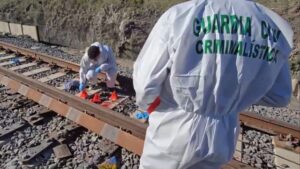
The CIAF clarifies that the investigation has now moved from reconstruction of the incident to the analysis of material evidence. Samples of the rail will be sent to a metallurgical laboratory to determine the causes of the fracture, which could open new lines of inquiry and potential responsibility. At the same time, recovery and analysis of the data recorders from the trains involved will take place in the coming weeks.
Particular importance is also given to findings related to the wheels of the Iryo train 6189. Investigators identified notches in the rolling surface of the right wheels of carriages 2, 3, 4, and 5. According to the report, the notches show a uniform pattern on carriages 2, 3, and 4 and are consistent with impact against the head of the rail. Visual comparison of the notches with the broken section of rail at the zero point of the derailment indicates, according to technicians, a possible match.
The CIAF’s technical analysis explains that if the rail had already fractured, its front section initially bore the full weight of the wheel, causing slight subsidence. As the rear section no longer functioned as a single unit with the front, a momentary “step” was created at the fracture point, which struck the wheel flange. At speeds of around 200 km/h, the second wheel passes the same point just three hundredths of a second later, before the rail has time to recover from the deformation.
Technicians estimate that during the passage of the fifth carriage, the rail overturned outward, to the right side according to the direction of travel, resulting in the sixth carriage derailing due to a complete loss of rolling continuity.
Ask me anything
Explore related questions