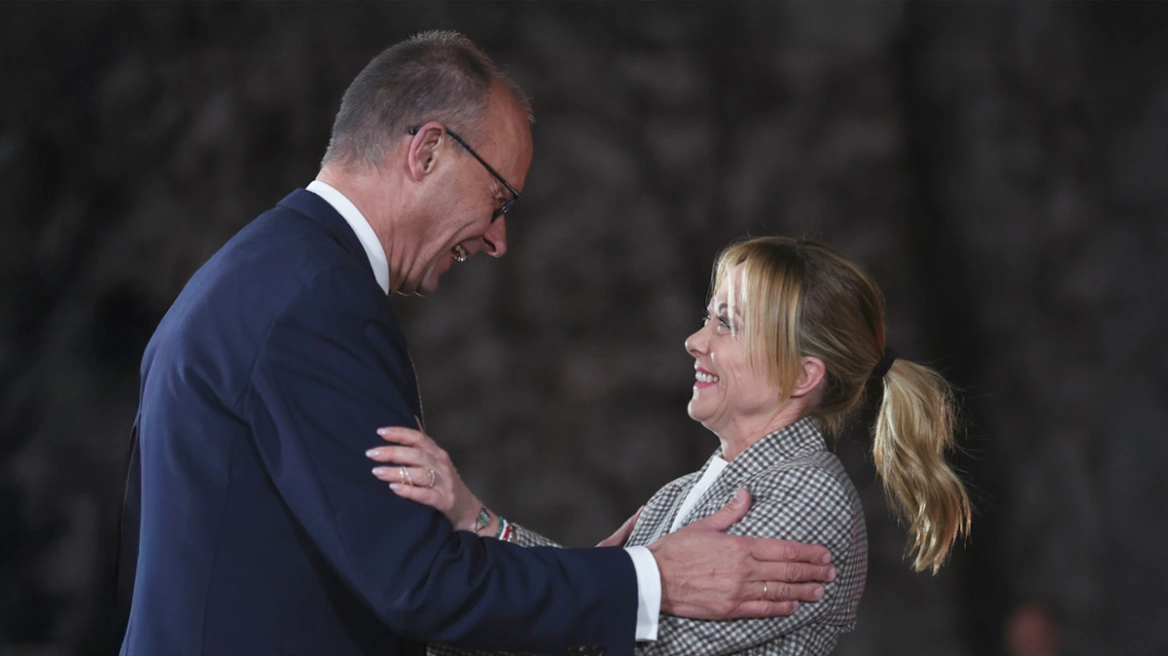
Germany’s Chancellor Friedrich Merz and Italy’s Prime Minister Giorgia Meloni are emerging as a new power pairing within the European Union, according to an analysis by Politico, as the two leaders meet today in Rome to strengthen their recently formed alliance.
The meeting is taking place at the Villa Doria Pamphilj, where Merz and Meloni are expected to underscore their growing cooperation. Politico describes their relationship as a “marriage of convenience,” driven by shared strategic interests, frustration with French President Emmanuel Macron, and a mutual desire to manage relations with former U.S. President Donald Trump.
Shared Outlook—and Shared Frustrations
According to the analysis, both leaders are right-leaning Atlanticists seeking to ease tensions with Trump. At the same time, both have grown increasingly frustrated with Macron.
Merz’s openness toward Meloni is partly rooted in Berlin’s irritation with Paris. Germany has been angered by France’s attempts to undermine the EU–Mercosur trade agreement with South America—a deal long championed by Berlin as a means of boosting industrial exports. Germany is also considering withdrawing from a €100 billion joint fighter jet program amid ongoing disputes with France.
A Broad Agenda in Rome
During today’s summit, Merz and Meloni are expected to sign a defense cooperation agreement, according to diplomats involved in the preparations. In total, 21 senior ministers from the two countries are participating, and roughly 10 bilateral agreements are expected to be signed, according to the Italian government.
Perhaps most ambitiously, Italy and Germany are working on a joint action plan aimed at reviving EU industry and expanding exports. This plan will be presented as a common position paper at the European Council summit on February 12. Berlin and Rome describe themselves as “Europe’s two main industrial countries”—language that Politico notes is likely to irritate Paris.
Political Calculations
A lawmaker from Meloni’s Brothers of Italy party argued that the alliance with Merz makes strategic sense, particularly given Macron’s expected exit from the European political stage following France’s elections next year.
“Our two countries have stable governments, especially compared to France,” the lawmaker said. “It is clear that Meloni and Merz likely still have a long road ahead of them, during which they can work together.”
Growing Trust Between Berlin and Rome
German officials have privately expressed enthusiasm about the deepening cooperation with Meloni, describing Italy as a reliable partner.
“Italy is reliable,” a senior German government official said—an adjective Politico observes Berlin has been less inclined to use recently when referring to France.
“The French are more talkative, but Italy is far more pragmatic,” said Axel Schäfer, a senior lawmaker from Germany’s Social Democratic Party who has long worked on German–Italian relations.
A Marriage of Convenience
Despite the warming ties, significant differences remain. Politico characterizes the relationship as a “marriage of convenience.”
Meloni initially refused to support Merz’s proposal to use frozen Russian assets to fund military aid for Ukraine. She also temporarily withheld support for the EU–Mercosur agreement in order to extract concessions for Italian farmers, before ultimately backing the deal.
Italy has long pushed for looser EU fiscal rules—traditionally aligning with France on this issue—while Germany has acted as Europe’s chief enforcer of budgetary discipline. However, some convergence has emerged: Meloni has curbed Italy’s spending, while Merz has overseen a historic, debt-financed expansion of spending on infrastructure and defense.
Domestic Shifts Behind the Alliance
According to Politico, the Merz–Meloni partnership is also the result of domestic political shifts aimed at survival.
Meloni has steered her nationalist Brothers of Italy party toward the political center, particularly on foreign policy. Meanwhile, the rise of the far-right Alternative for Germany (AfD) has pushed Merz to move his conservative party sharply to the right on migration.
This ideological convergence has helped smooth relations. As Merz searched for European partners to curb asylum flows, reduce regulation, promote trade—and counterbalance Macron—Meloni has become an increasingly central figure in his European strategy.
Ask me anything
Explore related questions