




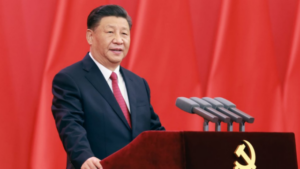
Shifts at the top of China’s military leadership occurred over the weekend, as Beijing announced an ongoing investigation into senior General Zhang Yuhua for “suspected serious violations of discipline and law.” This is a radical move by Chinese standards, as Zhang was the highest-ranking military official immediately after President Xi Jinping.
China’s Ministry of Defense announced on Saturday that authorities are investigating two senior officers: General Zhang Yuhua, senior to the two vice presidents of the powerful Central Military Commission — the country’s top military body — and General Liu Zhenli, a lower-ranking member of the same commission, who was responsible for the Joint Staff of the armed forces.
This development nearly overturns the entire composition of the commission, chaired by Xi Jinping himself, leaving only one of the six members active. “Xi Jinping has completed one of the largest purges of military leadership in the history of the People’s Republic of China,” commented Neil Thomas, analyst at the Asia Society Policy Institute.
The full consequences of these changes for the People’s Liberation Army and for China overall remain unclear. However, some experts believe the developments could also influence Beijing’s future handling of Taiwan, the self-governing island that China considers part of its territory.
Why Zhang’s removal matters
China’s Ministry of Defense provided no details on the alleged violations. On Sunday, the People’s Liberation Army newspaper limited itself in an editorial to noting that the investigation concerns “serious violations of discipline and law,” emphasizing the Communist Party’s commitment to punishing corruption, a policy Xi Jinping has pursued since the early years of his presidency.
Despite rumors circulating on social media and some reports (the Wall Street Journal suggested Zhang is accused of leaking nuclear weapons data to the U.S. and accepting bribes for promotions), there is no official explanation for the removal. “I don’t believe that any evidence selectively released or leaked by Chinese authorities will necessarily reflect the core reason for Zhang’s removal,” said K. Tristan Tang from the Pacific Forum. As he noted, the critical point is that Xi Jinping decided to act against him, since once such an investigation starts, “problems are almost always found.”
The purges are believed to aim at reforming the military and ensuring absolute loyalty to Xi. They are part of a broader anti-corruption campaign, under which more than 200,000 officials have been punished since 2012.
A few months before Zhang and Liu’s removals, the Communist Party had also dismissed the other vice president of the commission, He Weidong, in October, replacing him with Zhang Shengmin, who now remains the sole active member of the commission.
According to military announcements and state media, since 2012 at least 17 generals of the People’s Liberation Army have been removed from their positions, including eight former top members of the Central Military Commission.
Possible implications for Taiwan
China considers Taiwan its territory and has threatened to bring it under control even by force. Recently, it has intensified military pressure and last month conducted two days of large-scale exercises around the island after the announcement of a significant U.S. arms sale to Taiwan.
Neil Thomas believes the recent purge “weakens China’s short-term threat to Taiwan but strengthens it in the long term.” In the short term, escalation would be riskier due to “a top military leadership in turmoil.” Over time, however, the army could become more loyal, less corrupt, and with increased military capabilities.
Tang notes, however, that the changes “do not fundamentally alter the assessment that China is not immediately ready for war,” adding that he does not believe the combat readiness of the People’s Liberation Army has suffered serious damage.
Uncertain future for the commission
After the recent developments, the Central Military Commission is effectively functioning with only one active member and Xi Jinping at the top as chairman. The People’s Liberation Army newspaper argued that these actions aim to “promote the revitalization of the military and give a strong push to building a powerful military force.”
It remains unclear whether the five vacant positions will be filled immediately or if Xi will wait until 2027, when the new Central Committee of the Communist Party is expected to be selected, which has the authority to appoint members of the military leadership. According to Tang, there is no pressure for immediate appointments, “unless the goal is to create an internal counterbalance” against the sole remaining active commission member.
Ask me anything
Explore related questions