






An anonymous letter alleging details about the religious and ethnic background of Constantinople’s jailed mayor, Ekrem Imamoglu, has been formally added to the case file against him by prosecutors—a move that has triggered accusations that President Recep Tayyip Erdogan is resorting to hate speech and identity politics to undermine a leading political rival.
The unsigned document, incorporated into the investigation file by a senior prosecutor, claims that Imamoglu’s family changed its surname in the 1980s—from “Mudafa” to its current form, which etymologically means “son of an imam”—allegedly to appear Muslim, and asserts that members of his family reside in Greece. While the letter does not explicitly describe Imamoglu as Greek or Christian, in light of earlier allegations it has been widely interpreted as implying such an identity.
The document bears no author’s name and is not supported by any evidence. Nevertheless, it was formally included in the dossier of a wide-ranging investigation into municipal contracts and alleged corruption, and became public when the court accepted a sweeping indictment.
See the letter in question here
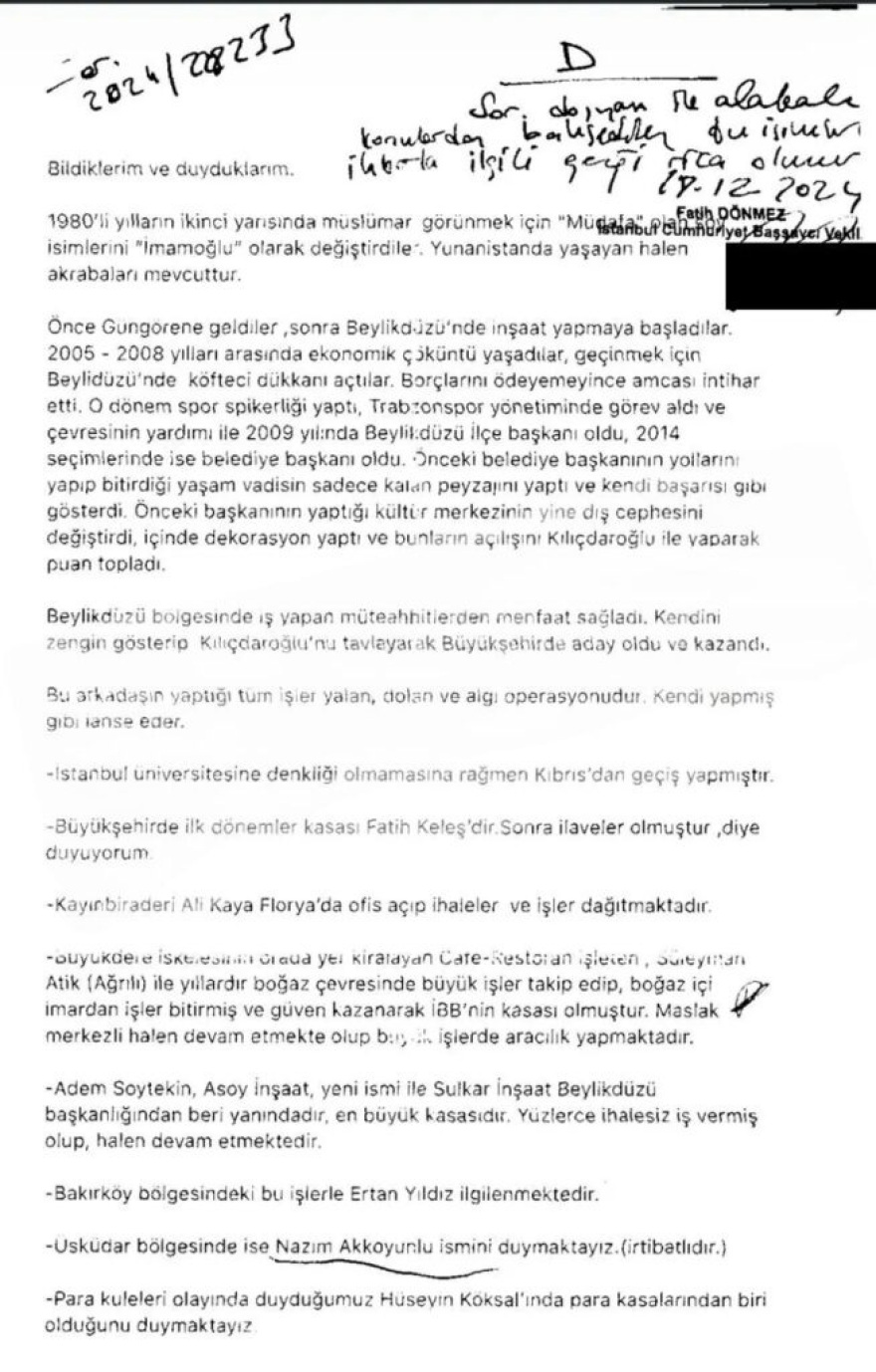
The inclusion of the letter caused particular controversy, as Turkish criminal procedure allows prosecutors to collect allegations and “information” at the investigative stage, but typically requires verification before such material can be treated as evidence. According to the official record, the letter was added to the case file through a formal note by the then deputy chief prosecutor of Istanbul, who requested that it be “evaluated” as part of the investigation.
Shortly afterward, the same prosecutor was transferred to the post of chief prosecutor at the city’s East Palace of Justice.
The allegations contained in the letter are sweeping. It accuses Imamoglu of having “deceived” political actors in order to secure his first nomination and portrays his public conduct as misleading. None of these claims are substantiated by evidence in the case file.
Arrest of journalist, hardening climate
The case escalated after journalist Furkan Karabhai disclosed the existence of the letter in the dossier. On 23 January 2026, he was arrested and put on trial on charges of “spreading misleading information” and “targeting persons involved in counter-terrorism operations.”
Although prosecutors sought his pre-trial detention, a judge ordered his release under restrictive conditions, including a travel ban and house arrest. Karabhai has previously served prison sentences in unrelated cases.
Imamoglu, a senior figure in the main opposition Republican People’s Party (CHP) and a declared presidential contender, has been held since late March 2025 at Marmara Prison in Silivri. He faces multiple charges, including leading a criminal organization, corruption, espionage, and manipulation of tenders. The indictment lists hundreds of suspects and seeks lengthy prison sentences.
First hearing on March 9
The nearly 3,900-page case file against Imamoglu was accepted by Istanbul’s 40th Criminal Court in November 2025. The first hearing is scheduled for 9 March 2026.
Prior to his arrest, opinion polls showed Imamoglu either leading President Erdogan or running neck and neck with him in prospective presidential races. Opposition figures argue that his detention is intended to neutralize a formidable political opponent.
In parallel, authorities annulled Imamoglu’s university degree—a legal prerequisite for presidential candidacy under Turkish law—effectively barring him from the race unless the decision is overturned. A court rejected his appeal last week.
The use of identity-based innuendo against Imamoglu is not new. In 2019, following his initial election as mayor, some Greek media described him as a “Pontic politician,” a term taken out of context and later weaponized in Turkish political discourse.
During the campaign preceding the rerun of that election—after his first victory was annulled in what many viewed as a politically motivated decision—the label was revived by his opponents, including President Erdogan. The tactic proved ineffective: Imamoglu won again by a wider margin.
In Turkey, the term “Pontian” often carries a negative connotation. While the anonymous letter does not use the term explicitly, critics argue that it follows the same pattern of identity insinuation. Imamoglu has repeatedly dismissed such claims as false and as part of what he describes as “black propaganda.”
Ask me anything
Explore related questions


