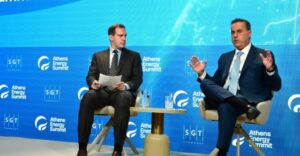
The Vertical Gas Corridor, hydrocarbon exploration with Chevron, the Greece–Cyprus electricity interconnection (GSI), and the issue of industrial energy costs together form a new, broader energy narrative of national and geopolitical importance for Greece. This framework was outlined by the Minister of Environment and Energy, Stavros Papastavrou, speaking at the Athens Energy Summit taking place today in Athens. He stressed that Greece is no longer merely a “transit corridor” but is evolving into a critical hub for Europe and transatlantic energy security.
Vertical Corridor: A Project of National and Transatlantic Importance
The Vertical Corridor was described by the minister as a “historic project,” noting that “for the first time, a product starts in Greece and reaches Ukraine without intermediate stops.” He emphasized that “all partners involved will work together to ensure the success of the Vertical Corridor,” adding that its success is a top priority for both Europe and the United States.
For Greece, the Vertical Corridor “goes far beyond natural gas,” Papastavrou said. “It is of national and strategic importance,” as it is not only about energy flows but also linked to critical infrastructure such as rail connections and transport networks. “Europe must replace Russian natural gas and needs a reliable supplier,” he noted, underlining that “cooperation in natural gas and the energy sector overall is inherently transatlantic.”
Chevron: Approvals, Investments, and Timeline
Referring to the agreements with Chevron, Papastavrou stated that “the Court of Audit has approved all four contracts” and that the next step is their formal signing. “Over the next two weeks, company representatives will come to sign the agreements, after which they will be submitted to Parliament,” he said.
According to the timeline, field exploration is expected to begin in the autumn of 2026, while the required investment is estimated at between €5 billion and €7 billion. The minister clarified that “the critical issue is not threats from Libya, but whether there are sufficient reserves,” placing emphasis on the technical and geological aspects of the project.
Regarding developments in the wider region, he recalled that “Turkey has announced an MOU for the development of its hydrocarbon sector,” while noting that “all Mediterranean countries want to develop their natural resources,” in an environment marked by increased competition but also significant opportunities.
GSI and IMEC: Pieces of a Larger Puzzle
On the Greece–Cyprus electricity interconnection (GSI), Papastavrou acknowledged that “there have been very mixed signals,” but noted that “in the second half of 2025 there is a unanimous decision by the President of the Republic of Cyprus to proceed with an evaluation by one of the credible rating agencies,” a process that is already underway.
At the same time, he referred to the “historic EU–India agreement,” which, as he said, “brings India closer to the West and dynamically revives discussions around IMEC.” Within this framework, “Greece can serve as a gateway,” with the Greece–Cyprus interconnection forming part of a broader geoeconomic puzzle. Updating the project’s financial data, he added, “will provide incentives for investors and give new momentum to the project.”
Industrial Energy Costs: A Solution in Sight
Finally, regarding the high cost of energy for industry, the minister expressed optimism. “We are close to reaching a settlement, always in compliance with the EU framework,” he said, stressing that “we do not want to give the impression that we are acting unilaterally.” He acknowledged that “cooperation with the European Commission can be slow,” but added that “there is awareness that this issue must be resolved, and we are close to that point.”
Ask me anything
Explore related questions