





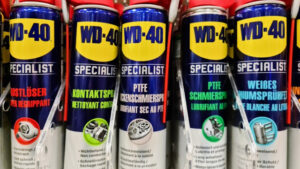
From the workshop to the living room, WD-40 has acquired almost mythical status. Whether it’s a rusted bolt that refuses to budge or a stubborn piece of chewing gum stuck to a carpet, many swear that the familiar blue-and-yellow spray can solve almost any small—or not so small—problem.
While countless “clever” uses circulate online, one thing remains impossible to find on the internet: the exact ingredients of WD-40. Its formula is guarded like a state secret and is considered one of the greatest commercial enigmas—on par with the recipe for Coca-Cola. The notebook containing the formula is locked inside a bank vault at an undisclosed Bank of America location in San Diego. Over the past thirty years, it has been removed only three times, and only a handful of people have ever seen it.
Even WD-40 CEO Steve Brass learned the product’s composition only 18 months ago, despite having worked at the company for three decades. Gaining access required a special key, the signing of a strict non-disclosure agreement, and a visit to the bank vault itself.
“Honestly, it’s like entering Fort Knox,” Brass told The Wall Street Journal, likening the experience to the legendary U.S. gold repository.
Before him lay the famous notebook containing the 39 failed attempts to create WD-40—and the 40th attempt, the one that succeeded and has remained unchanged for 70 years. The product’s name comes from that history: “Water Displacement,” 40th formula, originally designed to repel moisture and prevent corrosion.
Throughout its history, the notebook has ventured into the outside world only three times. On one occasion, former CEO Gary Ridge carried it through Times Square on horseback, wearing armor, to celebrate WD-40’s 50th anniversary on the Nasdaq. Another time, it was transported chained to a person’s wrist inside a metal briefcase, moving from one bank vault to another. Most recently, in the summer of 2024, Brass and CFO Sarah Haiser viewed it while signing documents at the bank—though neither could decipher the handwritten notes.
“I’m not a scientist, so I wouldn’t be able to remember what it said anyway,” Haiser told the WSJ. “The only thing that stuck with me was the phrase ‘No smoking.’” Even employees tasked with developing new applications for WD-40—which generates about 80% of the company’s revenue—work with a coded version of the formula to preserve the secret.
Naturally, speculation has never stopped. Some claim WD-40 contains fish oil, a theory the company firmly denies. Others suggest a mixture of orange peel, coconut oil, and vanilla, pointing to its distinctive scent—another claim dismissed by WD-40. About a decade ago, Wired magazine sent a sample to a laboratory and managed to identify certain components. The company’s response was telling:
“The chemicals listed are described at a very general level,” a spokesperson said. “It’s like saying you know what’s in Coca-Cola—carbonated water, sugar, and caramel—but that knowledge alone will never let you recreate the final product.”
And that, perhaps, is the secret behind WD-40’s enduring mystique: everyone thinks they’re close to cracking it—yet no one ever truly does.
Ask me anything
Explore related questions


