





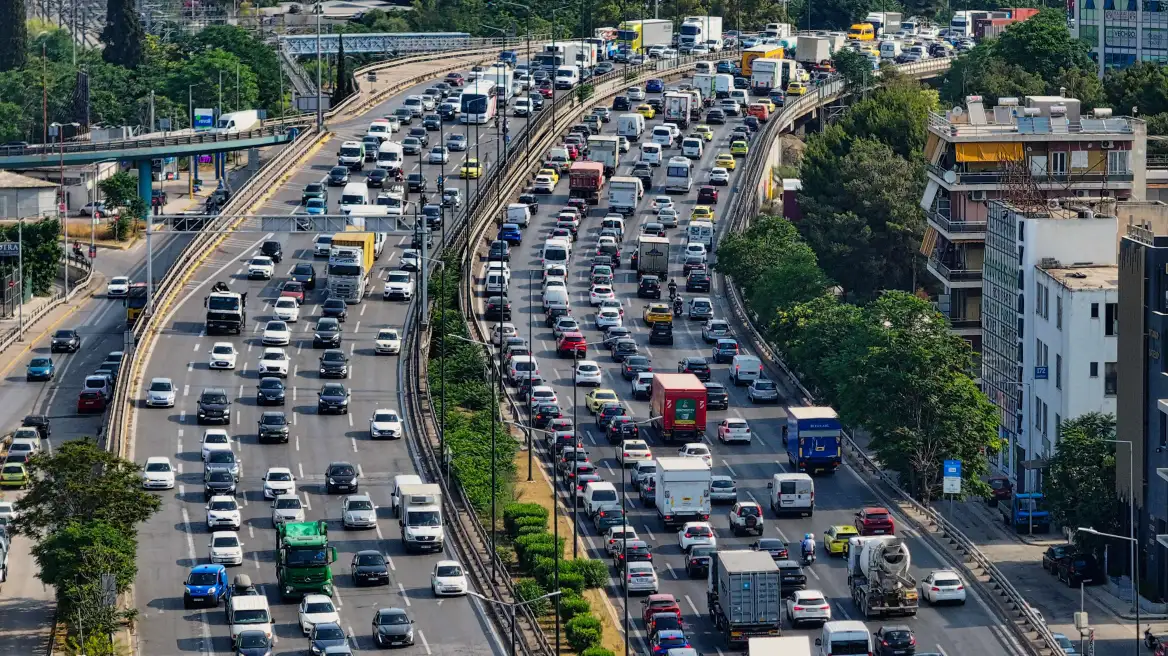
Infrastructure and Transport Minister Christos Dimas spoke about the traffic chaos that burdens millions of people in Attica.
Speaking to ERTnews, the minister referred to the measures already underway and the scenarios under consideration to improve traffic conditions and reduce the presence of heavy vehicles on urban roads.
He first noted that the priority is upgrading public transport. “We have proceeded with the replacement of almost the entire fleet of urban buses over the past 1.5 years. The new buses are modern, use low-emission technology, and are fully accessible. This is evident to anyone moving around the city,” he said. At the same time, construction of Metro Line 4 is progressing, which will connect 15 densely populated areas of Athens.
Infrastructure interventions are also significant. “The first intervention concerns the triple interchange at Skaramangas. Connecting the Western Aigaleo Ring Road with the National Road and Attiki Odos will provide an outlet for heavy vehicles away from the urban fabric. The contract is expected to be signed within 2026, and the project will be completed in about three years.”
In addition, he referred to the Metamorfosi interchange, where the inbound lanes from the airport onto Attiki Odos will be separated, reducing congestion.
Regarding freight trucks, he stressed that the government has not “backed down” and is working with all relevant ministries to reduce heavy-vehicle traffic within the urban area. As he noted, incentives for relocating businesses outside Athens are also being examined.
Scenarios under consideration for Kifisos
According to the Minister of Infrastructure and Transport, several scenarios are being examined for Kifisos Avenue. “Kifisos certainly needs major interventions, which is why we are considering several different scenarios. A successful example is the elevated high-speed roadway in Thessaloniki, which doubles the number of vehicles that can be served per hour, from 5,000 to 10,000. It is a truly innovative project that is progressing rapidly and has already significantly reduced congestion there,” Mr. Dimas emphasized.
He explained, however, that there are concerns about what will happen in Athens during the construction period, but, as he said, the experience in Thessaloniki shows that such interventions work.
The minister also recalled that, alongside the elevated roadway, Thessaloniki’s Metro began operation, while measures were taken by the Traffic Police and local authorities. “Citizens see the 10–11 construction sites on the ring road every day and recognize the progress of the projects, despite the inconvenience during construction,” he noted.
The role of the Traffic Police and the Ministry of Citizen Protection is also important. “We will see initiatives for enforcing the law, cracking down on illegal parking, and strengthening road safety. The new Highway Code, passed six months ago, tightens penalties, while the installation of smart cameras for violations and checks on uninsured vehicles or those without valid technical inspections is moving forward,” he said.
Finally, the minister referred to infrastructure projects outside Attica, such as the new airport at Kastelli, which will begin operating in 2028, and the concession of the Northern Crete Road Axis (BOAK), where construction sites are already active and road safety measures are being implemented to reduce accidents.
“It is a set of actions, both short-term and medium-term, aimed at easing traffic and ensuring the safety of citizens,” Mr. Dimas concluded.
Ask me anything
Explore related questions