





A window for dialogue between Washington and Tehran appeared to open on Saturday evening, according to leaks from the regime’s side, at a time when diplomatic efforts by major players in the Middle East to mediate in order to avoid a new U.S. military operation—which could escalate into a broader conflict—are intensifying.
In a post on X, Iran’s Secretary of the Supreme National Security Council and confidant of Khamenei, Ali Larijani, spoke of “media-manufactured” war rhetoric and pointed out that “a process is underway to form a framework for dialogue” with Washington.
Earlier, according to sources cited by Axios, he met in Tehran with Qatar’s Prime Minister Mohammed Abdulrahman Al Thani, who is trying to mediate and bring the two sides to the same table. On the same issue, Iranian President Pezeshkian also spoke by phone during the day with his Egyptian counterpart, Al-Sisi. Moscow is also trying to play a role, as earlier in the week Larijani was received by Putin at the Kremlin, while Erdoğan, for his part, has also entered the game, pressing for a trilateral Washington–Tehran–Ankara format.
The “armada” within firing range of Iran and Trump must decide
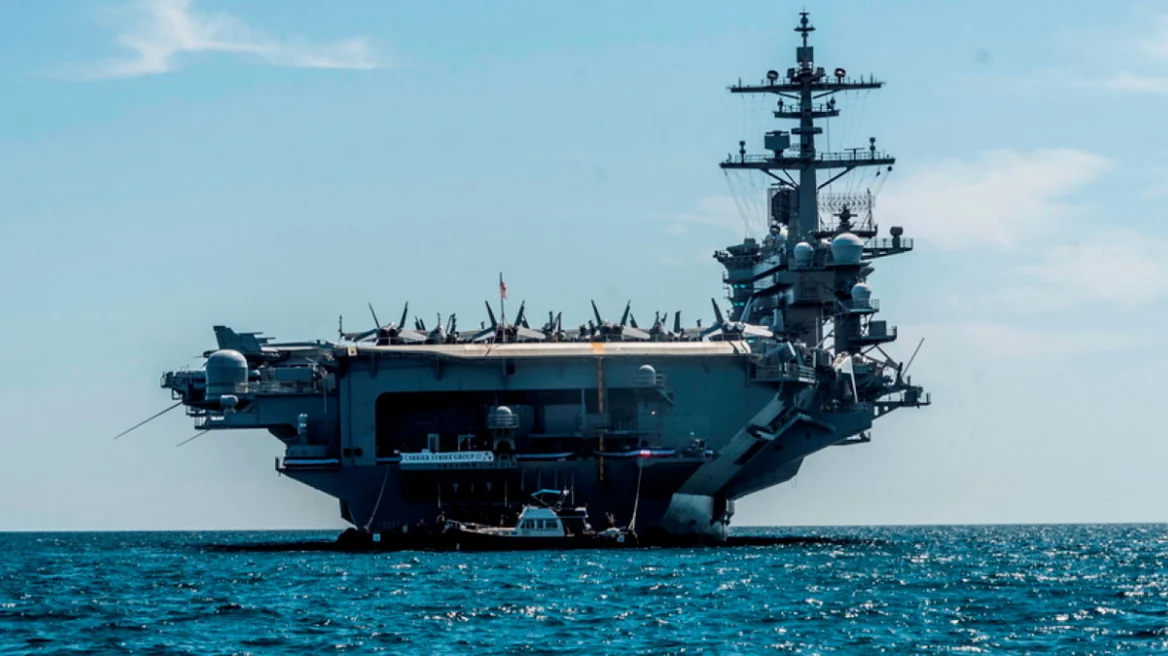
But can this diplomatic frenzy prevent what, according to the latest indications from the American side, seems like the most likely outcome? It is a fact that since midweek, the U.S. military has assembled a powerful force in the Middle East, within firing range of Iran. Now, Donald Trump must decide how to use it.
The “3+1” options
As more and more warships and aircraft arrive in the region, U.S. administration officials told the Wall Street Journal that what is on the table is whether the main target of an attack would be Iran’s nuclear program, whether they would strike Tehran’s arsenal of ballistic missiles, whether they would seek to bring about the collapse of the government, or some combination of all three.
Trump asked his aides to propose quick and decisive attack options that would not spark a prolonged war in the Middle East, the officials said. The ideal option would be an attack that would hit the regime so hard that it would have no choice but to accept U.S. nuclear demands and sideline dissenters, they added. Discussions have even taken place about a bombing campaign that could topple Iran’s government, while Trump and his team have also considered leveraging the threat of military force to extract diplomatic concessions from the regime.
Trump’s decision will determine the shape of any military action. A senior White House official said that while the American president has repeatedly stated that Iran cannot have nuclear weapons, he remains deliberately vague about his intentions in order to keep his strategic objectives secret.
Speaking about the ships—the “armada,” as he called it—gathering in the Middle East, Trump told reporters on Friday in the Oval Office that “they have to sail somewhere. So let them sail close to Iran.”
Iranian Foreign Minister Abbas Araghchi, for his part, stressed that Tehran is open to discussions on the nuclear program, but that “the U.S. must stop the military threats.”
Numerous attacks in the second term without providing explanations
In his second term, Trump has ordered strikes in Yemen, Iran, Venezuela, Syria, Somalia, and Nigeria, often without providing public explanations for his actions or seeking congressional approval.
Still fresh is the raid shortly after the New Year in Caracas, with the ultimate aim of capturing Venezuela’s president Nicolás Maduro and bringing him before a court. The air raids and missile strikes against Iran in June, during the 12-day war, targeted its key nuclear facilities using powerful bombs designed to penetrate such targets.
Air Force General Dan Caine, chairman of the Joint Chiefs of Staff, and other military advisers to Trump have helped the White House achieve notable tactical successes, often using surprise operations developed over months in order to avoid stalemates.
There is no “shock and awe” solution to the Iranian issue
In Iran, the American president faces an adversary that, although significantly weaker militarily than it was a few years ago, remains capable of withstanding a major U.S. attack and retaliating with missile and drone strikes against American bases, warships, and allies across the broader region, including Israel.
“There is no ‘shock and awe’ solution to the Iranian issue,” said Danny Citrinowicz, a researcher at the Tel Aviv-based Institute for National Security Studies, drawing a comparison with the U.S. bombing campaign before the 2003 invasion of Iraq. “Anyone who promises something different is probably mistaken.”
Trump’s path toward a new military confrontation with Tehran began when he pledged—via an aggressive statement on Truth Social—to help anti-government protesters demonstrating in Tehran and other cities.
At that time, there were not enough U.S. forces in the region to launch a bombing campaign while simultaneously defending American bases and allies in the Middle East from the inevitable retaliation Iran has promised. Faced with options that were all bad, Trump suddenly decided not to proceed with military action.
Now he has more forces at his disposal. “We have many and very large, very powerful ships sailing toward Iran right now. And it would be wonderful if we didn’t have to use them,” he said on Thursday, adding that he had communicated his demands to Tehran.
“I told them two things: First, no nuclear weapons, and second, stop killing protesters,” the American president said.
The “grand plan” in his pocket
Trump has been briefed on potential attack options jointly developed by the White House and the Pentagon. Among them is the so-called “grand plan,” which envisions the U.S. attacking regime facilities and those of the Islamic Revolutionary Guard Corps in a large-scale bombing campaign, according to officials.
More limited options include strikes on symbolic regime targets, leaving room for escalation if Iran—which denies seeking to develop nuclear weapons—does not agree to a framework that satisfies Trump.
The difficulties of making Khamenei a “new Maduro”
An operation targeting the Supreme Leader, Ayatollah Ali Khamenei—such as the one Trump ordered in Caracas to capture Maduro using Delta Force—would be far more difficult in Iran, which is extremely cautious about protecting its leadership, while the region’s geography is also less favorable, as the capital lies inland.
Even if Khamenei were removed, no one can say with certainty whether the government that would succeed him would be more friendly, officials say. Some believe that a senior figure from the Revolutionary Guards would likely take control, potentially maintaining—or even intensifying—the regime’s hard line.
Speaking to a Senate committee on Wednesday, Secretary of State Marco Rubio said it remains an open question what would happen if Khamenei were removed and the regime fell. “I don’t think anyone can give you a simple answer about what would happen next in Iran,” the American secretary said.
“Even if you defeat the regime very quickly, the day after matters,” said Vali Nasr, an Iran expert and former U.S. official now working at Johns Hopkins University.
Retreat through the threat
Washington officials are using the threat of an attack to pressure Tehran into agreeing to talks on limiting its nuclear program, as well as restrictions on ballistic missiles and assistance to regional allies (such as the Houthis in Yemen or Hezbollah in Lebanon).
The White House, despite Tehran’s latest opening, remains cautious about engaging in negotiations that would produce no tangible results. If Trump orders an attack, analysts say, none of the goals he has set are achievable through a quick series of airstrikes or missile attacks like those the Pentagon appears to be preparing.
“He likes the use of military force when it is quick, cheap, and decisive,” Justin Logan, director of defense and foreign policy studies at the Cato Institute in Washington, said of Trump. “The problem is that (with Iran) you can’t do things quickly and cheaply and get decisive results.”
Ask me anything
Explore related questions