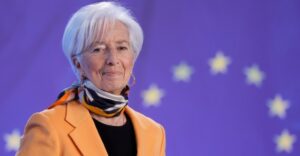
Increased uncertainty in the Eurozone is seen as a key risk factor by Christine Lagarde, President of the European Central Bank (ECB). She acknowledged that economic prospects remain highly uncertain amid geopolitical tensions and instability in international trade policies. According to her, uncertainty surrounding global trade strategies continues to be a major risk for economic activity, affecting both investment and market confidence.
During a press conference, she said:
“The Eurozone continues to face an unstable environment. Rising uncertainty could weigh on demand. A deterioration in global financial market conditions could also limit demand. Further friction in international trade could disrupt supply chains, reduce exports, and weaken consumption and investment. Geopolitical tensions, and in particular Russia’s unjustified war against Ukraine, remain a significant source of uncertainty.”
Inflation outlook
Referring to inflation prospects, the ECB chief noted that they remain more uncertain than usual due to the unstable global political environment. She said:
“Inflation could prove lower if tariffs reduce demand for Eurozone exports more than expected, and if countries with excess production capacity further increase their exports to the Eurozone. In addition, a stronger euro could reduce inflation beyond current expectations. More volatile and risk-averse financial markets could weigh on demand and, therefore, also reduce inflation.”
On the other hand, inflation could prove higher if there is a persistent upward shift in energy prices or if more fragmented global supply chains push import prices higher, limit the supply of critical raw materials, and exacerbate constraints on the Eurozone’s productive capacity, Lagarde noted. If wage growth slows more gradually, service-sector inflation may fall later than expected. She also mentioned that planned increases in defense and infrastructure spending could drive medium-term inflation upward.
Ask me anything
Explore related questions