Significant investments in natural gas exploration—estimated to reach €1 billion by 2031—along with strong prospects for increased public revenues, are being unlocked by the new hydrocarbon exploration contracts in four offshore blocks south of Crete and the Peloponnese.
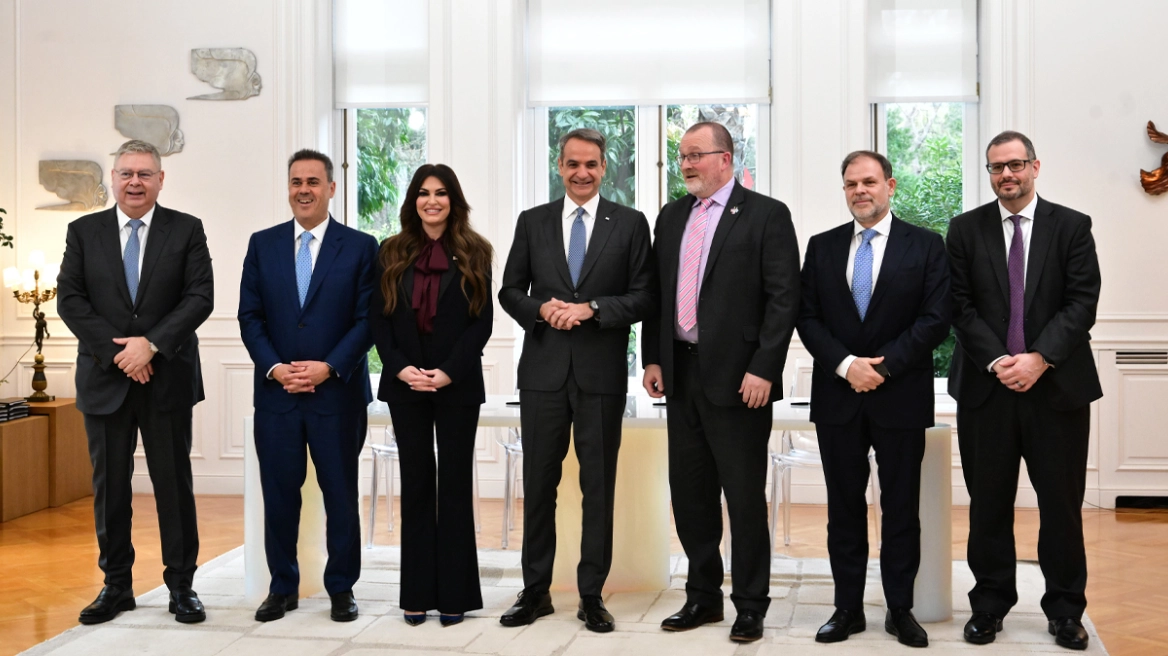
The agreements signed yesterday at the Prime Minister’s Mansion mark an acceleration of the national hydrocarbon program and strengthen Greece’s position as an emerging energy investment destination, attracting strong interest from two of the world’s largest international energy groups, ExxonMobil and Chevron.
Doubling of the area
With the addition of the new concessions, the total area of Greek territory where hydrocarbon exploration has been carried out or is planned increases from 47,905 to 94,094 square kilometers—effectively doubling.
This development significantly boosts the chances of discovering commercially exploitable deposits, as both the geographic coverage and the quality of available geological data expand.
The financial data and investment footprint of the concessions were presented yesterday by the CEO of HEREMA, Aris Stefatos, who noted that investments made since 2014 exceed €176 million, of which more than €111 million were directed to seismic mapping of the Greek offshore subsurface. These data constitute a national asset, as they remain the property of the Greek state and enhance geological knowledge and the country’s energy planning.
At the same time, new commitments totaling €41.5 million have already been undertaken for additional seismic surveys, which will further mature the areas. Moreover, with the launch of the exploratory drilling in Block 2 in the Ionian Sea, additional investments of around €80 million are being activated, marking the transition from geophysical surveys to the stage of direct deposit confirmation.
Three exploration phases with bank guarantees
The exploration program will unfold in three distinct phases over a total duration of seven years, accelerating investment maturation and the transition to drilling.
The first phase, lasting three years, includes the collection and analysis of 2D seismic data, with bank guarantees of €17.5 million to ensure implementation of the exploration program and compliance with contractors’ obligations.
The second phase, lasting two years, includes high-resolution 3D seismic surveys across all four concessions, backed by bank guarantees of €24 million, enabling more precise imaging of geological formations and assessment of potential deposits.
The third phase involves one exploratory well per area, with investments estimated at around €100 million, marking the most critical stage for confirming commercially exploitable deposits and moving to development.
Up to 41% of profits
According to an analysis by the Hellenic Hydrocarbon Resources Management Company (HEREMA), the Greek state’s total estimated effective benefit ranges between 38% and 41% of net profits from potential production.
This percentage derives from a combination of taxes, royalties, and mandatory payments made by contractors throughout the life of a field.
According to HEREMA, the main pillar of state revenues is corporate income tax at 20% of net profits. In addition, a 5% regional tax is levied, earmarked for local communities to fund development projects in areas hosting energy activities.
Royalties also play a decisive role, ranging from 4% to 15% of the value of production. Unlike profit taxes, royalties are paid regardless of profitability, ensuring steady state revenues from the very start of production.
Beyond taxes, the contracts предусматривают a range of additional financial obligations, including a one-off signing bonus of €3.45 million, as well as production-start and production bonuses that can total tens of millions of euros.
They also provide for area-use fees ranging from €700,000 up to €35 million, along with funding for training and know-how programs for Greek scientists.
Investments and faster permitting
If exploration confirms commercially viable deposits, total investments for drilling and development could reach up to €790 million, lifting the overall investment footprint to around €1 billion.
Administrative processes have also been significantly accelerated: the time for evaluation and completion of contracts has been reduced to about 11 months from 22 previously, while the total duration of exploration commitments has been shortened to seven years from more than eight.
Chevron: Strategic strengthening of presence in the Eastern Mediterranean
Strong investment interest is also confirmed by Chevron Corporation, which is incorporating Greece into its broader strategic planning in the Eastern Mediterranean.
“This is another important milestone for Chevron as we continue to build momentum in the Mediterranean, a region where we already have a significant position and are actively seeking exploration opportunities to strengthen and further expand our portfolio,” said Kevin McLachlan, Chevron’s Vice President of Exploration, in a company statement yesterday.
Papastavrou: Tangible exercise of sovereign rights
The geopolitical dimension of the agreements was highlighted yesterday afternoon in an interview on Mega TV by the Minister of Environment and Energy, Stavros Papastavrou. He said that activating exploration constitutes a tangible exercise of Greece’s sovereign rights.
He noted that carrying out exploration activities in maritime areas under Greek jurisdiction confirms the country’s right to utilize its natural resources and strengthens its position in the Eastern Mediterranean.
“Europe needs natural gas, and Greece can produce it,” he stressed, underscoring the country’s strategic role in enhancing European energy security.
Ask me anything
Explore related questions