Greece never ceases to amaze with the diversity of its landscapes. From the arid, Cycladic islands with their turquoise waters to the imposing mountain ranges of the mainland that offer panoramic views to those who reach their peaks, natural beauty spreads to every corner.
Even those who have travelled the country from end to end constantly discover routes that seem almost unreal, landscapes that are hard to believe are within the Greek borders.
One of these extraordinary images is found on the route leading to Coronisia, a place many call the “Polynesia of Greece.”
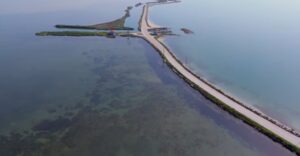
Koronisia, a small fishing village of 167 people, is connected to Epirus by a road that creates the feeling of hovering over the sea. The visitor crossing it has the impression that the roadway disappears into the watery landscape, as if it becomes “one” with it.
The narrow strip, about 6.5 kilometres long, separates the lagoons of Logarou and Tsoukalios in the Amvrakikos Gulf. The experience for the driver is unique, as the landscape creates the illusion of moving on the surface of the water.
The impression of being on the surface of the water is like being on the surface of the water.
At a distance of about 25 km from Arta, the route is framed by small islands scattered in the water environment. According to local accounts, these islands were once joined together, forming sandy strips that emerged from the sea.
Koronisia itself is a special destination. The village is associated with Hosios Onoufrios, who lived as a monk in the monastery of the “Birth of the Virgin”, and the area has significant ecological value. The Tsoukalios lagoon is home to about 35 pairs of silver pelicans, a rare and endangered species that is an important element of the local biodiversity.
A special place in local life is occupied by the sardine festival, which is held every year in the second half of August. Visitors have the opportunity to taste different versions of traditional dishes with sardines as a main ingredient, while the feast is accompanied by music and dances that highlight the cultural identity of the region.
Ask me anything
Explore related questions