

×
GreekEnglish

×
  • Politics
  • Diaspora
  • World
  • Lifestyle
  • Travel
  • Culture
  • Sports
  • Cooking
Wednesday
14
Jan 2026
weather symbol
Athens 9°C
  • Home
  • Politics
  • Economy
  • World
  • Diaspora
  • Lifestyle
  • Travel
  • Culture
  • Sports
  • Mediterranean Cooking
  • Weather
Contact follow Protothema:
Powered by Cloudevo
> Science

Proton collisions at CERN have shown unexpected phenomena

Theoretical models didn’t expect any rise in strange particles for proton collisions – and that makes this a big deal

Newsroom May 9 11:52

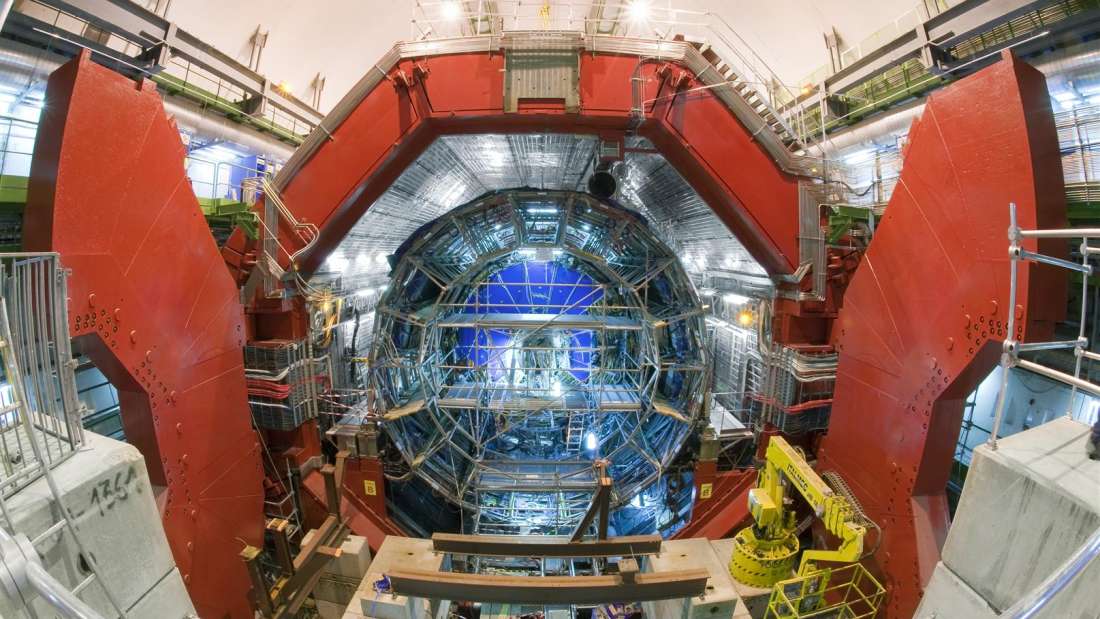
Physicists at the Large Hadron Collider (LHC) have observed some unusual events in a very rare type of proton collision.

Collisions between protons don’t always create the same particles, and in a small number of cases, they can create a large number of uncommon bits of matter. That’s fertile ground to test theories, and physicists were looking for something unexpected. And they found exactly that.

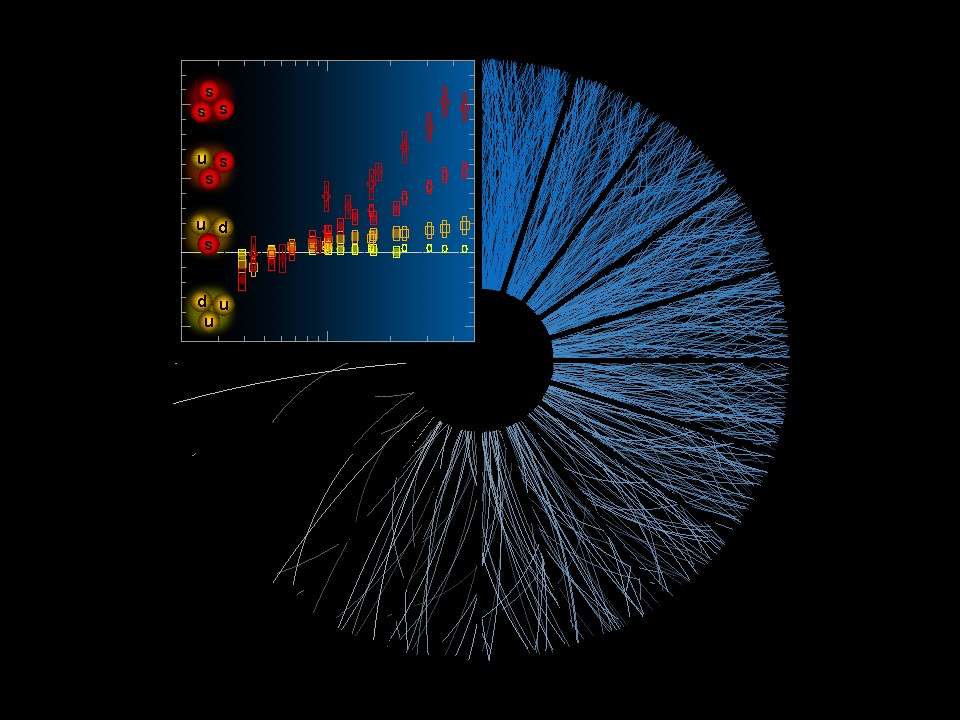
The team working on the ALICE experiment noticed an increase in particles that have strange quarks, a heavier version of the up and down quarks that are found in both protons and neutrons. This increase was previously detected in the quark-gluon plasma, a state that the LHC obtained by smashing lead nuclei together. But theoretical models didn’t expect any rise in strange particles for proton collisions – and that makes this a big deal.

“We are very excited about this discovery,” said Federico Antinori, spokesperson of the ALICE collaboration, in a statement. “We are again learning a lot about this primordial state of matter. Being able to isolate the quark-gluon-plasma-like phenomena in a smaller and simpler system, such as the collision between two protons, opens up an entirely new dimension for the study of the properties of the fundamental state that our universe emerged from.”
cern1

(Particles with more strange quarks were more likely to be created in the proton collisions)


The findings, published in Nature Physics, are pretty unusual. The production of these strange particles – such as Kaon, Lambda, Xi, and Omega – increase with the number of particles produced in a collision, which is known as multiplicity. The higher the multiplicity, the more strange particles detected.

>Related articles

Elon Musk: Don’t save for retirement – It won’t matter

Research: The BBC’s “first Black Briton” from the Roman era was ultimately…white and originated from southern England

The Greeks of Silicon Valley

Surprisingly, even though protons have no strange quarks, the collision produced more particles with a higher number of strange quarks than particles with less. And this didn’t depend on the energy of the collision or the mass generated.

This discovery opens a new door on quark-gluon plasma, the rare state of matter that existed just after the Big Bang. The extreme conditions necessary to recreate it in the lab allowed physicists to research the strong nuclear force, one of the four fundamental forces of the universe, and possibly even discover new and unexpected physics.

Source

Ask me anything

Explore related questions

#CERN#nature#physics#proton#science#technology
> More Science

Follow en.protothema.gr on Google News and be the first to know all the news

See all the latest News from Greece and the World, the moment they happen, at en.protothema.gr

> Latest Stories

What farmers gained from the meeting with Mitsotakis: The package for electricity, fuel, and income support – The message to the “hardliners” at the roadblocks

January 13, 2026

“Digital noise” from outdated technology caused chaos in the Athens FIR – What the committee’s findings say

January 13, 2026

JPMorgan: Greece one of the most attractive markets for the Emerging Europe category

January 13, 2026

Kimon arrives at Faliro as Europe’s heavily armed frigate enters Greek waters

January 13, 2026

ELSTAT: Inflation up to 2.6% in December

January 13, 2026

Spain aims to control deepfakes created with AI

January 13, 2026

Le Pen’s party’s appeal to decide her presidential future begins

January 13, 2026

Pyrgos: man attacked his wife with a knife and then threatened to kill himself

January 13, 2026
All News

> World

Spain aims to control deepfakes created with AI

The bill makes it illegal to use a person's image or voice created without consent through AI for advertising or commercial purposes

January 13, 2026

Le Pen’s party’s appeal to decide her presidential future begins

January 13, 2026

South Korea prosecutors seek death penalty for former President Yoon Suk Yeol

January 13, 2026

Parliamentary elections set for April 12 in Hungary as Orbán appears weakened in polls

January 13, 2026

Iran is preparing to execute by hanging a 26-year-old man, Erfan, for his participation in anti-government protests.

January 13, 2026
Homepage
PERSONAL DATA PROTECTION POLICY COOKIES POLICY TERM OF USE
Powered by Cloudevo
Copyright © 2026 Πρώτο Θέμα