





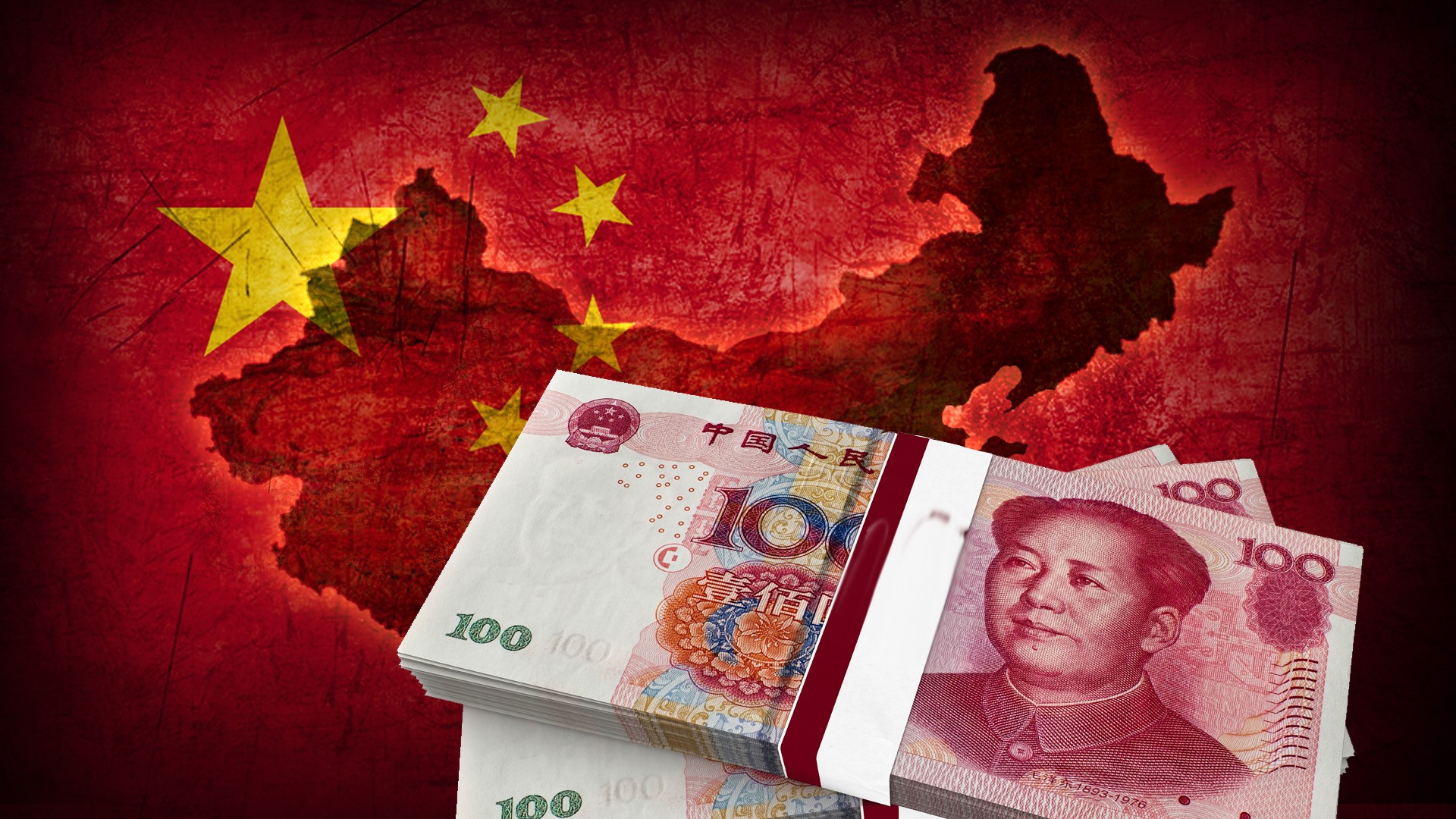
Moody’s Investors Service cut China’s sovereign credit rating for the first time in nearly three decades, citing expectations that the country’s financial strength will deteriorate in the coming years as debt keeps rising and the economy slows.
In a Wednesday statement, Moody’s said it downgraded China’s rating to A1 from Aa3, while changing its outlook to stable from negative. In March of last year, it cut China’s outlook to negative from stable. Moody’s last cut its China credit rating in November 1989, not long after the bloody crackdown on mass protests in Beijing’s Tiananmen Square rocked the nation. Moody’s now rates China’s credit alongside that of countries such as Japan, Saudi Arabia and Israel.
The news triggered an early selloff in Chinese stocks, with shares in Shanghai falling more than 1% before recovering, in addition to modest losses for the Chinese currency in the freely traded offshore market. The impact on the heavily-controlled domestic currency and bond markets was muted.
China’s Ministry of Finance said the downgrade was based on an “inappropriate” procyclical method. In a statement posted to its website Wednesday, the ministry said the ratings agency’s decision “overestimated the difficulties in the Chinese economy, while underestimated the ability of the Chinese government to deepen supply-side reforms and reasonably expand total demand.”
The move comes as Beijing has intensified a campaign in recent months to rein in risky investment and financing practices that pose a serious threat to the stability of the world’s second-largest economy. The People’s Bank of China has raised a suite of key short-term interest rates twice since early February, while the banking regulator cracked down on investment products with highly leveraged bets in capital markets.
The central bank’s tightening efforts precede a key political conclave in fall, during which a number of top leadership changes are expected. Beijing has been eager to ensure economic stability in the run-up to that meeting. China posted economic growth of 6.9% in the first quarter.
Still, a number of analysts are concerned that China’s economy has become too reliant on ever-rising levels of credit, much of which has been provided by the country’s expanding shadow banking sector. China’s total debt reached 253% of its gross domestic product last year, up from 213% in 2013 and 149% in 2008, according to J.P. Morgan.
The rise in debt, which started in earnest with a massive stimulus program during the 2008-2009 global financial crisis, has increasingly weighed on the world’s second-largest economy. Accommodative monetary policy and robust state spending over many years have also fueled excess production capacity in industries such as glass and steel, which has diverted funding to “zombie” companies rather than to promising firms in the real economy.
“The downgrade reflects Moody’s expectation that China’s financial strength will erode somewhat over the coming years, with economy-wide debt continuing to rise as potential growth slows,” Moody’s said in the statement.
“While ongoing progress on reforms is likely to transform the economy and financial system over time, it is not likely to prevent a further material rise in economy-wide debt, and the consequent increase in contingent liabilities for the government,” it added.
Another ratings firm, Fitch Ratings, downgraded China’s debt in 2013 to A+, a rating that is on a par with Moody’s after the downgrade. S&P rates China’s debt at AA-, equivalent to a notch higher.
The U.S. also saw its sovereign debt downgraded in August 2011 when S&P cut its rating to AA+ from AAA, the first such move in 70 years. S&P said the move was driven by the U.S. budget deal, which the ratings agency said hadn’t done enough to address the gloomy outlook for America’s finances. S&P affirmed its AA+ rating on the U.S. in June 2016; Moody’s and Fitch both maintain a triple-A rating for the country.
Since the S&P rating cut, aggregate debt levels in the U.S. have remained fairly constant. Its ratio of debt to GDP stood at 252% in 2011, edging up to 256% as of the third quarter of 2016, according to the Bank for International Settlements—almost exactly the same level as in China now.
The timing of Moody’s downgrade coincides with increased investor nerves about China. While China’s economy had held up well at the start of the year, surprising investors who had been bracing for a slowdown, more recent indicators point to weakening activity. The tightening of credit in China was the biggest risk cited by global fund managers surveyed by Bank of America Merrill Lynch in May, and foreign investor interest in a range of Chinese assets has waned recently.
“Investors are not that keen on Chinese bonds anyway,” said Ben Sy, head of fixed income, currencies and commodities at J.P. Morgan Private Bank in Hong Kong.
The Moody’s downgrade could have an impact on China’s exchange rate and economy over the longer term as it could weaken Chinese companies’ ability to raise new debt or repay existing loans in global markets, said Zhu Chaoping, a China economist at UOB Kay Hian Holdings, a Singapore investment bank.
“Once Chinese companies run into trouble with their overseas debt, the yuan will be under pressure,” Mr. Zhu said.
In the freely traded offshore market, the U.S. dollar was recently at 6.8843 against the yuan, up slightly from 6.8808 at Tuesday’s close. In the onshore yuan market, where the central bank has a firm grip, the pair is up at 6.8932 from 6.8897 Tuesday.
The yuan’s steady performance in the wake of the downgrade prompted some market participants to suspect intervention from the country’s central bank.
“I would say that, without the PBOC’s heavy hand, Moody’s downgrade would have pushed the yuan down to at least 6.9100 this morning,” said a Shanghai-based senior currency trader at a domestic bank.
China’s domestic bond market, which has fallen sharply in recent months due to Beijing’s efforts to reduce leverage and financial risk, appeared to shrug off the rating action. The yield on the 10-year Chinese government bond was recently unchanged at 3.67%.
“This is because the onshore bond market remains dominated by local investors, especially banks and insurance companies, who are unlikely to take such news into consideration,” Mr. Zhu said. Chinese banks account for about two thirds of all trading in China’s $8 trillion bond market.
Still, the downgrade could make foreign investors even more cautious about entering China’s onshore bond market, said Ken Cheung, Asia currency strategist at Mizuho Bank in Hong Kong. The downgrade comes as China is planning to launch a bond connect program with Hong Kong that would allow foreign investors to more easily access the mainland market.
Ask me anything
Explore related questions