

×
GreekEnglish

×
  • Politics
  • Diaspora
  • World
  • Lifestyle
  • Travel
  • Culture
  • Sports
  • Cooking
Thursday
15
Jan 2026
weather symbol
Athens 11°C
  • Home
  • Politics
  • Economy
  • World
  • Diaspora
  • Lifestyle
  • Travel
  • Culture
  • Sports
  • Mediterranean Cooking
  • Weather
Contact follow Protothema:
Powered by Cloudevo
> Science

Mystery of the disappearing star – how N6946-BH1 vanished without a trace!

The findings could shed light on the origin of supermassive Black Holes

Newsroom May 26 09:52

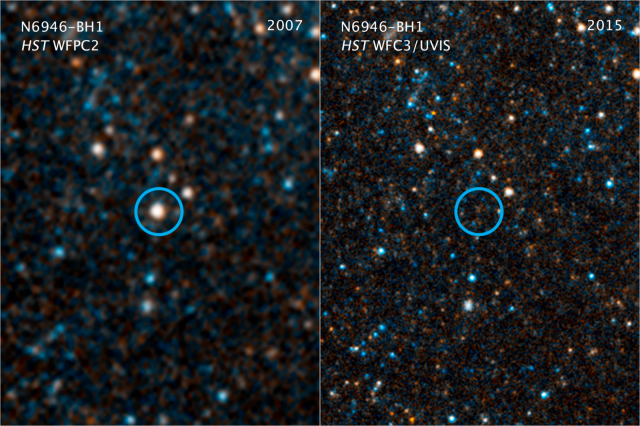
The star N6946-BH1 in a spiral formation 22 million light years away known as the ‘fireworks galaxy’, was last seen by Nasa’s Hubble Telescope in 2009. By 2015, it wasn’t there anymore.

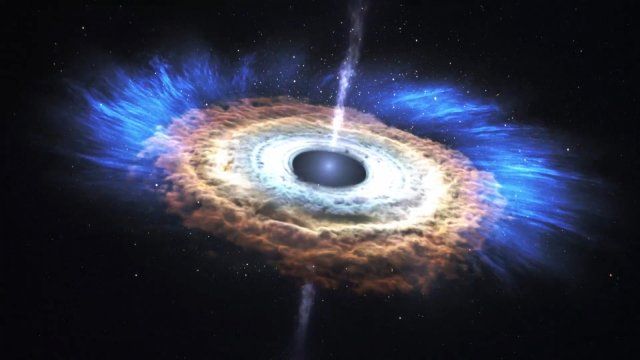
How did a star 25 times the size of our Sun simply wink out of existence? Such large stars often go out with a bang – a supernova – blasting off much of their remaining mass before collapsing to form an incredibly dense black hole.
s1


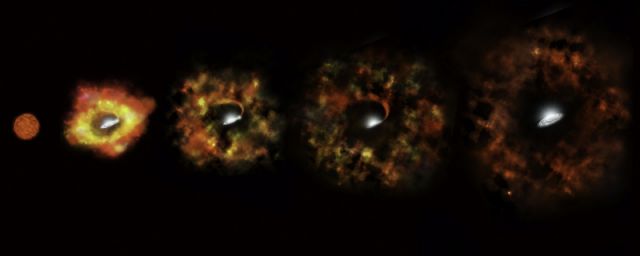
But this didn’t happen to N6946-BH1, according to a paper published in the Monthly Notices of the Royal Astronomical Society. There was a slight brightening around 2009 where the star expelled its outer layer in a gentle puff, but it wasn’t anywhere near bright enough to be a supernova.

The Hubble Telescope and the Spitzer Space Telescope were not able to detect the star when they looked with the same filters at this patch of space in 2015. One theory for what happened to it is that it formed a black hole directly without going through the usual process of a supernova first.

“The typical view is that a star can form a black hole only after it goes supernova,” said Christopher Kochanek of Ohio State University in a statement.

Although this contradicts current theories of the role of supernovas in forming black holes, it may be much more common than astronomers previously thought.
s3


“If a star can fall short of a supernova and still make a black hole, that would help to explain why we don’t see supernovae from the most massive stars.”

As such, the findings could shed light on the origin of supermassive black holes. Up to 30% of massive stars capable of a supernova could instead collapse to become a black hole without an explosion. Astronomers have dubbed this process a “massive fail”.

“N6946-BH1 is the only likely failed supernova that we found in the first seven years of our survey. During this period, six normal supernovae have occurred within the galaxies we’ve been monitoring, suggesting that 10 to 30% of massive stars die as failed supernovae,” said Scott Adams, a former Ohio State student.

However, another theory for what happened to the star is that it is in fact still there, shrouded in a cloud of gas. The miniature explosion noted in 2009 could have created a cloud that would hide it from instruments on Earth.
s2

>Related articles

Elon Musk: Don’t save for retirement – It won’t matter

Sick astronaut on mission – NASA considers early return of International Space Station crew

NASA published a new map of the universe; the “SPHEREx” space telescope changes the data landscape

But very little infra-red radiation was seen from the site where the star was. At least some radiation would be expected to seep through if N6946-BH1 was hiding behind a cloud.

Further observation of this region of space with Nasa’s Chandra X-ray Observatory could help to elucidate whether the star is really still there or not.

Source

Ask me anything

Explore related questions

#Black Holes#exoplanet#nasa#planets#science#stars#technology
> More Science

Follow en.protothema.gr on Google News and be the first to know all the news

See all the latest News from Greece and the World, the moment they happen, at en.protothema.gr

> Latest Stories

Sophie Turner’s first photo as Lara Croft released for Tomb Raider series

January 15, 2026

Obst sealed the win at the end against Panathinaikos as Bayern defeated them 85–78 in Munich

January 15, 2026

“You think you are descendants of Plato and Aristotle, but you’re not” – Rama’s tirade against Greek journalist, watch video

January 15, 2026

“Aunt Pecu,” who lived outside all protocol: Who the unconventional and eccentric princess Irene was

January 15, 2026

High-tech fraud – SMS blaster attack: Bank data stolen using special equipment installed in a car’s trunk

January 15, 2026

Ballistic missile strike hits pier in Ukraine

January 15, 2026

Ursula von der Leyen from the Green Line: Pushing for a solution to the Cyprus issue is a priority

January 15, 2026

The ordeal of a 28-year-old Greek man in Australia: He went on holiday to visit relatives, was injured at a beach, and is at risk of quadriplegia

January 15, 2026
All News

> Economy

Tourism: Greece, Athens, and Attica lead with over 4.75 billion euros in revenue by 2019—Doubling previous figures

The latest data from the studies of INSETE give the picture in the 13 regions of the country

January 15, 2026

Oil prices fall 3% after Trump’s statements on Iran

January 15, 2026

Pierrakakis: The new 10-year bond record is the most convincing answer to those who question the value of the investment grade

January 14, 2026

UBS: Greek banks in the spotlight – Piraeus Bank portfolio top pick

January 14, 2026

Austrian press on the Greek bond: Investors are now queuing up in Athens

January 14, 2026
Homepage
PERSONAL DATA PROTECTION POLICY COOKIES POLICY TERM OF USE
Powered by Cloudevo
Copyright © 2026 Πρώτο Θέμα