
×
GreekEnglish

×
  • Politics
  • Diaspora
  • World
  • Lifestyle
  • Travel
  • Culture
  • Sports
  • Cooking
Saturday
17
Jan 2026
weather symbol
Athens 8°C
  • Home
  • Politics
  • Economy
  • World
  • Diaspora
  • Lifestyle
  • Travel
  • Culture
  • Sports
  • Mediterranean Cooking
  • Weather
Contact follow Protothema:
Powered by Cloudevo
> World

Roman dodecahedrons: Mysterious objects found across the Roman Empire

As no classical accounts mention them, the purpose of these objects remains a mystery

Newsroom June 13 10:37

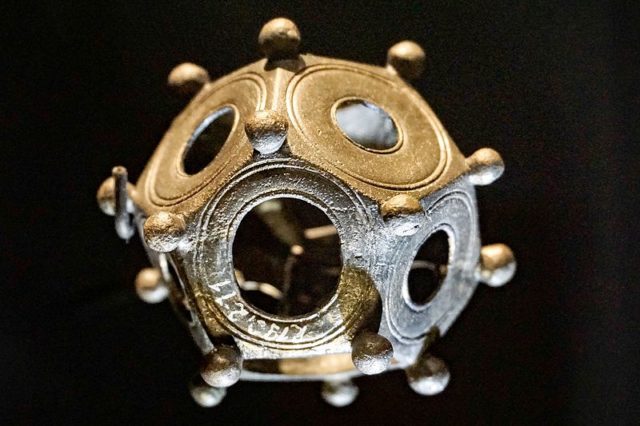
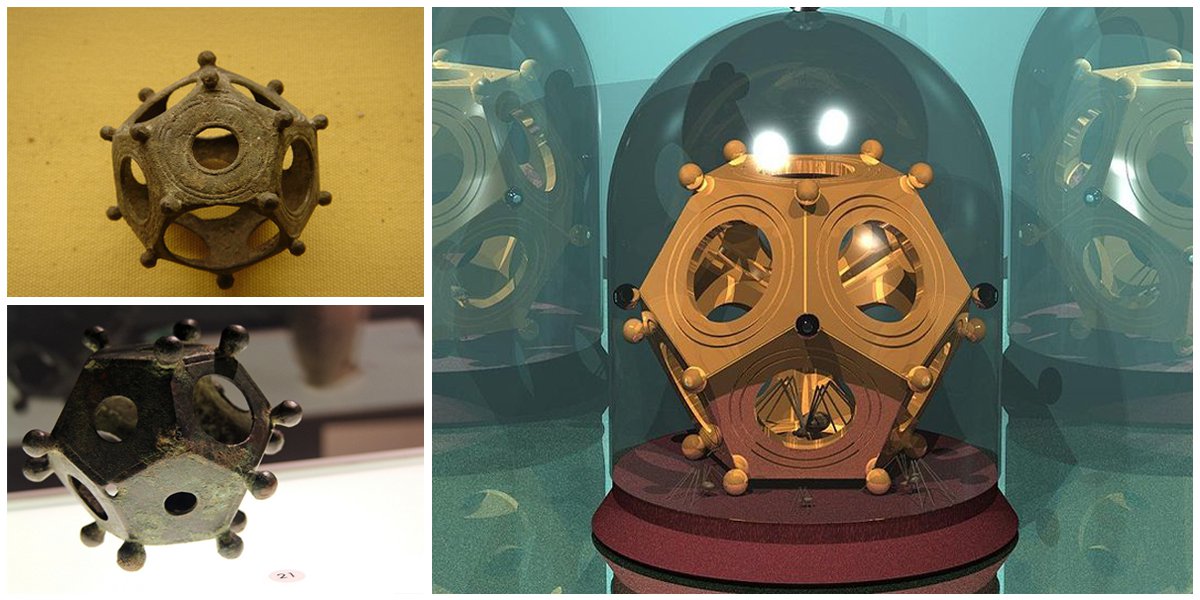
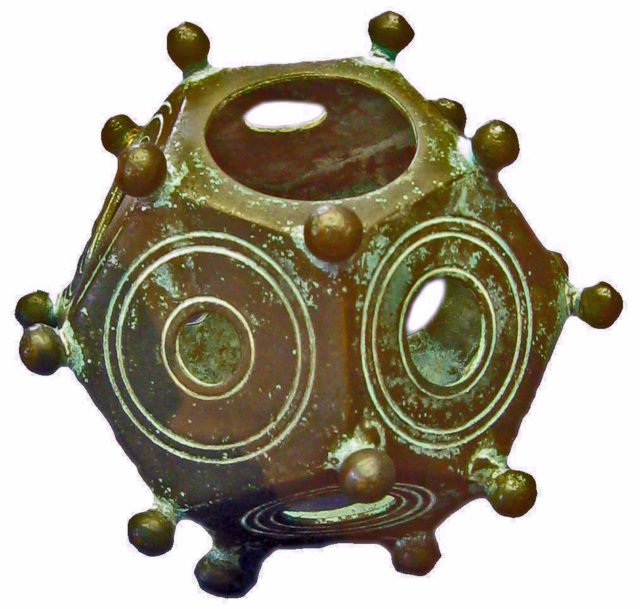
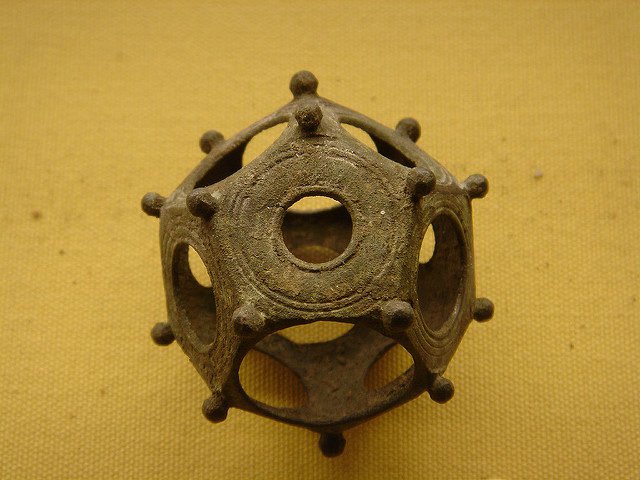
Dating from around 200 AD, the Roman dodecahedron is a small hollow object made of bronze or (more rarely) stone, with a geometrical shape that has twelve flat pentagonal faces, each with a circular hole in the middle. All sides connect into a hollowed center.

They were also embellished with a number of knobs at each corner point of the pentagon.
d2


d3

(They are embellished with spheroids at each vertex and circular holes of various diameters in each face)

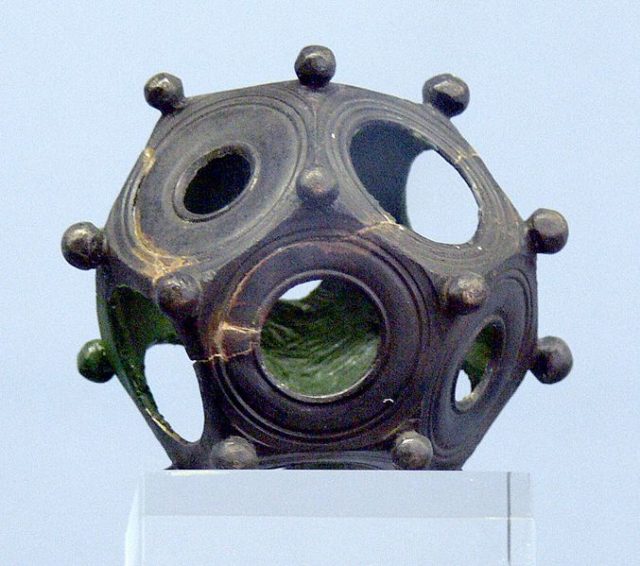
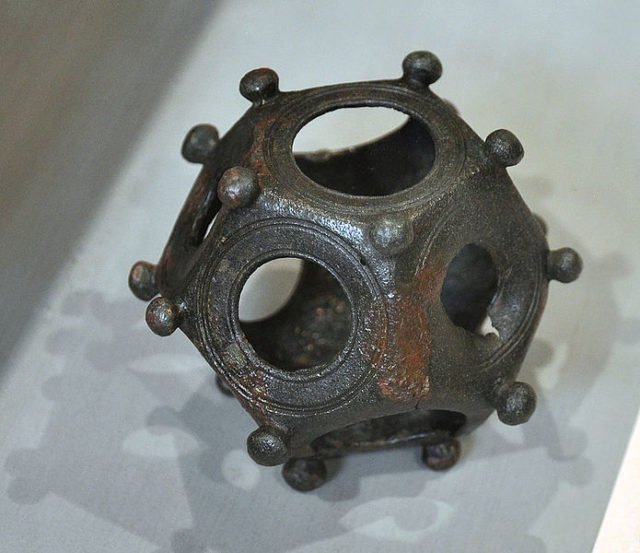
Ranging from 4 cm to 11 cm, over 100 of these fascinating looking objects have been found in various European parts of the Roman Empire. The focus of findings of the dodecahedrons has been in central modern Europe or today’s France and southwest Germany.
d4

(They were found in multiple locations across the territory of the Roman Empire)
 

d6

(More than one hundred of these artifacts have been found across Great Britain, Netherlands, Germany, Luxembourg, Austria, Switzerland, France, Belgium and Hungary)

As no classical accounts or narratives seem to mention them, the purpose of this mysterious object remains a puzzling mystery that has confused archaeologists since their first discovery.

In the course of the years, several different theories have been formulated, attempting to clarify the use of the dodecahedron.
d7

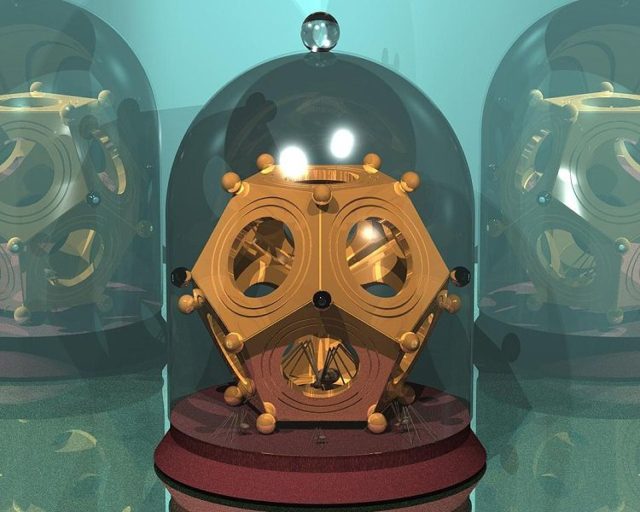
(The use or function of the dodecahedra is unknown since there is no mention of them in any text of pictures of that time)

Speculated uses include candlestick holders (wax was found in one of them), flower stands, staff or scepter decorations, a fortune telling devices, a bludgeon, a children’s toy, dice, or a measuring device (more precisely as a range measuring object on the battlefields).
d8

(They appear in various contexts and have been constructed of several materials, such as bronze and stone)

However, the most widely-held theory is that they were religious artifacts, based on the fact that most of the examples have been found in Gallo-Roman sites (one such object was found in a woman’s burial ground).

The Roman dodecahedrons have long been discussed in regards to their actual usage. A satisfactory explanation has yet to be given.
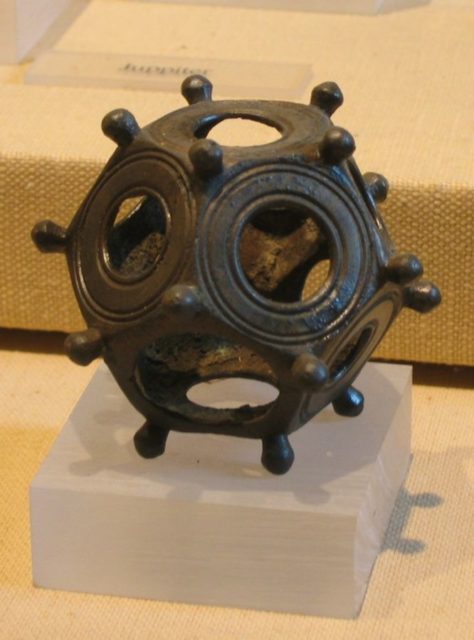
d9

(Roman dodecahedron found in Germany on display in Saalburg castle near Bad Homburg)
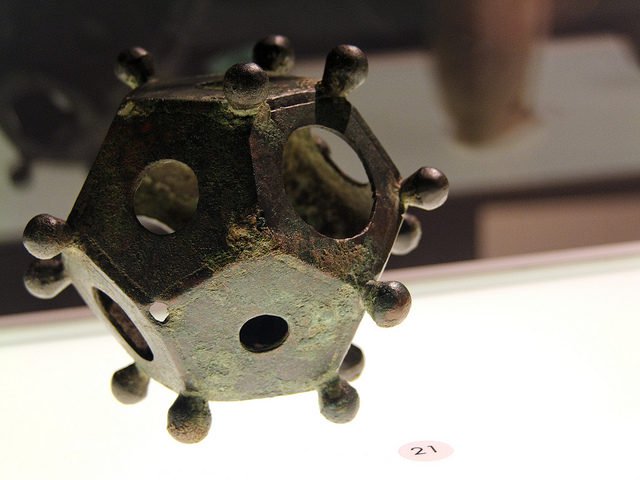
 

d10

(A unique ancient artifact)

>Related articles

Erich von Däniken, Swiss bestselling author who linked ancient civilizations to extraterrestrials, dies at 90

Crete, Pompeii & Stonehenge: The most important archaeological discoveries of 2025 that overturn what we knew

7,000-year-old wall found at the bottom of Brittany may explain the myth of the lost city

In the video below, YouTube user Martin Hallett offers his own thoughts about what the Roman dodecahedrons might have been used for in ancient times.

Source

Ask me anything

Explore related questions
#archaeology#artifacts#mystery#Roman Empire
> More World

Follow en.protothema.gr on Google News and be the first to know all the news

See all the latest News from Greece and the World, the moment they happen, at en.protothema.gr

> Latest Stories

War, diplomacy, or insurrection: What’s next in Iran

January 17, 2026

New tensions in the Middle East as Trump invites regional leaders to the Gaza Peace Council

January 17, 2026

Weather: A return to winter in the coming days – Cold and strong northerly winds – Kolydas’ post

January 17, 2026

A view of Nikolaos Stasinopoulos of Viohalco – The “enduring imprint” of Greece’s greatest industrialist

January 17, 2026

The horror of the “Tariff of the Dead”: how the Iranian regime prices the bodies of protesters

January 17, 2026

Mitsotakis on the Karystianou party: “There is a long distance between being the parent of a tragedy victim and being the leader of a political party”

January 17, 2026

Patras in carnival mode – This evening, the city’s official opening ceremony

January 17, 2026

Greenland as the first line ofdefense for the U.S. and NATO:

January 17, 2026
All News

> Culture

The historic cafes of Athens: 12 legendary hangouts lost to time

The café-patisseries that set the rhythm of cosmopolitan Athens – “Flokas,” “Papaspirou,” “Sonia,” “Alaska,” “Lentzos,” “Floral,” “Blue Bell,” “Prapas,” “Pachos,” “Galaxy,” “Caprice,” “Centaur” were the most popular meeting points where modern Greek history was written, became songs and books, and left their mark with their famous culinary creations

January 16, 2026

Actress Melpo Zarokosta dies at 93

January 16, 2026

Cycladic Identity Initiative launches fourth funding phase to preserve the Cultural and Natural Heritage of the Cyclades

January 16, 2026

Grief in Crete for the loss of Yannis Xylouris

January 15, 2026

“A Picasso for 100 euros” — Christie’s for a million-euro painting

January 15, 2026
Homepage
PERSONAL DATA PROTECTION POLICY COOKIES POLICY TERM OF USE
Powered by Cloudevo
Copyright © 2026 Πρώτο Θέμα