





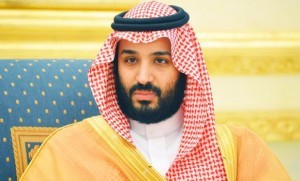
King Salman of Saudi Arabia promoted his 31-year-old son, Mohammed bin Salman, to be next in line to the throne on Wednesday, further empowering a young, activist leader at a time when the kingdom is struggling with low oil prices, a rivalry with Iran and conflicts across the Middle East.
The decision to remove the previous crown prince, Mohammed bin Nayef, 57, comes as some members of the royal family have chafed at the rise of the younger prince, who emerged from relative obscurity when his father, 81, ascended the throne in January 2015.
Prince Mohammed bin Salman has since accumulated vast powers in the wealthy kingdom, a crucial ally of the United States, serving as defense minister, overseeing the state oil company and working to overhaul the Saudi economy.
His supporters have praised him as hard-working and as offering a hopeful vision for the kingdom’s future, especially for its large youth population. His critics have called him inexperienced and power hungry.
The royal reordering brings to an end the career of Prince Mohammed bin Nayef, who served as interior minister and was widely respected by Saudis and their foreign allies for dismantling Al Qaeda’s networks inside the kingdom.
King Salman’s decrees on Wednesday removed Prince Mohammed both from his place in the line of succession and from his post as interior minister.
Saudi Arabia is one of the world’s few remaining absolute monarchies. All major decisions rest with the king, a structure that King Salman has used to empower his offspring.
Prince Mohammed bin Salman’s swift rise had led many Saudi watchers to suspect that his father wanted to make him the next king; the young prince had quickly assumed prominent roles handling some of the kingdom’s most important files.
As deputy crown prince, he spearheaded the development of a wide-ranging plan, called Saudi Vision 2030, which seeks to decrease the country’s dependence on oil, diversify its economy and loosen some of the conservative, Islamic kingdom’s social restrictions.
As defense minister, he also had primary responsibility for the kingdom’s military intervention in Yemen, where it is leading a coalition of Arab allies in a bombing campaign aimed at pushing Houthi rebels from the capital and at restoring the government.
That campaign has made limited progress in more than two years, and human rights groups have accused the Saudis of bombing civilians, destroying the economy of what was already the Arab world’s poorest country, and exacerbating a humanitarian crisis by imposing air and sea blockades.
Prince Mohammed has taken a hard line on Iran, saying in a television interview last month that dialogue with the Shiite power was impossible because it sought to take control of the Islamic world.
“We are a primary target for the Iranian regime,” he said, accusing Tehran of seeking to take over Islamic holy sites in Saudi Arabia, which is home to Mecca and Medina. “We won’t wait for the battle to be in Saudi Arabia. Instead, we’ll work so that the battle is for them in Iran.”
Saudi Arabia and Iran stand on opposite sides of conflicts in Bahrain, Syria and Yemen while seeking to lessen each other’s influence across Africa, Asia and the Middle East.
Oil prices fell on Wednesday, continuing their downward drift, with the international crude benchmark falling 1 percent to around $45.50 a barrel. Over the long term, though, Prince Mohammed’s increasing power over the world’s largest oil exporter could have far-reaching consequences.
The Saudi royal family had largely left the operation of the energy industry to technocrats, but Prince Mohammed has taken a more direct role.
In particular, he has drawn criticism for driving an initial public offering of the state oil giant, Saudi Aramco, a highly secretive company that has underpinned the kingdom’s economy and generated tremendous wealth for decades. He has also made pronouncements on oil production policy that sometimes seemed to undercut more experienced Saudi energy officials.
“The problem is that he is unpredictable, and it is not clear who he is relying on for advice,” said Paul Stevens, a Middle East oil analyst at Chatham House, a London-based research organization.
Prince Mohammed’s promotion comes at an awkward time for the Saudi oil industry.
Production cuts by the Organization of the Petroleum Exporting Countries, largely orchestrated by the Saudis last year, have so far failed to bolster prices, presenting the Saudis and other big oil producers with few good options. Major oil exporters could further cut output, or the Saudis could go back to a policy they pursued in late 2014: allowing prices to fall, forcing smaller, lower-margin producers out of the market and, as a result, grabbing more market share.
During his rise, Prince Mohammed has looked for mentorship to Sheikh Mohammed bin Zayed, the crown prince of Abu Dhabi in the United Arab Emirates. The two men have recently worked in tandem to isolate Qatar, accusing it of supporting terrorism, an accusation their small neighbor denies.
Prince Mohammed has pursued a uniquely public profile for the traditionally private kingdom, giving interviews to Western news outlets and taking high-profile trips to China, Russia and the United States, where he met President Trump in March.
Saudis who work with him praise him as detail-oriented and unafraid to take risks and break conventions, a rare trait in the historically cautious kingdom.
But his father’s moves to empower him rankled other branches of their family, which found themselves sidelined in favor of a young prince who had no significant military or business experience before 2015.
Another of the king’s sons, Prince Khalid bin Salman, was recently named ambassador to the United States.
Saudi news outlets portrayed the move as an orderly reshuffle, saying that 31 of 34 members of a council of senior princes had approved the appointment and broadcasting footage of Prince Mohammed bin Nayef pledging allegiance to his successor. King Salman named a young and relatively unknown prince, Abdulaziz bin Saud bin Nayef, as interior minister.
The departing prince’s profile had waned as that of his younger cousin grew. As head of the powerful Interior Ministry, which is charged with domestic security, the older prince led a campaign against Al Qaeda in the kingdom a decade ago and had close ties to American and other Western officials.
In 2009, the prince was wounded when a militant, who came to his palace saying he wanted to turn himself in, detonated a bomb hidden in his rectum. People who have met with him recently said the injury’s effects have lingered, although it was unclear whether they played a role in the king’s decision to replace him.
Ask me anything
Explore related questions