In central Laos, thousands of large stone jars carved from solid rock have mystified archaeologists. For decades, the question was “What were these jars used for?”
That question might be answered with the recent excavations on the Plain of Jars. Archaeologists have discovered 2,500-year-old human remains buried at sites near to the clusters of stone jars. This discovery suggests that the jars might have been used to “distill” the bodies before burial. The pits where the bones were buried had been covered with a large limestone block. In other cases, the bones had been placed in ceramic vessels before being buried.
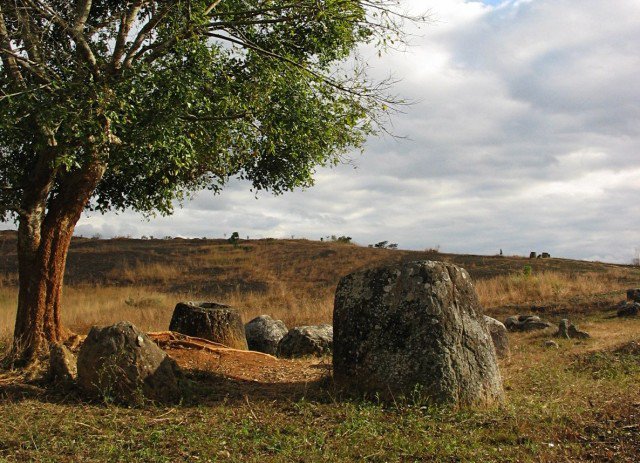
(Plain of Jars)
Despite being named a “plain” of jars, the landscape is actually a collection of lowland slopes and valleys in Xieng Khouang.
Measuring between three and ten feet tall, the jars themselves are hewed from sandstone and limestone. The jars located on the Xieng Khouang plateau date from 500 BC to 500 AD. The stone seems to have been quarried from several areas in the Xieng Kouang foothills, then spread across more than 90 sites, some of which had just a handful of jars while others had hundreds. The largest location has about 400 stone vessels. Each jar has a cylindrical shape with the bottom wider than the top and most have lip rims, which suggest that the jars had originally had lids. Few, lids, however, have ever been found at the sites. A single jar has been found decorated with a human “frogman” relief carved on the exterior.
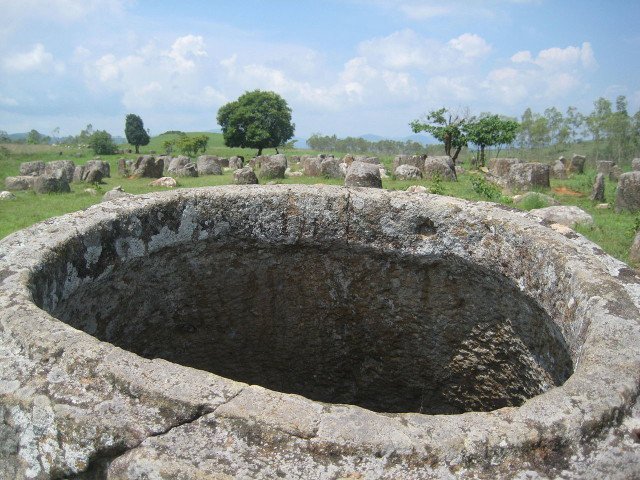
(Plain of Jars – Site One)
The archaeologist leading the work at the Plain of Jars, Dr Dougald O’Reilly , was the one to suggest the theory that the jars were used to decompose the bodies before the bones were removed and reburied. The archaeologists are not only trying to figure out the purpose of the jars but about the people and culture who made them.
Dr O’Reilly said, “What is now clear is that these are mortuary and were used for the disposal of the dead. This will be the first major effort since the 1930s to attempt to understand the purpose of the jars and who created them. One theory is that they were used to decompose the bodies. Later, after the flesh was removed, the remains may have been buried around the jars.”
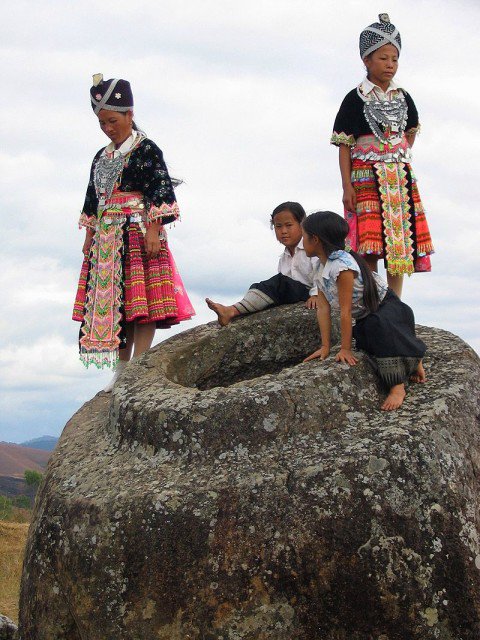
(Hmong Girls climbing on one of the jars at Site)
Other theories for the purpose of the jars include their being used as storage vessels or to hold the cremated remains of the dead. These theories have been supported by the various findings in the vessels – cremated fragments of bones and teeth, and glass beads.
The vessels that do remain have not only yielded bones and trinkets, but their existence suggests that the culture which used them had a multiple-step funeral process, according to Dr O’Reilly. “Our excavations have also revealed, for the first time at one of these sites, a primary burial, where a body was placed in a grave.”
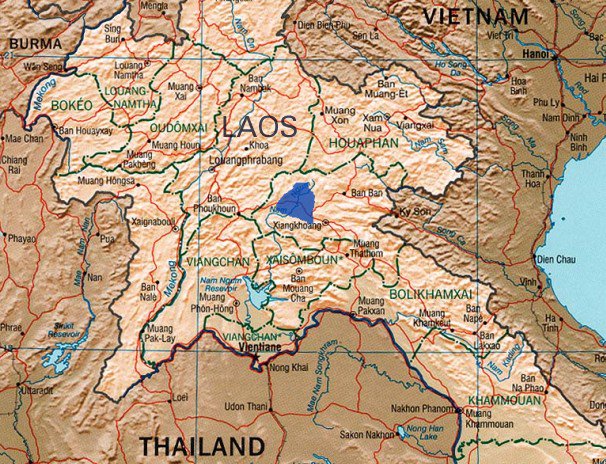
(Location of Plain of Jars and Xieng Khouang plain -blue shading-)
Dr O’Reilly also said that one of the many goals of the archaeologists is to determine the status of the buried individuals. That task, however, is difficult due to the lack of material objects buried with them. Nevertheless, Dr O’Reilly and his team hope that further analysis of the various graves will provide some clues. “This will open up a huge amount of information into who these people were,” he said, determinedly optimistic.
Unfortunately, many of the sites have been unreachable to researchers due to the danger of the unexploded bombs that were dropped on the area by the United States during the Vietnam War. Although many jars are relatively intact today, it is feared that many jars – and their contents – were destroyed by the bombs that did detonate.
Ask me anything
Explore related questions