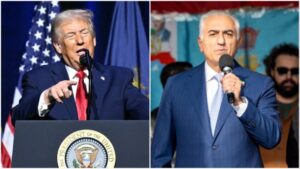
To listen to Donald Trump, speaking during his recent trip there, the Middle East splits neatly into opposing camps and it’s obvious which one harbors the good guys.
It didn’t take long for that notion to be publicly debunked. Within a couple of weeks of the president’s departure, a crisis over the Gulf state of Qatar had U.S. allies at loggerheads. More than that, it showed that there aren’t just two power blocs in the region. There are at least three.
An alliance led by Saudi Arabia apparently enjoys Trump’s full support. Iran heads a coalition of America’s enemies. But a third bloc, looser and harder to classify, is at the heart of the dispute in the world’s oil repository. It includes Qatar, which hosts a major U.S. military base; Turkey, a NATO member; and the stateless, beleaguered yet resilient group that both nations support: the Muslim Brotherhood.
The 90-year-old Islamist movement has been in the crosshairs of the Saudis and other Gulf monarchies since the Arab revolts at the start of this decade, when it briefly held power after winning elections in Egypt, and seemed set to repeat the feat elsewhere.
“They see the Brotherhood as the only organized, transnational movement that offers a different model of political activity and legitimacy,” said Shadi Hamid, a senior fellow at the Brookings Institution who worked at the think-tank’s Doha center. “They see that as a threat. That’s why the Muslim Brotherhood is so divisive. Because it captures this fundamental divide over the Arab Spring.”
‘Disrespectful’
That agenda was apparent in the demands presented to Qatar. Placed under a partial blockade, the small, gas-rich nation was told to cut back ties with Iran and end its alleged support for al-Qaeda and Islamic State, the groups that top most Western terror lists.
But it was also ordered to stop supporting the Brotherhood, which Western countries don’t classify as terrorist; to shut down the Brotherhood-friendly broadcaster Al Jazeera; and to kick Turkish troops out of their new base in Qatar.
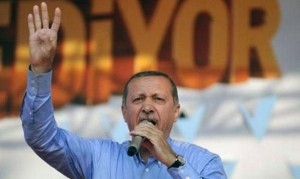
Qatar has rejected the ultimatum but will still deliver a formal response on Monday after the Saudi-led coalition agreed to a two-day extension of its deadline for Qatar to meet its demands. Turkey promised support for the embattled emirate and rushed through a bill allowing deployment of a token number of soldiers, and held a joint military exercise near the Qatari capital Doha. The demands are an attack on Qatar’s sovereignty, and talk of evicting Turkish troops is “disrespectful,” President Recep Tayyip Erdogan said.
Qatar, like its Gulf allies-turned-antagonists Saudi Arabia and the United Arab Emirates, is an autocratic monarchy. It doesn’t allow political groups like the Brotherhood a say in its own affairs, even as it sponsors them elsewhere. But Erdogan, as an elected Islamist leader, claims a deeper affinity. His ruling party sees itself as the product of the same demographic forces that brought the Brotherhood to power in Egypt at the peak of the Arab Spring.
Turkey Vulnerable
That’s one reason why Amr Darrag now lives in Istanbul.
He was minister for planning in Egypt’s short-lived Brotherhood government. After its president, Mohammed Mursi, was ousted by the army in 2013 amid large-scale protests against his rule, many Brotherhood leaders found themselves in jail. Darrag left — for Qatar. And then he moved to Turkey, where he heads the Egyptian Institute for Political and Strategic Studies in Yenibosna, an Istanbul suburb newly thriving on an influx of Arab entrepreneurs.
Darrag says he got a warm welcome from the Turkish government, which strongly opposed the coup in Egypt — just as Saudi Arabia welcomed it. When Qatar came under pressure to sever ties with the Brotherhood in 2014, the year that the Saudis and Emiratis labeled it a terrorist group, the Gulf nation had Turkish backing. As it does now.
“Turkey is standing with Qatar because there’s a belief that if Qatar surrenders or falls, then Turkey becomes vulnerable,” Darrag said. If both countries were to change course, “it would be probably the end of moderate Islamist movements in the area for some time.”
It’s clear who would take their place, according to Yasin Aktay, a lawmaker from Erdogan’s party who was its point-person in dealings with the Brotherhood. The group “represents Islamic democracy,” he said in an interview. “And if you push it out the realm of democracy, then you’d have to deal with groups like Islamic State.’
‘Where Next?’
Of course, the Saudis and their allies don’t agree that the Brotherhood is moderate. A Saudi interior minister once called it the “source of all evil” in the kingdom. The U.A.E. has jailed dozens of people it accuses of working on the group’s behalf to seize power.
The Brotherhood is “seen as an organization that’s meddling in other countries’ affairs through secret cells and terrorism,” said Ghanem Nuseibeh, London-based founder of Cornerstone Global Associates.
In its first weeks, the Trump administration weighed the idea of following the Saudi lead and designating the Brotherhood a terrorist group. It hasn’t done so. Secretary of State Rex Tillerson told the House Foreign Affairs Committee last month that elements of the organization have joined governments in some countries and “have done so by renouncing violence.”
The group has shown signs of fragmenting since the coup in Egypt, which followed a year of often chaotic Brotherhood rule. Analysts say that some breakaway members have carried out attacks on Egyptian security forces.
Darrag says that if there are splits, they’re not over the use of force but the question of how things could have been done differently when the 2011 uprising opened the way to power. There was an opportunity to sweep away the old, corrupt security state and establish a civilian democracy, he said. “Millions of people went to the streets, they wanted change.” But, “ because the Brotherhood is not a revolutionary movement but a gradualist and a reformist movement, it went along with the agenda of the military” — and paid a steep price.
Such questions are familiar to Erdogan, who’s battled Turkey’s traditionally secular army ever since he came to power in 2003. He survived a coup attempt a year ago. Mithat al-Haddad, a member of the Muslim Brotherhood’s governing council and another Egyptian exile in Istanbul, recalls the night of July 15, 2016 very well. When power hung in the balance and Erdogan disappeared from sight for several hours, he said, “we were thinking, the Egyptian community and Arabs in general, where to go next.”
‘Not My Level’
Ideological sympathies aren’t the only reason for Turkey’s ties to Qatar, the world’s richest country on a per-capita basis. Qatar was the second-biggest foreign investor in Turkey in the first four months of this year; its companies have acquired stakes in the banking, broadcasting and defense industries.
When it comes to commerce, though, Saudi Arabia and the U.A.E. loom larger. They bought $8.6 billion of Turkish exports last year, almost 20 times as much as Qatar.
“The risk of at least some economic fallout is rising” for Turkey, Anthony Skinner, a director with U.K.-based forecasting company Verisk Maplecroft, said. “The worst case scenario involving a limited embargo or selective sanctions against Turkey would reduce Erdogan’s economic firepower.”
Perhaps that’s why Erdogan’s support for Qatar hasn’t been accompanied by any harsh rhetoric toward the Saudis. He’s well capable of railing against fellow Muslim leaders who get on his wrong side. “You are not my interlocutor, you are not at my level,” he thundered at Iraqi premier Haider al-Abadi last year amid a dispute about the presence of Turkish troops in the neighboring country. “You are not of the same quality as me.”
By contrast, even when criticizing the treatment of Qatar in recent weeks, the Turkish president referred respectfully to Saudi King Salman as “the servant of Islam’s two Holy Cities,’’ a title used by Ottoman caliphs for four centuries.
Turkey is important to the U.S. in all kinds of ways, from hosting a key airbase near the Syrian border to joining NATO missions in Afghanistan and elsewhere. Erdogan has shown little desire to join any anti-Saudi bloc. Nor does he want to take sides with the kingdom and cut Qatar, and the Brotherhood, loose.
And that shows how the Saudi campaign against Qatar, egged on by Trump, may have blurred the dividing lines in the Middle East still further — instead of creating the united front the president was seeking.
When the Saudis closed Qatar’s only land border, blocking a main route for food imports, Turkey was one of two regional powers that offered to step in and keep the supermarket shelves stocked during the Islamic holy month of Ramadan.
The other one was Iran.
Ask me anything
Explore related questions